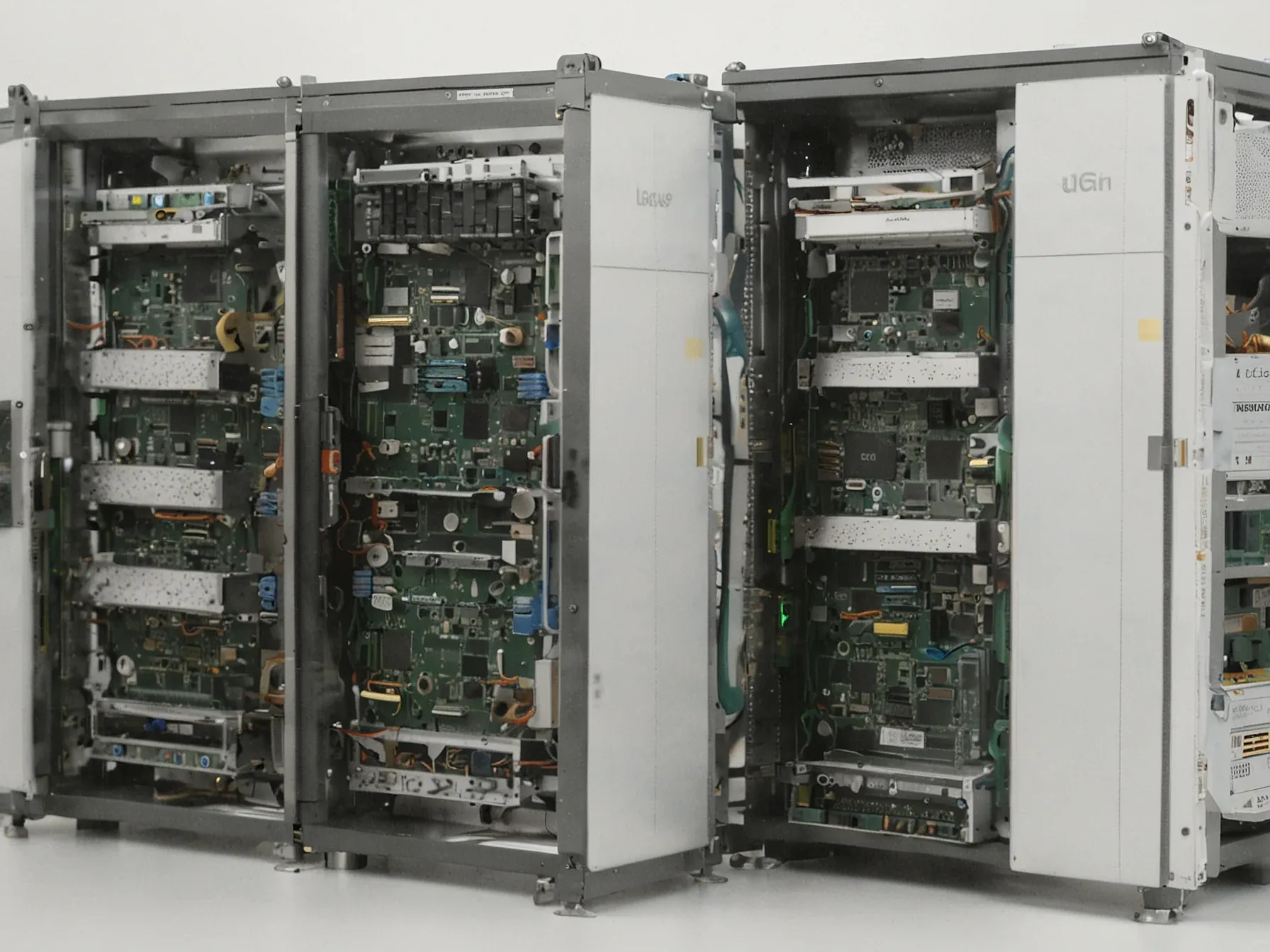
Editorial illustration for Anthropic Expands Claude AI Across Google, Amazon, and Nvidia Cloud Platforms
Anthropic Expands Claude AI Across Major Cloud Platforms
Anthropic's deal backs Claude on Google TPUs, Amazon Trainium, Nvidia GPUs
Anthropic is covering its bets. In one sweeping deal, the AI startup just wired its Claude model into Google Cloud, Amazon Web Services, and Nvidia's platforms. That’s the entire board—the three biggest computing camps in the industry.
Call it a power move. This lets Anthropic run Claude on Google's specialized TPUs, Amazon's custom Trainium chips, and Nvidia's ubiquitous GPUs all at once. They can pick the best hardware for each task—training, research, serving customers—without getting locked to a single vendor. For a company whose revenue is exploding, that flexibility isn't just convenient; it's the entire strategy.
The numbers tell the real story. They're staggering.
The deal fits Anthropic's multi-cloud strategy, where Claude models run across Google TPUs, Amazon Trainium, and Nvidia GPUs, with specific platforms optimized for training, inference, and research. Anthropic's compute needs are rising with rapid revenue and user growth: annual revenue run rate is nearing $7 billion, Claude is used by 300,000+ businesses (300× in two years), large $100k+ customers are up ~7× year over year, and Claude Code hit a $500 million annualized run rate within two months of launch. Despite the TPU expansion, AWS remains Anthropic's primary cloud partner: Amazon has invested $8 billion (vs.
Google's $3 billion total to date), and Anthropic's Project Rainier supercomputer uses Trainium 2 to reduce cost per compute by avoiding premium chip margins. Microsoft's Mico is a 'Clippy' for the AI era Microsoft introduced Mico, a customizable animated avatar for Copilot that serves as a "face" for the AI assistant, debuting first in the U.S., Canada, and the U.K.
Look at those figures again: $7 billion in annual revenue. Three hundred thousand business customers, up from just one thousand two years ago. Its coding tool, Claude Code, found a $500 million run rate almost instantly.
That explosive growth demands an absurd amount of silicon. You cannot be hostage to one supplier’s shortage or price hike.
Amazon’s $8 billion investment keeps it the primary partner—that’s more than double Google’s stake. The custom Project Rainier supercomputer runs on Amazon’s own Trainium 2 chips to sidestep premium margins. But bringing Google and Nvidia into the fold sends a clear signal.
Anthropic is building a fortress of compute, paid for and walled with money from its rivals. It’s a precarious way to operate. At this scale, it might be the only way.
The cloud wars have found their latest proxy. However this fight ends among Google, Amazon, and Nvidia, Anthropic wins.
Related Reading
Browse all Google news → Business & Startups
 Nordic pilot adds Gemini for Education, NotebookLM to boost AI literacy
 Business & Startups
 Kling launches Video O1, all-in-one model with MVL bridge using transformer
 Business & Startups
 DeepSeek Seeks More Capital Weeks After USD 7B Funding Round
 Related Topic
 NVIDIA and Google Cloud let developers scale AI from prototype to production
Market Trends
 Related Topic
 Google tests visual 'magazine-style' UI for Gemini 3 Pro users
LLMs & Generative AI
 From Archives
 Universal partners AI startup Udio on next-year platform, revenue for UMG artists
 From Archives
 Cursor 2.0 adds own coding model, runs 8 AI agents, adds voice and team commands
 From Archives
 Google plans Gemini 3 launch in 2025 as AI drives USD 100B revenue
 From Archives
 Google offers Jio users free Gemini 2.5 Pro access worth Rs 35,100 via MyJio app
LLMs & Generative AI
Common Questions Answered
How many cloud platforms is Anthropic deploying Claude AI across?
Anthropic is strategically deploying Claude AI across three major cloud platforms: Google, Amazon, and Nvidia. This multi-cloud approach allows the company to leverage specialized hardware for different computational needs like training, inference, and research.
What is Anthropic's current annual revenue run rate for Claude?
Anthropic's annual revenue run rate is nearing $7 billion, with significant growth driven by Claude's rapid adoption. The AI model has been used by over 300,000 businesses, representing a 300-fold increase in just two years, and large enterprise customers have grown nearly sevenfold.
How quickly did Claude Code reach its annualized run rate?
Claude Code achieved a remarkable $500 million annualized run rate within just two months of its launch. This rapid growth demonstrates the strong market demand and potential for Anthropic's AI technology in enterprise and development environments.
Further Reading
- Anthropic to Expand Use of Google Cloud TPUs and Services — Google Cloud Press Corner
- Anthropic Secures 1M Google TPUs While Keeping Amazon as Primary Training Partner — Maginative
- Expanding our use of Google Cloud TPUs and Services — Anthropic
