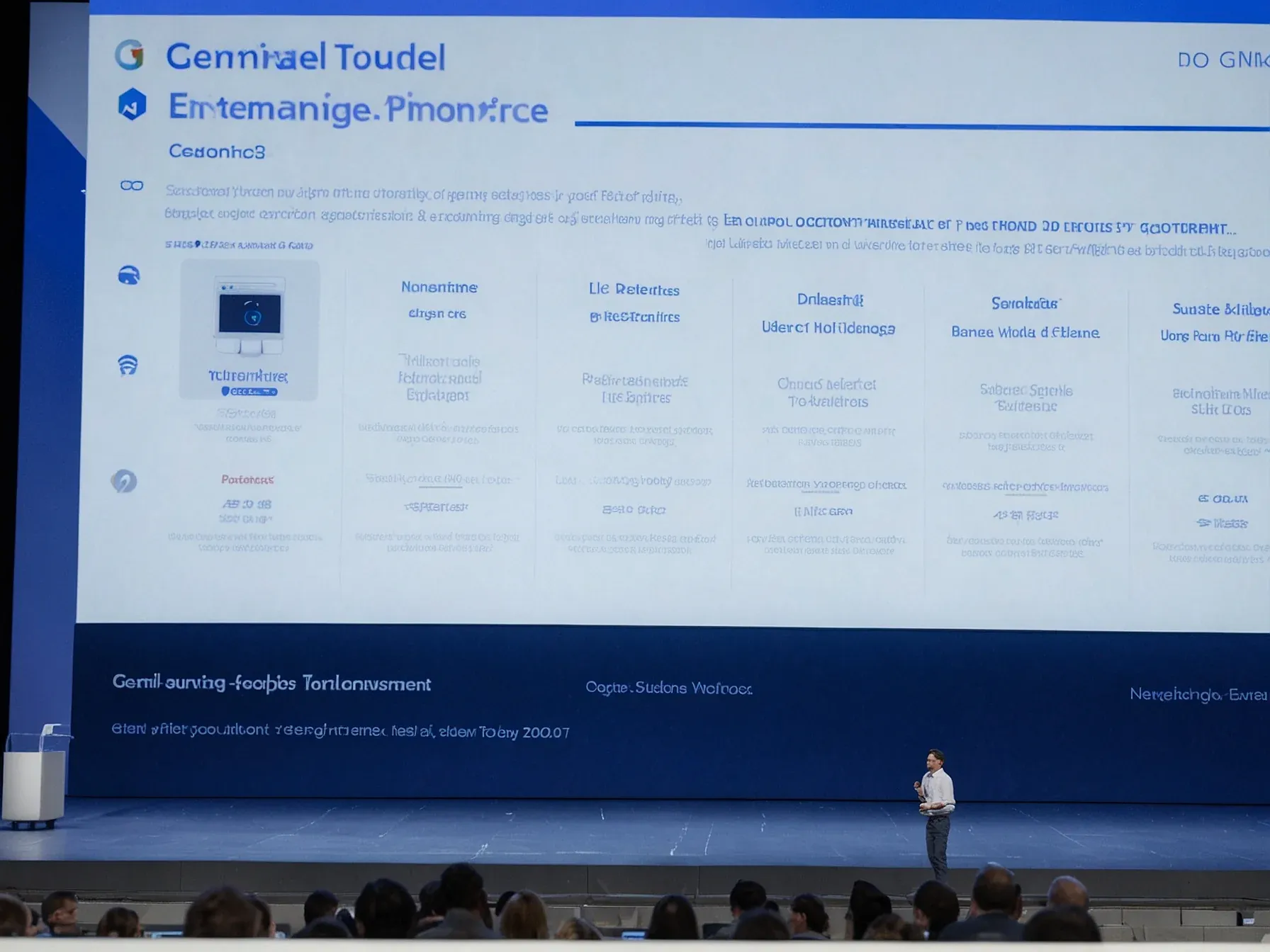
Editorial illustration for Google Eyes Gemini 3 in 2025 as AI Drives USD 100B Revenue Milestone
Gemini 3 to Drive Google's $100B AI Revenue Milestone
Google plans Gemini 3 launch in 2025 as AI drives USD 100B revenue
Google’s next big AI model, Gemini 3, is scheduled for 2025. This is not a speculative roadmap. It’s a hard date for a company whose revenue just hit $100 billion in a quarter, largely on the back of existing AI work.
The plan is simple. Keep feeding the engine that is suddenly working. Alphabet’s unusual revenue expansion isn't coming from moonshots.
It's from wiring generative AI into products people already use, especially search. AI Overviews and AI Mode have 75 million daily users. For Google, the future is now a very expensive, very effective iteration of the present.
Gemini 3 represents the next bet. A quantum leap in capability would help, but the real goal is user growth. The Gemini app has 650 million monthly active users.
Queries tripled last quarter. That’s good. It is also not enough.
OpenAI’s ChatGPT reports 800 million weekly users. Google is ahead in revenue but behind in pure adoption. The 2025 launch is about closing that gap.
Google is gearing up to launch its next-generation AI model, Gemini 3, with CEO Sundar Pichai confirming a 2025 release during the latest earnings call.
Pichai’s “generative AI era” line is a statement of fact, not ambition. The money proves it. The user numbers, while trailing a key rival, are massive and growing. This is a consolidation play.
Google’s strategy looks less like a sprint and more like a siege. It has the infrastructure, the distribution, and now the proven revenue model. Gemini 3 is the next artillery piece being wheeled into position.
The consistent December release pattern for Gemini versions is a tell. It shows a system, not a scramble.
The challenge is inertia. A $100 billion quarter creates its own gravity. The real test for Gemini 3 won’t be the technical specs.
It will be whether it can pull millions more users from other platforms into Google’s orbit and keep them there. That’s the inflection point they’re actually targeting.
Further Reading
- Google launches Gemini 3 Flash, makes it the default model in the Gemini app - TechCrunch
- Apple Selects Google's Gemini For New AI-Powered Siri - Search Engine Journal
- Google announces Gemini 3 Flash, rolling out to Gemini app - 9to5Google
- Google's new Gemini 3 Flash is fast, cheap and everywhere - Axios
Related Reading
Browse all Google news → Business & Startups
 Nordic pilot adds Gemini for Education, NotebookLM to boost AI literacy
 Business & Startups
 Kling launches Video O1, all-in-one model with MVL bridge using transformer
 Business & Startups
 DeepSeek Seeks More Capital Weeks After USD 7B Funding Round
 Related Topic
 NVIDIA and Google Cloud let developers scale AI from prototype to production
Market Trends
 Related Topic
 Google tests visual 'magazine-style' UI for Gemini 3 Pro users
LLMs & Generative AI
 From Archives
 Adani Airport Holdings partners with AionOS for multilingual AI travel service
 From Archives
 Tata Communications and NiCE combine AI suites for agent-first contact centres
 From Archives
 Google offers Jio users free Gemini 2.5 Pro access worth Rs 35,100 via MyJio app
LLMs & Generative AI
 From Archives
 Choreographer partners with Google Arts & Culture Lab on AI tool AISOMA
Market Trends
Common Questions Answered
When is Google planning to launch Gemini 3?
Google is targeting a 2025 launch for Gemini 3, its next-generation artificial intelligence model. This strategic release is part of the company's ongoing efforts to advance its AI capabilities and maintain competitiveness in the generative AI market.
How many monthly active users does the Gemini app currently have?
The Gemini app currently counts over 650 million monthly active users, with query volumes tripling in just one quarter. This significant user growth demonstrates the rapid adoption and increasing popularity of Google's generative AI platform.
What revenue milestone did Alphabet achieve in Q3 2025?
Alphabet reached a historic revenue milestone of $100 billion in Q3 2025, which represents a substantial doubling of revenue over five years. This achievement is largely attributed to the company's strategic investments in generative AI technologies like the Gemini platform.
Further Reading
- Google Gemini 3.0: Release Date, Features & What's New in 2025 — Xole AI
- Gemini 3 Release Date Expectations 2025 Late Q4 Launch — Skywork AI
- Google Confirms Gemini 3 AI Model Release Timeline — Gadgets 360
- Strange leak suggests Gemini 3.0 could be unveiled on October 22 — 9to5Google
- Gemini 3 Pricing Plans Breakdown 2025 Google Charge — Skywork AI
