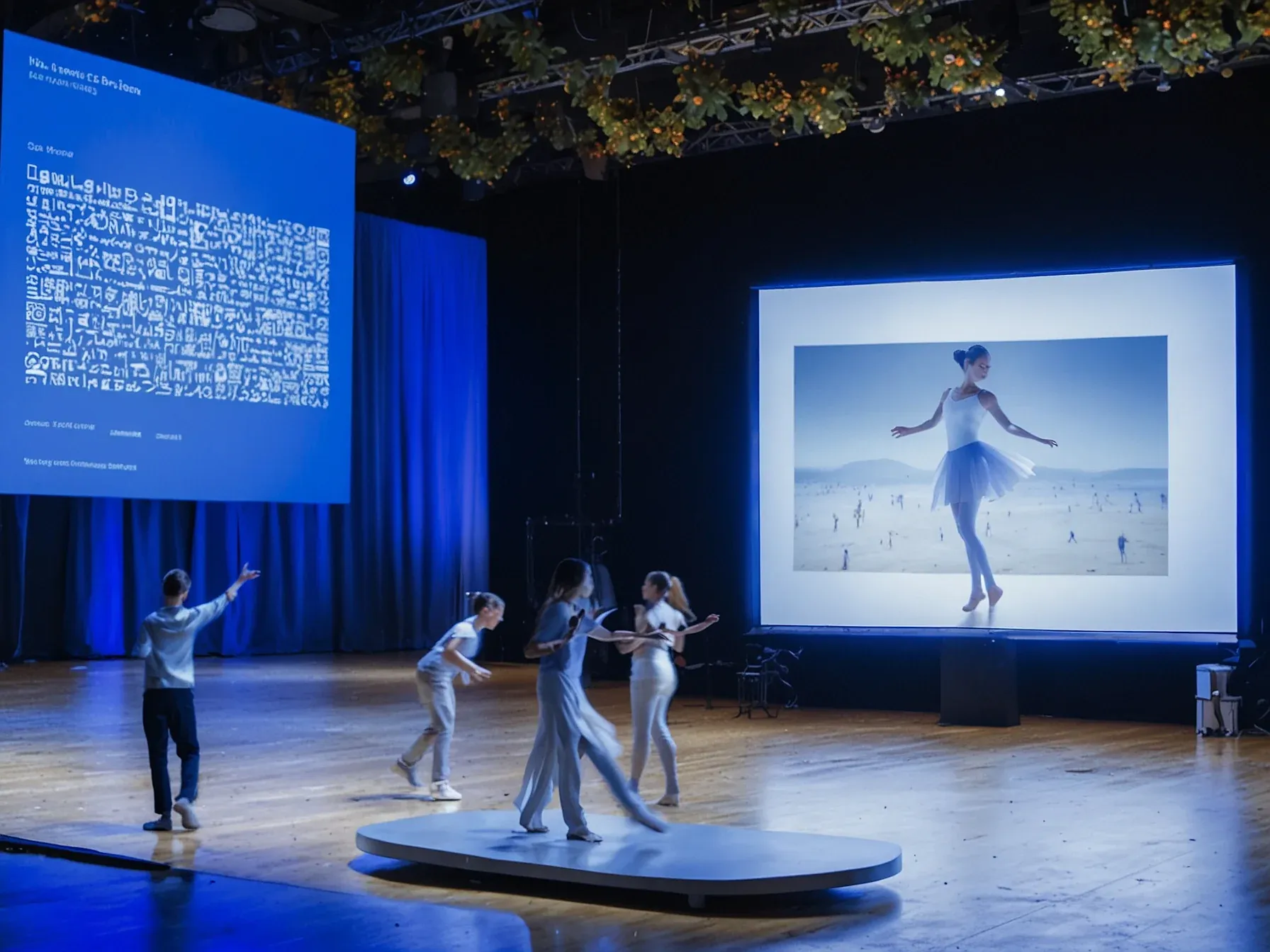
Editorial illustration for Google Arts & Culture Lab and Choreographer Unveil AI Dance Tool AISOMA
AI Dance Tool AISOMA Reimagines Movement with Google Lab
Choreographer partners with Google Arts & Culture Lab on AI tool AISOMA
Every new AI tool is pitched as a revolution. This one actually might be interesting. Choreographer Wayne McGregor and the Google Arts & Culture Lab built AISOMA, an AI trained to speak his specific movement language.
It doesn't just make dance moves. It tries to talk back.
The tool was fed nearly four million poses pulled from hundreds of videos in McGregor's archive, a 25-year record of his work. Now it generates original choreographic phrases that stem from that vocabulary. The goal isn't to replace the artist. It's to argue with him.
McGregor started this in 2019. He's used the tool in the studio to push against his own sequences. Now it's online for anyone to try.
In 2019, I started a collaboration with Google Arts & Culture Lab to explore how AI could enable a more active dialogue with my 25-year body of work.
This is a specific kind of ambition. Most art-AI projects are generic, spitting out images or music in a popular style. AISOMA is narrow and deep.
It only knows one choreographer's life's work. The output is constrained by that. That constraint is the point.
Putting it online changes things. It shifts from a private studio tool to a public experiment. You can feed it your own movement and see how McGregor's trained model responds. Whether this leads to meaningful new art or just a neat party trick depends on who uses it and why.
For now, it's a rare case of AI built not to automate creativity but to complicate it. The machine isn't the artist. It's a very strange, very well-read dance partner.
Further Reading
- From dance archive to creative catalyst with Google AI - Google Blog
- Wayne McGregor's AISOMA - Google Arts & Culture
- Google AI Creates Dance Moves From McGregor's Archive - TechBuzz
- Wayne McGregor: Infinite Bodies - Somerset House
Related Reading
Browse all Google news → Market Trends
 AI drives three initiatives to accelerate global action for planet protection
 Market Trends
 Akamai data shows AI training bots and content‑fetching bots rise since July
 Market Trends
 NVIDIA and Google Cloud let developers scale AI from prototype to production
 Related Topic
 Google to End Free Access to Gemini AI for Non-Subscribers
LLMs & Generative AI
 Related Topic
 Google tests visual 'magazine-style' UI for Gemini 3 Pro users
LLMs & Generative AI
 From Archives
 Meta, Google, Microsoft boost AI spending; capex hits USD 34.9B, up USD 5B
 From Archives
 Generative AI's Limits in SDLC: Programmers' Intuition Still Essential
 From Archives
 NotebookLM adds full 1 million-token Gemini context window, boosts processing
Research & Benchmarks
 From Archives
 Gemini for Home voice assistant: 100 commands to play music, podcasts, TV
LLMs & Generative AI
Common Questions Answered
How does AISOMA use AI to generate original dance movements?
AISOMA is an AI-powered choreography tool that creates new dance movements based on an artist's existing choreographic language. The tool acts as a creative catalyst by analyzing and expanding upon a choreographer's unique movement sequences, generating original dance ideas that are rooted in the artist's style.
What was the origin of the AISOMA collaboration between Google Arts & Culture Lab and the choreographer?
The collaboration began in 2019 when the choreographer started working with Google Arts & Culture Lab to explore how AI could interact with their 25-year body of work. The goal was to develop an AI tool that could serve as a creative partner, generating new dance movements while respecting and building upon the artist's existing choreographic language.
What makes AISOMA different from other AI creative tools?
AISOMA is unique in its approach to dance creation, focusing on expansion rather than replacement of human creativity. The tool is designed to challenge and interrogate existing movement sequences, acting as a collaborative partner that generates original dance ideas deeply rooted in an artist's specific choreographic style.
