
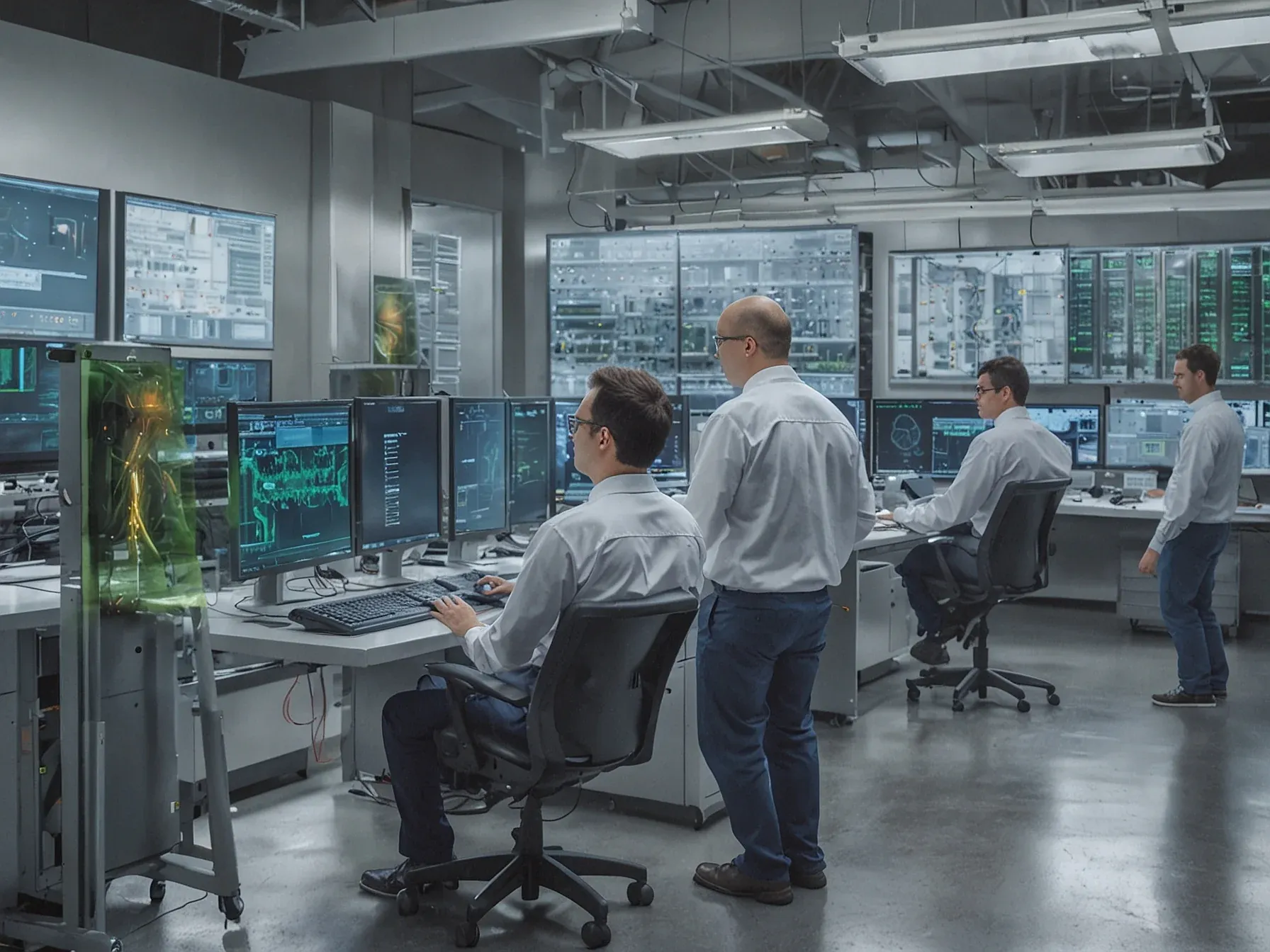
Editorial illustration for SpaceX Boosts AI Capabilities with NVIDIA's Petaflop Supercomputer System
SpaceX Levels Up AI with NVIDIA's Petaflop Supercomputer
SpaceX Receives NVIDIA DGX Spark Petaflop AI Supercomputer with Software Stack
SpaceX has a new supercomputer. It’s a petaflop AI system from NVIDIA, called DGX Spark, and it just landed at the company. This isn't a speculative purchase for some distant lab. It's a piece of factory-floor hardware meant to be used now.
The machine comes with NVIDIA’s entire software stack pre-loaded. Frameworks, libraries, pre-trained models. The box is meant to be opened and plugged in, a complete platform for building things.
SpaceX will likely point it at the tedious, computationally monstrous problems of aerospace: simulating fluid dynamics, optimizing flight paths, parsing mountains of sensor data from test flights. The goal isn't magic. It's margin.
DGX Spark comes with the full NVIDIA AI software stack — frameworks, libraries, pretrained models and NVIDIA NIM microservices, ready to power workflows like: - Customizing image-generation models such as FLUX.1 - Building vision search and summarization agents with NVIDIA Cosmos - Deploying optimized chatbots using Qwen3 This isn’t a dev box. It’s a launchpad… A petaflop of AI performance within arm’s reach for developers, researchers and creators everywhere. Partners Power Up: DGX Spark Lands Beyond the Data Center From PC giants to AI pioneers, the diminutive DGX Spark is sure to start something big.
DGX Spark is already in the hands of innovators — from ISVs optimizing their tools to researchers pushing the boundaries of robotics, art and edge AI. DGX Spark isn’t just a breakthrough in size and performance… it’s a platform built on collaboration. Acer, ASUS, Dell Technologies, GIGABYTE, HP, Lenovo and MSI are rolling out systems that put petaflop AI on your desk, transforming the desktop into an AI launchpad.
The quote describes a tool for rapid prototyping. Custom image models, vision search agents, chatbots. For SpaceX, the immediate applications are probably less whimsical.
Think of an AI that can scan thousands of hours of engine test footage to spot anomalies a human would miss. Or a model that iterates through a million subtle variations in a component design overnight.
This is an operational move. The system is described as a "launchpad," not a research project. The software is ready.
The implication is that SpaceX engineers will be expected to produce with it, and quickly. The company has always treated computation as a raw material, like aluminum or carbon fiber. This is another delivery.
They will now bend it into shape.
Related Reading
 Business & Startups
 Nordic pilot adds Gemini for Education, NotebookLM to boost AI literacy
 Business & Startups
 Kling launches Video O1, all-in-one model with MVL bridge using transformer
 Business & Startups
 DeepSeek Seeks More Capital Weeks After USD 7B Funding Round
 Related Topic
 NVIDIA and Google Cloud let developers scale AI from prototype to production
Market Trends
 Related Topic
 NVIDIA NeMo powers telco reasoning model for autonomous network workflows
Industry Applications
 From Archives
 Perplexity Comet Now Public, Automates 7 Key Business Tasks
 From Archives
 AMD Bets on Software to Close NVIDIA's CUDA Ecosystem Lead
 From Archives
 NVIDIA Outlines AI Infrastructure Advances in Networking and Compute
Research & Benchmarks
 From Archives
 Nvidia's NVentures: 21 Deals in 2023 Fuel AI Ecosystem Expansion
Common Questions Answered
How will the NVIDIA DGX Spark supercomputer enhance SpaceX's AI capabilities?
The NVIDIA DGX Spark provides SpaceX with a petaflop of computing power and a comprehensive AI software stack for advanced machine learning projects. This system will enable SpaceX to accelerate AI development across multiple domains, including rocket design and mission planning, with pre-configured frameworks and tools.
What specific AI workflows can SpaceX develop using the DGX Spark system?
The DGX Spark system supports multiple advanced AI workflows, including customizing image-generation models like FLUX.1, building vision search and summarization agents with NVIDIA Cosmos, and deploying optimized chatbots using Qwen3. These capabilities will allow SpaceX to rapidly prototype and implement complex AI applications across their research and development efforts.
Why is the NVIDIA DGX Spark considered more than just a standard computing system?
The DGX Spark is not merely a development box, but a comprehensive AI ecosystem with pre-configured software frameworks, libraries, and pretrained models. It represents a strategic toolset that provides developers with immediate access to advanced AI capabilities, enabling rapid prototyping and innovation in machine learning applications.
Further Reading
- NVIDIA DGX Spark: Petaflop System for SpaceX - HowAIWorks.ai
- NVIDIA DGX Spark Arrives for World's AI Developers - NVIDIA Newsroom
- NVIDIA DGX Spark: A Petaflop Powerhouse for Creators - LinkedIn (NVIDIA)
- NVIDIA DGX Spark Petaflop AI Supercomputer: A Game Changer for ... - LinkedIn (Community Post)
- DGX Spark Arrives at SpaceX: Jensen Huang and Elon Musk ... - YouTube Shorts
