
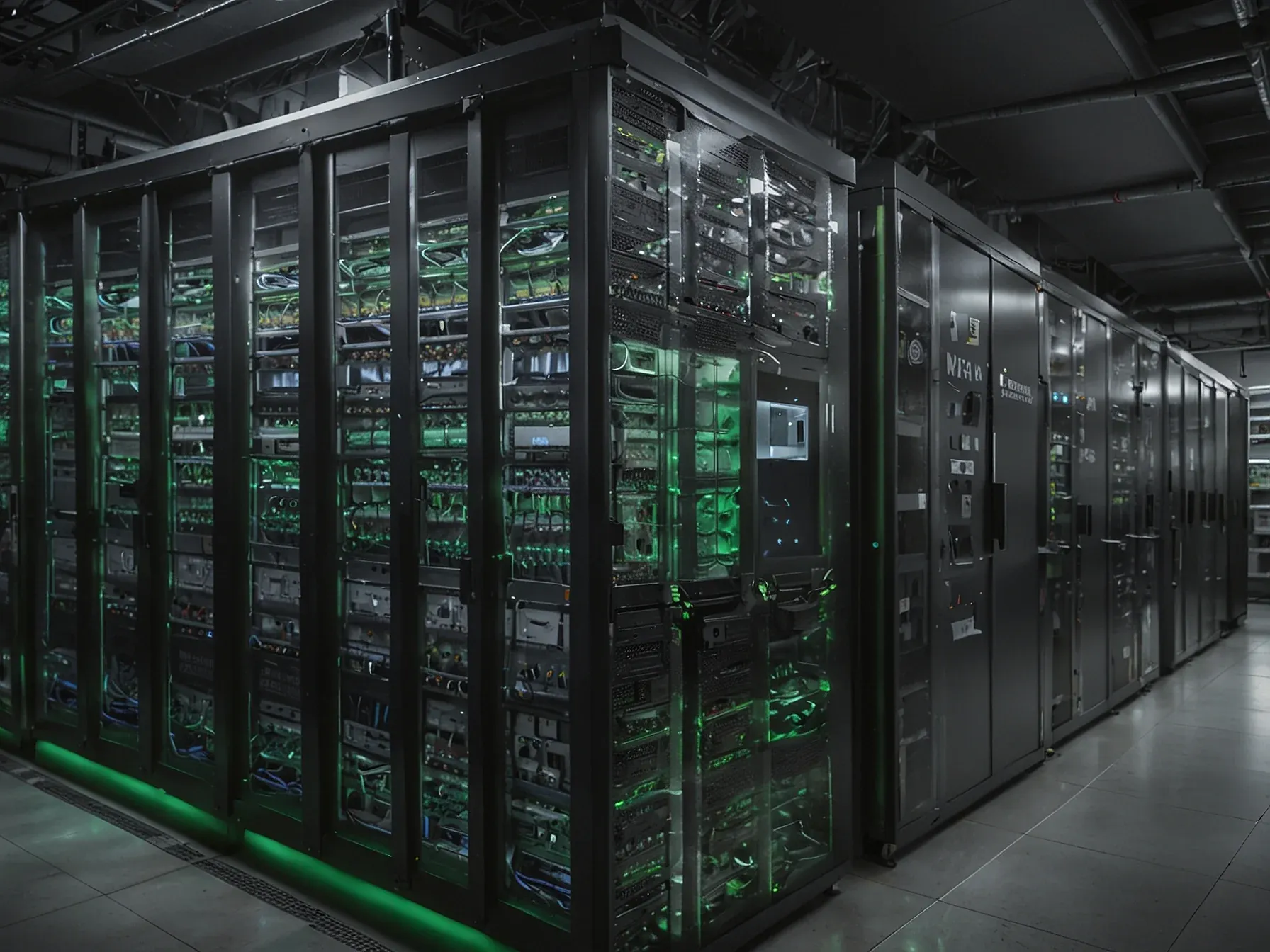
Editorial illustration for NVIDIA Unveils AI Infrastructure Upgrades in Networking and Compute Platforms
NVIDIA Reveals Next-Gen AI Infrastructure Breakthrough
NVIDIA Outlines AI Infrastructure Advances in Networking and Compute
The data center is no longer a room of humming servers, it’s a factory. And NVIDIA is engineering its blueprint from the ground up. At the Open Compute Project Summit, the company unveiled sweeping advances in networking, compute, and power, revealing plans for 800-volt DC designs and new benchmarks for its Blackwell GPUs.
The message was clear: AI’s exponential hunger cannot be fed with piecemeal parts. “From chip to grid,” NVIDIA executives insisted, the industry must think in integrated systems. Meta and Oracle Cloud Infrastructure are already betting on that vision, adopting NVIDIA’s Spectrum-X Ethernet, a platform that claims 95% throughput with zero latency degradation.
The era of the AI factory demands coordination, not compromise.
NVIDIA detailed new developments in AI infrastructure at the Open Compute Project (OCP), revealing advances in networking, compute platforms and power systems. The company also revealed new benchmarks for its Blackwell GPUs and plans to introduce 800-volt direct current (DC) power designs for future data centres. Speaking at a press briefing ahead of the OCP Summit, NVIDIA executives said the company aims to support the rapid growth of AI factories by coordinating “from chip to grid”.
Joe DeLaere, data centre product marketing manager at NVIDIA, said the surge in AI demand requires integrated solutions in networking, compute, power and cooling, and that NVIDIA’s contributions will remain open to the OCP community. Meta will integrate NVIDIA’s Spectrum-X Ethernet platforms into its AI infrastructure, while Oracle Cloud Infrastructure (OCI) will adopt the same technology for large-scale AI training clusters. NVIDIA said Spectrum-X is explicitly designed for AI workloads, claiming it achieves “95% throughput with zero latency degradation”.
NVIDIA isn’t just building chips. It’s wiring the entire factory floor, from the silicon to the substation. The 800-volt DC push, the Spectrum-X throughput claims, the open contributions to OCP, all of it says the same thing: AI infrastructure can no longer be a patchwork of proprietary parts.
Meta and Oracle, two very different giants, just put their weight behind the same Ethernet fabric. That’s a signal. The real benchmark, though, won’t be 95% throughput or zero latency degradation.
It will be whether this coordinated ecosystem can scale fast enough to meet demand that doesn’t pause for design cycles. NVIDIA is betting the answer is yes, and it’s engineering the grid to prove it.
Related Reading
 Research & Benchmarks
 Microsoft AI Chief: "If It Isn't Safe We Shouldn't Build It
 Research & Benchmarks
 Google's FACTS benchmark shows 70% factuality ceiling across four tests
 Research & Benchmarks
 Nvidia's DLSS 4.5 beta adds 6x Multi Frame Generation for RTX 50 GPUs
 Related Topic
 NVIDIA NeMo powers telco reasoning model for autonomous network workflows
Industry Applications
 Related Topic
 China offers cheaper electricity to AI firms abandoning NVIDIA chips
Business & Startups
 From Archives
 AI-Generated Consumer Simulations Could Replace Traditional Surveys
 From Archives
 7 Pandas Techniques for Efficient Large Dataset Management
 From Archives
 Nvidia's NVentures: 21 Deals in 2023 Fuel AI Ecosystem Expansion
Business & Startups
 From Archives
 NVIDIA Nemotron Simplifies Log Analysis with Self-Correcting AI Agents
AI Tools & Apps
Common Questions Answered
What key infrastructure upgrades is NVIDIA introducing at the Open Compute Project (OCP) conference?
NVIDIA is unveiling comprehensive upgrades across networking, compute platforms, and power systems for AI infrastructure. The company is targeting improvements in chip design, data center power management, and computational capabilities to support the rapid growth of AI technologies.
How are NVIDIA's Blackwell GPUs demonstrating performance improvements for AI computing?
NVIDIA revealed new benchmarks for its Blackwell GPUs, showcasing significant advancements in computational power and efficiency. The benchmarks highlight the company's commitment to pushing the boundaries of AI processing capabilities.
What is NVIDIA's approach to supporting AI infrastructure from 'chip to grid'?
NVIDIA is taking a holistic approach to AI infrastructure by coordinating developments across multiple technological domains, including chip design, networking, and power systems. This strategy aims to create more integrated and efficient solutions for AI data centers and computational platforms.
Further Reading
- OCP Summit 2025: The Open Future of Networking Hardware for AI - Facebook Engineering
- NVIDIA to Showcase Blackwell and Networking Solutions at OCP Summit - NVIDIA Blog
- Broadcom Delivers the Future of AI Infrastructure with End-to-End AI Networking - Broadcom Investor News
- Shaping the Future of Open Infrastructure for AI, presented by NVIDIA - NVIDIA YouTube
