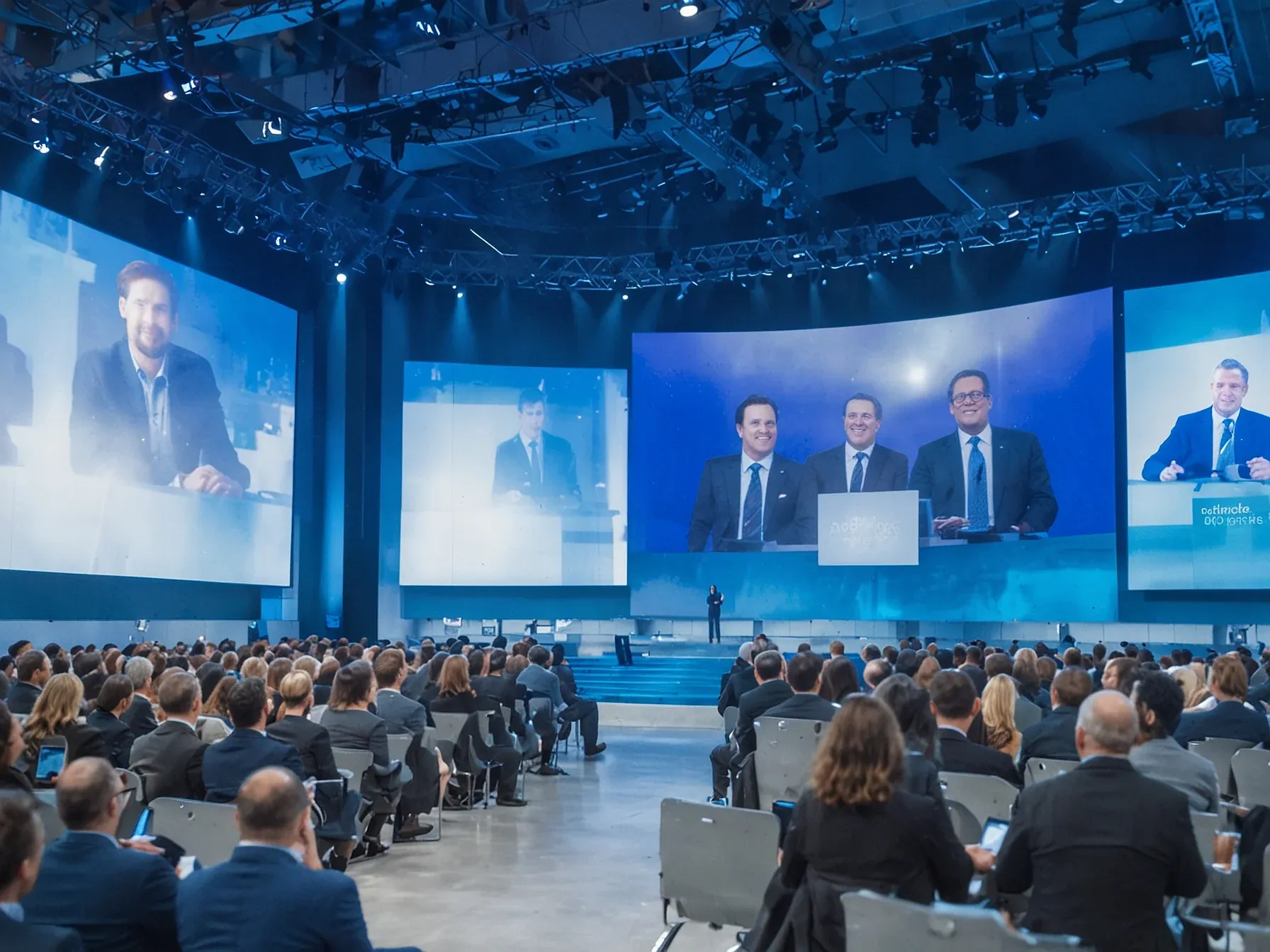
Editorial illustration for Salesforce Unveils AI Agents to Address USD 7B Enterprise Software Challenge
Salesforce AI Agents Target $7B Enterprise Software Gap
Salesforce Tackles $7B Software Problem with AI Agents at Dreamforce
Most enterprise AI projects fail. Everyone knows it. This week, as 50,000 people crowd into San Francisco for Salesforce’s Dreamforce conference, the company is aiming its entire arsenal at that boring, expensive truth.
Its target: a 95% failure rate for corporate tech demos, a graveyard it calls “pilot purgatory.” The proposed escape route is Agentforce 360, a plan to weave autonomous AI agents—not just chatbots—directly into its sales, service, and marketing software. Co-founder and CTO Parker Harris calls this the biggest technological shift of his career, a portfolio-wide reengineering. Salesforce has already deployed over 12,000 of these agents internally.
Now it wants to sell that capability to everyone else, framing it as the exit from a $7 billion problem of wasted investment.
As 50,000 attendees descend on Salesforce's Dreamforce conference this week, the enterprise software giant is making its most aggressive bet yet on artificial intelligence agents, positioning itself as the antidote to what it calls an industry-wide "pilot purgatory" where 95% of enterprise AI projects never reach production. The company on Monday launched Agentforce 360, a sweeping reimagination of its entire product portfolio designed to transform businesses into what it calls "agentic enterprises" — organizations where AI agents work alongside humans to handle up to 40% of work across sales, service, marketing, and operations. "We are truly in the agentic AI era, and I think it's probably the biggest revolution, the biggest transition in technology I've ever experienced in my career," said Parker Harris, Salesforce's co-founder and chief technology officer, during a recent press briefing. "In the future, 40% of the work in the Fortune 1000 is probably going to be done by AI, and it's going to be humans and AI actually working together." The announcement comes at a pivotal moment for Salesforce, which has deployed more than 12,000 AI agent implementations over the past year while building what Harris called a "$7 billion business" around its AI platform.
Forget the spectacle. Execution is everything. Salesforce’s calculation is pragmatic, even grim: the core obstacle is no longer the technology, but corporate psychology.
The fear of letting a non-human system handle a customer complaint. Agentforce 360 argues that fear is a luxury no one can afford, not with that 95% failure rate looming. Parker Harris sees a future where AI does two-fifths of the work in major corporations.
That’s either a bold vision of augmented productivity or a stark admission of how much busywork defines the modern enterprise. The software is built. The industry spent billions watching projects die in labs.
Now it must decide whether to spend more letting them live.
Related Reading
 Business & Startups
 Nordic pilot adds Gemini for Education, NotebookLM to boost AI literacy
 Business & Startups
 Kling launches Video O1, all-in-one model with MVL bridge using transformer
 Business & Startups
 DeepSeek Seeks More Capital Weeks After USD 7B Funding Round
 Related Topic
 Salesforce and OpenAI Expand Partnership, Integrating Agentforce 360 with Advanced AI Models
LLMs & Generative AI
 Related Topic
 LangChain GTM Agent pulls Salesforce, BigQuery data, tracks funding, launches, AI
Open Source
 From Archives
 SkillIndex Aims to Close the AI Talent Gap by Benchmarking Workforce Skills
 From Archives
 Risk Reviews Stall AI Deployments Amid Rapid Tech Shifts
Common Questions Answered
What is Salesforce's Agentforce 360 and how does it aim to solve enterprise AI challenges?
Agentforce 360 is Salesforce's comprehensive approach to transforming enterprise AI by addressing the 'pilot purgatory' where 95% of AI projects fail to reach production. The platform is designed to help businesses more effectively build and implement AI solutions across their entire software ecosystem.
How big is the market opportunity that Salesforce is targeting with its AI agent strategy?
Salesforce is targeting a potential $7 billion market opportunity by developing AI agents that can help enterprises successfully implement artificial intelligence projects. The company believes its approach can help break through the current barriers that prevent most AI initiatives from moving beyond experimental stages.
What does Salesforce mean by the term 'agentic enterprise'?
The 'agentic enterprise' concept refers to businesses that can effectively leverage AI agents to transform their operational capabilities and drive meaningful technological innovation. By creating intelligent AI agents, Salesforce aims to help companies move beyond traditional software implementation and create more adaptive, intelligent business processes.
Further Reading
- Papers with Code - Latest NLP Research - Papers with Code
- Hugging Face Daily Papers - Hugging Face
- ArXiv CS.CL (Computation and Language) - ArXiv
