Industry Applications - Page 2 of 7
Real-world AI implementations and enterprise deployments transforming healthcare, finance, retail, and other industries.
126 articles
View complete article list
Real-world AI implementations and enterprise deployments transforming healthcare, finance, retail, and other industries.
Hallucination is not a bug in RAG, it is generative AI’s default behavior. Large language models predict the next token; they do not look things up.

Google's latest AI update is a kitchen sink of features, promising to react to your screen, make videos, and babysit your portfolio.

Why does a random split matter in spatial‑temporal forecasting? Because geography isn’t a tidy list of independent rows. Each point carries geometry, adjacency and a web of dependence that can silently inflate a model’s apparent performance.

For decades, engineers tracking things through a network have had two bad options. They could use a classic Kalman filter, which is elegant but brittle. It needs perfect math and exact knowledge of the noise.

Neural reconstruction at scale is a hunger for GPU cycles, each iteration devouring time and infrastructure dollars. When even modest gains slash substantial costs, precision optimization isn’t a luxury, it’s a necessity.

Upgrading a large language model is like replacing the engine on a moving train. The new power plant might be more efficient, but it also tends to disconnect every wagon behind it, from the fine-tuned cargo haulers to the specialized dining cars.

Every AI request racing through a data center burns two things: power and time. We devour gigawatt-hours of electricity, chasing milliseconds. MIT grad student Gohar Chaudhry built a system to curb that appetite.

Teaching an AI the difference between right and wrong isn't about programming endless rules. It’s about instilling character.
NVIDIA built its AI empire on raw speed. Now, the glaring constraint is the power bill. Consider the cost: training a single massive model can consume more electricity than 100 U.S. homes use in a year.
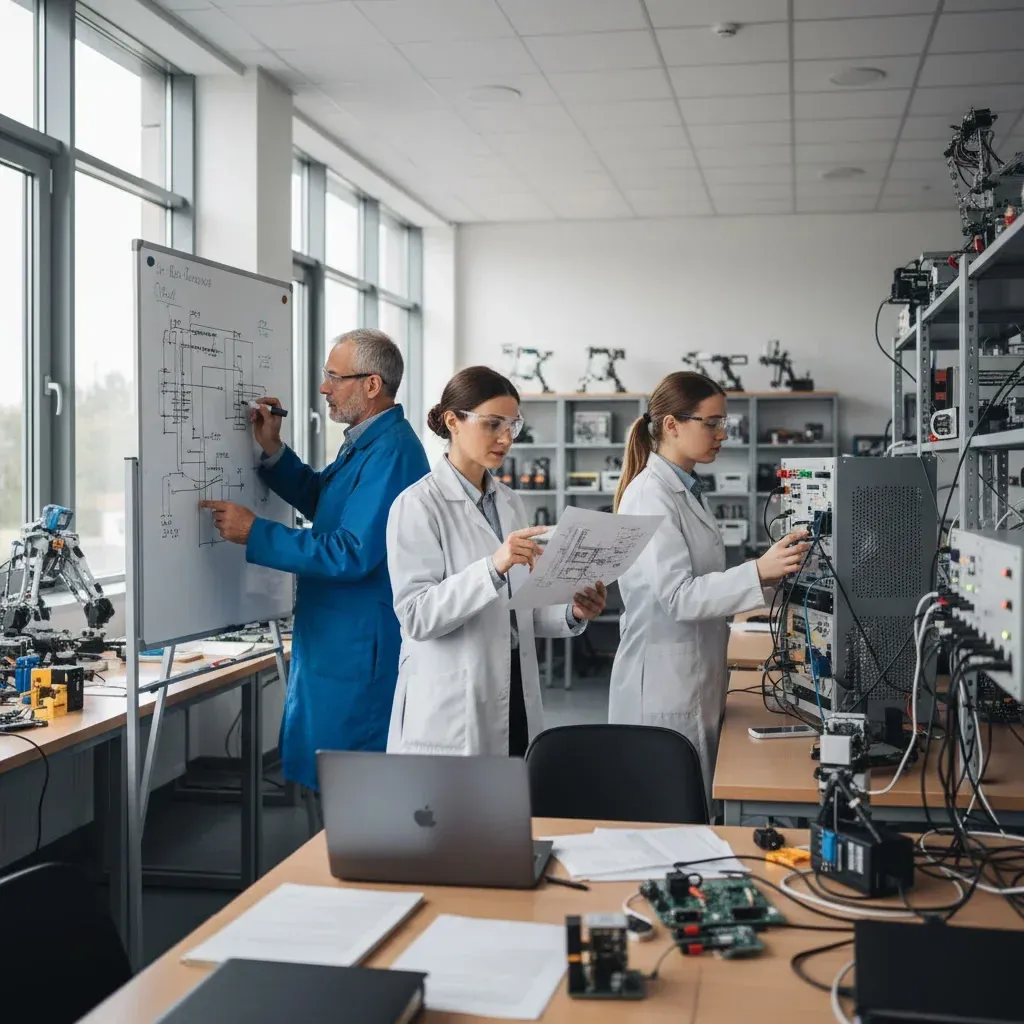
For years, the dream of intelligent robots crashed against a simple, non-negotiable fact: a two-ton factory arm cannot fail like a chatbot. Safety wasn't just a feature; it was the entire barrier.

A 4.8% diagnostic rate doesn’t sound like much. Until you consider the context: these were children with rare genetic diseases, their cases already reviewed by experts to no avail. The AI didn’t deliver a breakthrough, it delivered a second chance.

HPE and NVIDIA just announced a new chip called Vera, which they are calling the first CPU built specifically for AI agents. This isn't a GPU for training.
Fifty thousand transaction embeddings, compressed into a three-dimensional space, reveal something striking: merchants cluster by industry, users by zip code.

Factory floors are ruled by chaos. Hundreds of different jobs, hundreds of different machines, all colliding in a brutal math problem called open-shop scheduling.
Personalized federated learning is a messy compromise. You want a model that learns from everyone's data without ever seeing it, and also adapts perfectly to each user's phone. The usual fix is to split the model. Some parts are shared.

Getting an AI to optimize anything is easy. Getting it to keep optimizing, for days, without breaking everything, is basically impossible. They get lost, forget what they tried, and eventually drive the whole system into a wall.

Decart is selling a machine that hallucinates highways. The two-year-old company just banked $300 million in new funding. Its product, the Oasis 3 world model, doesn't just render a street. It simulates hours.

Chalk dust and a Google AI model mixed in thirty Sierra Leonean schools. Test scores rose. But the real story was who wielded the chalk: the teachers.
Medical AI research is a mess of contradictory claims, and a new dataset finally shows how deep the problem runs. MedicalRec-Bench collected over 5,000 reported model performances from 3,000 published papers.

The hype around artificial intelligence often paints a future where algorithms replace human expertise wholesale. In meteorology and climate science, that future hasn’t arrived, and it’s not even close.
Learn to build AI-powered apps without coding. Our comprehensive review of No Code MBA's course.
Curated collection of AI tools, courses, and frameworks to accelerate your AI journey.
Get the week's most important AI news delivered to your inbox every week.