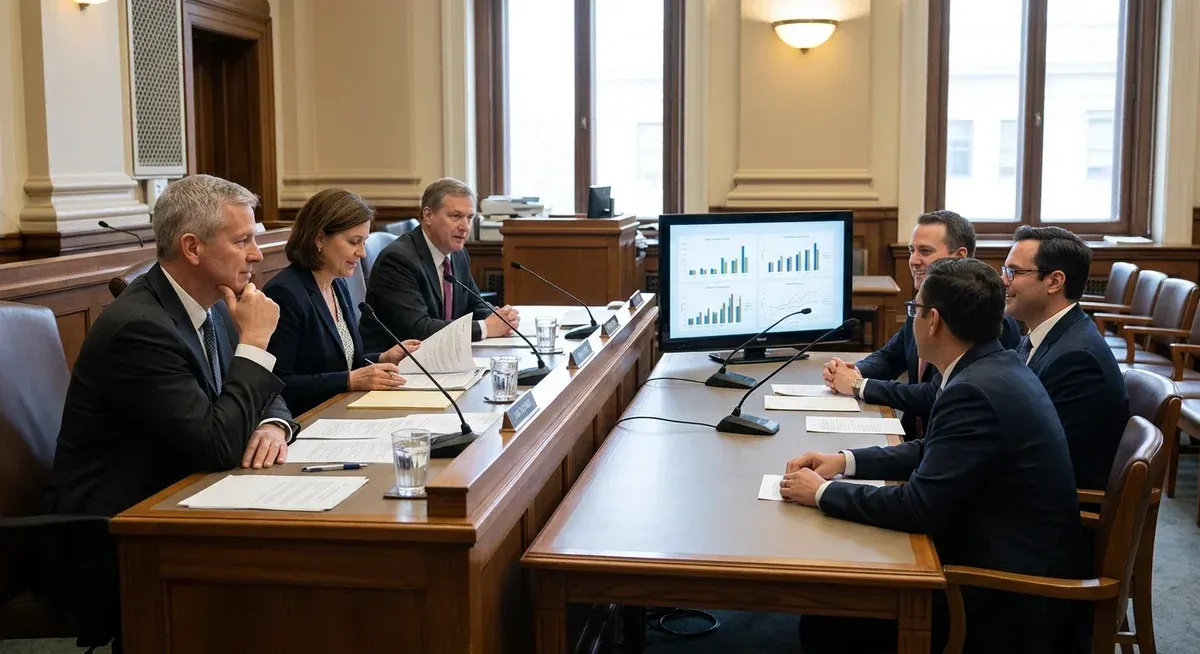
Editorial illustration for Sanders and Bannon Press Washington for AI Controls
Sanders and Bannon Unite on AI Control Push
Sanders and Bannon Press Washington for AI Controls
Bernie Sanders and Steve Bannon shared a stage in Washington this week, and for once the disagreement wasn't the story. At the Pro-Human Assembly, organized by the Future of Life Institute, the two men delivered back-to-back speeches calling for hard limits on artificial intelligence. Several hundred people showed up, a mix that included evangelical pastors, Mormon and Catholic leaders, artists, and lawmakers from both parties. Attendees walked out with hats reading "Keep the future human."
The policy demands on the table range from freezing new data center construction to pushing for a presidential executive order. President Trump has waved off the alarm as a hoax and threatened penalties against companies pushing back on his AI agenda. Meanwhile, OpenAI, the company whose own technology sits at the center of most of these fears, has thrown its support behind the FRONTIER Act, the first federal bill that would require major AI developers to submit to safety audits from independent third parties.
What's missing from this coalition is agreement on what "reining in AI" actually means in practice, and that gap surfaced almost immediately once the speeches ended.
Bipartisan pressure to rein in artificial intelligence is building across the US. At a Washington conference, political opposites found common ground, while OpenAI backed its first concrete safety bill.
Why this matters
We've reached the point where Bernie Sanders and Steve Bannon agree on something, and that alone should tell developers and founders which way the wind is blowing. Sanders wants a construction freeze on data centers and a Trump-Xi pact against superintelligent AI; Bannon wants an executive order because he doesn't trust Congress to move fast enough. Neither approach is likely to produce workable policy, but the coalition itself is the signal: opposition to unchecked AI buildout no longer sorts by party.
Meanwhile Trump calls the whole conversation a hoax and threatens operators with penalties, which means the federal posture right now is contradiction, not policy. OpenAI's support for the FRONTIER Act suggests some labs would rather help write the rules than get hit with a freeze order later. For anyone building on top of frontier models, the practical takeaway is that permitting, compute access, and data center timelines are becoming political footballs, not engineering problems.
Plan for volatility, not clarity.
Related Reading
 Policy & Regulation
 Akamai Proposes SAFE Cybersecurity Guidelines for AI Threats
 Policy & Regulation
 After ditching AI fitness apps and a Fitbit, I return to Peloton classes
 Policy & Regulation
 Sony Music, Warner Chappell Sue Anthropic Over "Blatant Theft
 From Archives
 Meta's USD 18B settlement, AI harms show why we need regulation, experts say
 From Archives
 AI Firms in Talks Over Safety for Weeks
Common Questions Answered
What specific AI controls did Bernie Sanders and Steve Bannon propose at the Pro-Human Assembly?
Sanders called for a construction freeze on data centers and a Trump-Xi pact against superintelligent AI development. Bannon advocated for an executive order to regulate AI, arguing that Congress would move too slowly to implement necessary safeguards. While their specific approaches differed, both emphasized the need for hard limits on artificial intelligence advancement.
Who organized the Pro-Human Assembly where Sanders and Bannon spoke about AI controls?
The Pro-Human Assembly was organized by the Future of Life Institute in Washington. The event brought together several hundred attendees from diverse backgrounds including evangelical pastors, Mormon and Catholic leaders, artists, and lawmakers from both political parties.
What does the bipartisan coalition forming around AI regulation signal to tech developers and founders?
The fact that political opposites like Sanders and Bannon are finding common ground on AI controls indicates a significant shift in political winds against unchecked AI buildout. This coalition signals that developers and founders should expect increased pressure and opposition to rapid, unregulated artificial intelligence expansion, regardless of which political party is in power.
How did OpenAI respond to the growing bipartisan pressure for AI regulation?
OpenAI backed its first concrete safety bill in response to the bipartisan pressure building across the US to rein in artificial intelligence. This represents a notable shift in the company's stance toward regulatory measures and safety standards.
Further Reading
- US Senator Sanders and Trump ally Bannon call for stronger oversight of artificial intelligence - Reuters
- Bannon, Sanders want to stop threat of AI – with vastly different approaches - USA Today
- Bernie Sanders and Steve Bannon call for curbs on AI - NPR
- AI skeptics from Bernie Sanders to Steve Bannon urge action, as Congress, Trump idle - CNBC
- Sanders, Bannon to speak at event calling for AI controls - The Hill
