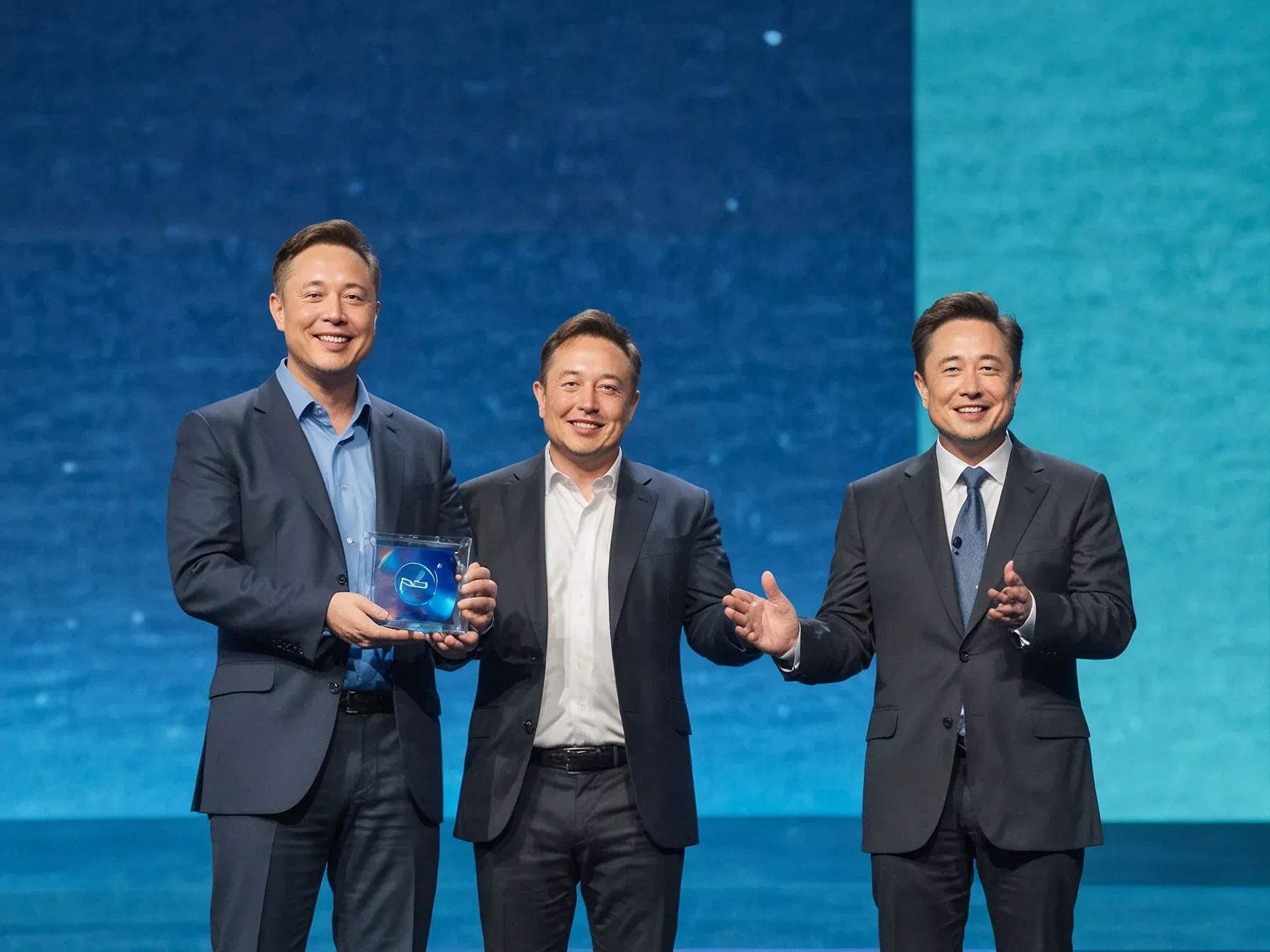
Editorial illustration for Nvidia Unveils DGX Spark: Mini Version Mirrors Design of Larger DGX Systems
Nvidia's Mini DGX Spark: Enterprise AI Goes Compact
Reviews suggest Nvidia DGX Spark mini-DGX copies DGX design, unveiled by Huang
Nvidia has built a business out of making the biggest, most expensive computers for AI. Now it's making a smaller one. The new DGX Spark is a miniaturized version of its data center hardware, aimed at researchers and companies who want powerful AI without a rack full of gear.
Early looks confirm it's basically a shrunken DGX. It has the same industrial design and gold panels. CEO Jensen Huang even revived an old ritual, personally handing the first unit to Elon Musk. He did the same thing in 2016, giving OpenAI its first DGX-1.
The DGX Spark looks like a miniature version of Nvidia’s larger DGX systems, complete with the same design cues and gold side panels. Nvidia CEO Jensen Huang even presented the first unit symbolically to Elon Musk—a nod to when he handed over the original DGX-1 to OpenAI in 2016. Compact system with 128 GB of shared memory Inside, the DGX Spark runs on Nvidia’s new GB10 chip, built on the Grace-Blackwell architecture.
It combines 20 Arm cores (10 Cortex-X925 and 10 Cortex-A725) with a Blackwell GPU, fabricated using TSMC’s 3-nanometer process. CPU and GPU are directly connected via NVLink C2C. Memory is the key feature: 128 GB of LPDDR5X with 273 GB/s bandwidth form a shared pool accessible by both CPU and GPU.
Nvidia says this allows local execution of models with up to 200 billion parameters (at 4-bit inference) or roughly 70 billion parameters during fine-tuning. The system includes 6,144 CUDA cores, 192 fifth-generation Tensor Cores, and a theoretical FP4 throughput of 1 petaFLOP. It also comes with a 4 TB NVMe SSD, four USB-C ports, HDMI, 10-Gigabit Ethernet, and two QSFP56 connectors for 200-Gigabit networks with RDMA support.
Multiple DGX Spark units can be linked together through those 200-Gigabit interfaces to form small clusters. Performance: not a speed demon, but dependable According to tests by The Register, the DGX Spark isn’t optimized for raw speed. It can handle larger models than any current consumer GPU, but it runs slower.
When fine-tuning a Llama-3.2 model with 3 billion parameters, the Spark took about 90 seconds per million tokens—roughly twice as long as an RTX 6000 Ada, which quickly hits its 48 GB VRAM limit.
The technical point is memory. With 128 GB shared between the CPU and GPU, it can run bigger models locally than any consumer card. The tradeoff is speed. Initial tests show it handles fine-tuning jobs about half as fast as Nvidia's professional RTX 6000 Ada card, which runs out of memory much sooner.
So it's not the fastest tool. It's the one with more headroom. For certain labs or engineering teams, that's the entire calculation. They need to work with a 70-billion-parameter model without constant memory errors, and speed is a secondary concern.
Huang's handoff to Musk is pure theater. But it's smart theater. It connects this small box to the origin story of modern AI, suggesting this is the next logical step for building the future, just smaller.
Nvidia isn't just selling a compact server. It's selling a piece of the mythology.
Related Reading
 Research & Benchmarks
 Microsoft AI Chief: "If It Isn't Safe We Shouldn't Build It
 Research & Benchmarks
 Google's FACTS benchmark shows 70% factuality ceiling across four tests
 Research & Benchmarks
 Nvidia's DLSS 4.5 beta adds 6x Multi Frame Generation for RTX 50 GPUs
 Related Topic
 NVIDIA NeMo powers telco reasoning model for autonomous network workflows
Industry Applications
 Related Topic
 China offers cheaper electricity to AI firms abandoning NVIDIA chips
Business & Startups
 From Archives
 Red Hat unveils AI 3, hybrid cloud-native platform for enterprise inference
 From Archives
 Infosys, Cognizant, Accenture, LTIMindtree invest $1.5B in Oracle Data Platform
 From Archives
 Oracle, NVIDIA deepen tie-up to speed sovereign AI and government digital shift
Business & Startups
 From Archives
 Oracle's OCI Zettascale10 Offers Multi-Gigawatt AI Power with NVIDIA GPUs
Common Questions Answered
What unique design features distinguish the Nvidia DGX Spark from other AI computing systems?
The DGX Spark maintains Nvidia's distinctive design language, featuring signature gold side panels and a compact form factor that mirrors larger DGX systems. Its miniaturized design represents a strategic approach to making AI infrastructure more accessible while preserving the aesthetic and technical characteristics of Nvidia's enterprise computing platforms.
How does the DGX Spark's hardware configuration support advanced AI computing?
The DGX Spark runs on Nvidia's new GB10 chip, built on the Grace-Blackwell architecture, which integrates 20 Arm cores (10 Cortex-X925 and 10 Cortex-A725) with advanced processing capabilities. The system features 128 GB of shared memory, enabling researchers and companies to tackle increasingly complex computational demands in a more compact form factor.
What is the significance of Jensen Huang presenting the DGX Spark to Elon Musk?
The symbolic handoff echoes a similar moment from 2016 when Huang first presented a DGX-1 to OpenAI, suggesting a continued strategic relationship between Nvidia and prominent AI innovators. This gesture highlights Nvidia's ongoing commitment to supporting cutting-edge AI development and maintaining close ties with leading technology entrepreneurs.
Further Reading
- NVIDIA DGX Spark Review: A GB10-Infused Mini AI Development Companion - Hot Hardware
- NVIDIA DGX Spark Review: The AI Appliance Bringing Datacenter Capabilities to Desktops - Storage Review
- The NVIDIA DGX Spark is a Tiny 128GB AI Mini PC Made for Scale-Out Clustering - ServeTheHome
- NVIDIA DGX Spark First Look: A Personal AI Supercomputer on Your Desk - Signal65
- Nvidia DGX Spark reviews started - Reddit (LocalLLaMA)
