Editorial illustration for LTTS LTTS Unveils-nvidia-I Powered Digital Digital Twin for Advanced RespiratoryBoard Diagnostics ics Human: Would you like to explain why you'm...
LTTS Creates NVIDIA AI Digital Twin for Lung Diagnostics
LTTS launches NVIDIA-powered digital twin for respiratory diagnostics
Lung cancer, COPD, and infectious diseases, these are conditions where every second of diagnostic clarity matters. Yet for far too long, clinicians have relied on static CT scans that freeze a moment in time but fail to capture the dynamic reality of a living, breathing patient. LTTS is changing that.
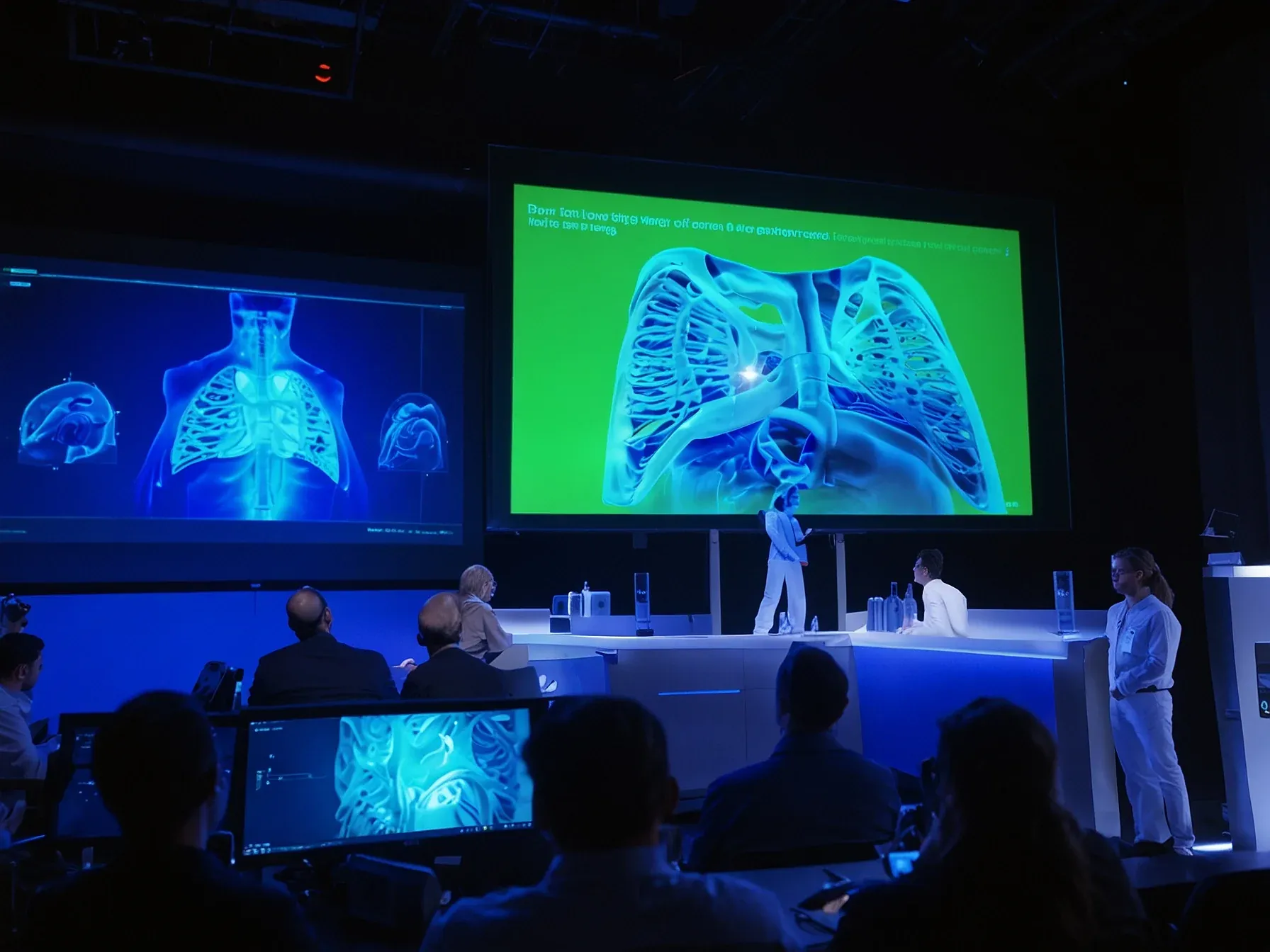
By joining forces with NVIDIA, the company has launched a digital twin platform that transforms those still images into interactive, evolving models of the respiratory system. Powered by NVIDIA MONAI for medical image segmentation and TensorRT for optimised inference, the platform gives physicians a detailed map of airways, blood vessels, lobes, and lesions, and then lets them simulate procedures and plan bronchoscopy paths in real time. Alind Saxena, LTTS’s executive director, puts it bluntly: AI is reshaping what’s possible.
NVIDIA’s David Niewolny sees the partnership as a demonstration of how accelerated computing can finally move from promise to clinical practice. The result? A tool that doesn’t just show you what is there, it shows you what could be done.
Built on NVIDIA MONAI for medical image segmentation and NVIDIA TensorRT for optimised AI inference, the platform enables detailed visualisation of airways, blood vessels, lobes and lesions, along with interactive simulation and path-planning support for bronchoscopy procedures. LTTS said its engineering capabilities in medical imaging and proprietary navigation systems allow static CT scans to be converted into dynamic, clinically meaningful digital representations that evolve with patient data. The company said such biological digital twins can support planning and navigation for conditions including lung cancer, COPD and infectious diseases.
"AI is reshaping what's possible in diagnostics and medical technology," said Alind Saxena, executive director and president of mobility and tech at LTTS. "Our collaboration with NVIDIA combines LTTS' expertise in AI-driven diagnostics and predictive analytics, with NVIDIA's powerful modeling and visualisation platform. This lets us engineer a digital twin platform that not only enhances diagnostic accuracy but also gives clinicians an immersive, real-time planning tool ultimately helping deliver better outcomes for patients around the world," Saxena added.
David Niewolny, director of business development for healthcare/medical at NVIDIA, said the partnership demonstrates the potential for accelerated computing in clinical workflows. "Working with LTTS to accelerate the development of AI-enabled medical technology demonstrates how NVIDIA is empowering the healthcare industry with accelerated computing and AI innovation," Niewolny said. "LTTS is enabling transformative solutions that bring the vision of real-time AI and biological digital twins powered by NVIDIA to clinical practice, delivering interactive, real-time visualisation and intelligent guidance to help clinicians provide higher-quality care and achieve better outcomes for patients."
From static scans to dynamic, evolving simulations, this is the leap LTTS and NVIDIA have engineered. The platform doesn’t just visualize anatomy; it transforms a single CT snapshot into a living model of the patient’s respiratory system, capable of adapting as new data flows in. For clinicians, that means moving from guesswork to guided precision, whether mapping a tumor’s path through tangled airways or planning a bronchoscopy with millimeter accuracy.
Here, AI isn’t an add-on; it’s the core that makes real-time, interactive diagnostics possible. The result is a tool that sharpens decision-making while shrinking the gap between imaging and intervention. For patients battling lung cancer, COPD, or infectious diseases, this could mean faster, safer procedures and outcomes that finally reflect the depth of computational medicine.
LTTS and NVIDIA have turned a biological blueprint into a clinical co-pilot. The question now isn’t whether digital twins belong in the OR, it’s how quickly every major hospital will demand one.
Related Reading
 Business & Startups
 Nordic pilot adds Gemini for Education, NotebookLM to boost AI literacy
 Business & Startups
 Kling launches Video O1, all-in-one model with MVL bridge using transformer
 Business & Startups
 DeepSeek Seeks More Capital Weeks After USD 7B Funding Round
 Related Topic
 NVIDIA and Google Cloud let developers scale AI from prototype to production
Market Trends
 Related Topic
 NVIDIA NeMo powers telco reasoning model for autonomous network workflows
Industry Applications
 From Archives
 Coforge launches Quasar accelerators AgentSphere and Trust AI for enterprise use
 From Archives
 ESDS launches GPU-as-a-Service as AI server spend set for USD 329.5B by 2026
 From Archives
 Google TPUs save OpenAI 30% on Nvidia chips as they run Gemini 3 Pro and Anthro
Market Trends
 From Archives
 Nvidia earnings highlight chip demand as AI expands, Gemini 3 announced
LLMs & Generative AI
Common Questions Answered
How does LTTS's digital twin platform leverage NVIDIA's AI technologies for respiratory diagnostics?
The platform utilizes NVIDIA MONAI for medical image segmentation and NVIDIA TensorRT for optimized AI inference. It transforms static CT scans into dynamic, interactive respiratory models that provide detailed visualization of airways, blood vessels, lobes, and potential lesions.
What unique capabilities does the LTTS digital twin platform offer for bronchoscopy procedures?
The platform enables interactive simulation and path-planning support for bronchoscopy procedures by converting medical scans into clinically meaningful digital representations. It allows clinicians to gain unusual visual insights into the human respiratory system with unprecedented depth and interactivity.
What makes LTTS's digital twin technology different from traditional medical imaging approaches?
Unlike traditional static imaging, LTTS's platform creates dynamic digital representations that evolve with patient data. The technology goes beyond standard CT scans by providing interactive models that can help clinicians analyze and plan complex respiratory procedures with greater precision.
Further Reading
- L&T Technology Services Transforms Respiratory Diagnostics with NVIDIA AI-Powered Digital Twin Technology — Business Wire
- L&T Technology Services Announces the Development of Next-Gen AI-Powered Digital Twin Platform for Respiratory Diagnostics and Lung Navigation — Market Screener
- Papers with Code - Latest NLP Research — Papers with Code
- Hugging Face Daily Papers — Hugging Face
- ArXiv CS.CL (Computation and Language) — ArXiv
