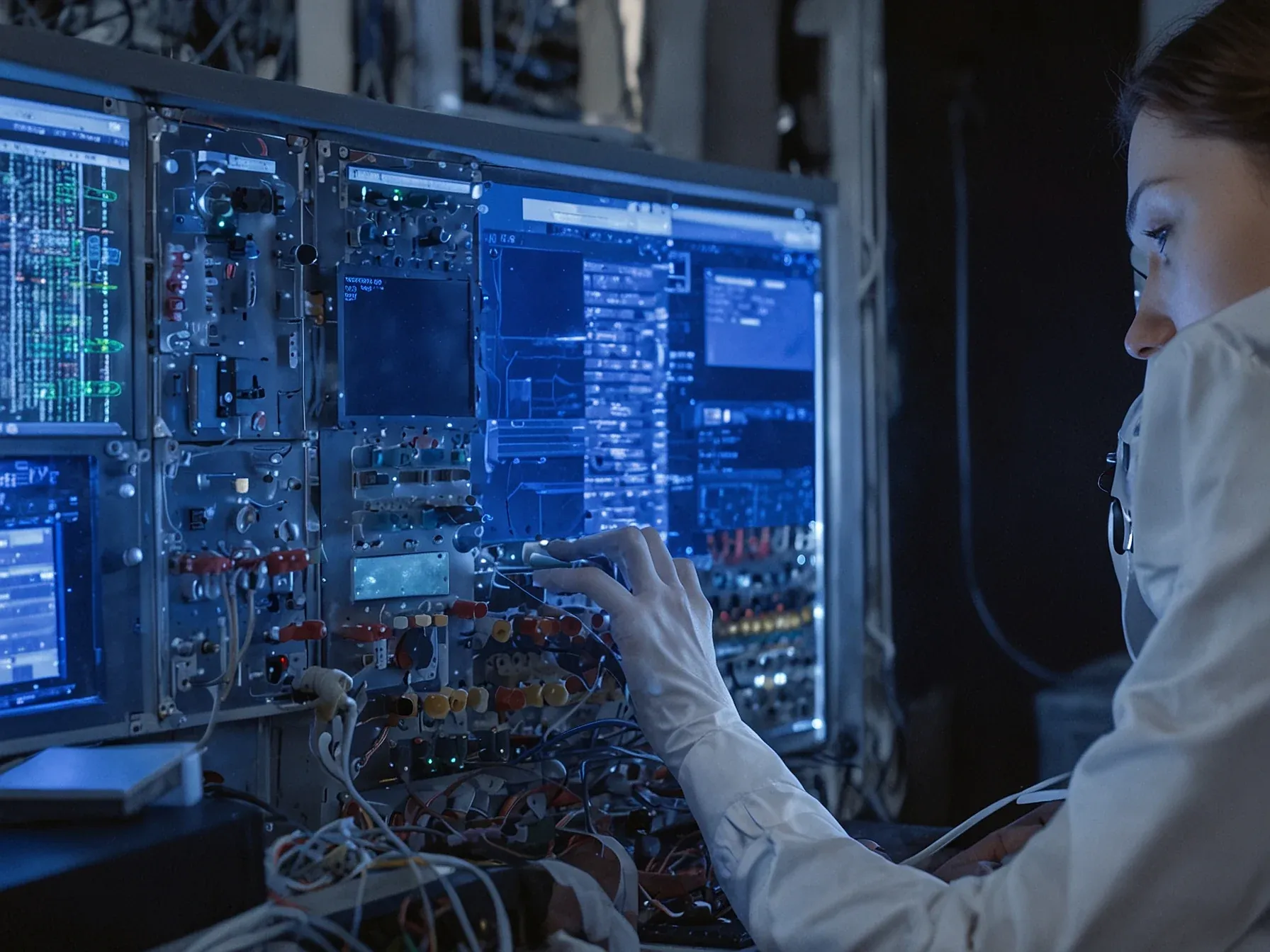
Editorial illustration for Google's Self-Modifying AI Model Demands Advanced Engineering and Compute
Google's Self-Modifying AI Rewrites Machine Learning Rules
Google's self-modifying model needs extra engineering, smarter compute for complex training
Google engineers are now attempting to construct an AI that gets bored. The industry's brute-force approach—more data, bigger clusters—has hit a wall of unsustainable cost. Their proposed escape hatch is HOPE, a new research architecture.
This system learns to alter the very algorithm that governs its own learning. The goal is a machine that grows restless with its own tasks.
Building on NL, the team introduces a self-modifying sequence model that “learns how to modify itself by learning its own update algorithm.”
That quote about "extra engineering effort" lays it bare. The complexity is the entire point. Picture a system where some neural components refresh every second while others lag for a week, all directed by a meta-algorithm the AI is writing in real time.
The static training loop is finished. What emerges is a dynamic, multi-speed organism. Its promise is a leap toward genuine adaptability.
Its immediate reality, as Google's own researcher states, is a colossal engineering migraine. HOPE points to models that evolve their own intelligence. Our current compute infrastructure, built for predictable workloads, may shatter against it.
Related Reading
Browse all Google news → Research & Benchmarks
 Microsoft AI Chief: "If It Isn't Safe We Shouldn't Build It
 Research & Benchmarks
 Google's FACTS benchmark shows 70% factuality ceiling across four tests
 Research & Benchmarks
 Nvidia's DLSS 4.5 beta adds 6x Multi Frame Generation for RTX 50 GPUs
 Related Topic
 Google to End Free Access to Gemini AI for Non-Subscribers
LLMs & Generative AI
 Related Topic
 NVIDIA and Google Cloud let developers scale AI from prototype to production
Market Trends
 From Archives
 ARC benchmark declines as labs tune AI to optimize its specific logic
 From Archives
 General Agentic Memory uses dual-agent design, beats RAG on benchmarks
 From Archives
 Google TPUs save OpenAI 30% on Nvidia chips as they run Gemini 3 Pro and Anthro
Market Trends
 From Archives
 Google's Gemini Agent automates planning, research, and multi-step tasks
LLMs & Generative AI
Common Questions Answered
How do self-modifying AI models differ from traditional neural networks?
Self-modifying AI models can dynamically reshape their own architectures during training, unlike static neural networks. These systems can adapt to computational challenges with unprecedented flexibility, potentially reconfiguring themselves in real-time to optimize performance.
What engineering challenges are associated with Google's self-modifying sequence model?
The self-modifying sequence model requires advanced engineering effort and sophisticated compute management due to its multi-level update frequencies. Researchers must develop complex mechanisms to enable the AI to learn and implement its own update algorithms effectively.
What is the significance of the Continuum Memory System in Google's AI research?
The Continuum Memory System assigns different MLP blocks to varying update frequencies, allowing for more dynamic and adaptive AI model architecture. This approach enables the AI to potentially modify its own learning and processing capabilities more intelligently during training.
Further Reading
- Introducing Nested Learning: A new ML paradigm for continual learning — Google Research Blog
- Google Nested Learning: A New Approach To Continual Learning — Quantum Zeitgeist
- Nested Learning: A New Machine Learning Approach for Continual Learning that Views Models as Nested Optimization Problems to Enhance Long-Context Processing — MarkTechPost
- Nested Learning: Why Deep Learning's Depth Might Be an Illusion and a New Roadmap for Smarter AI — Plain English
