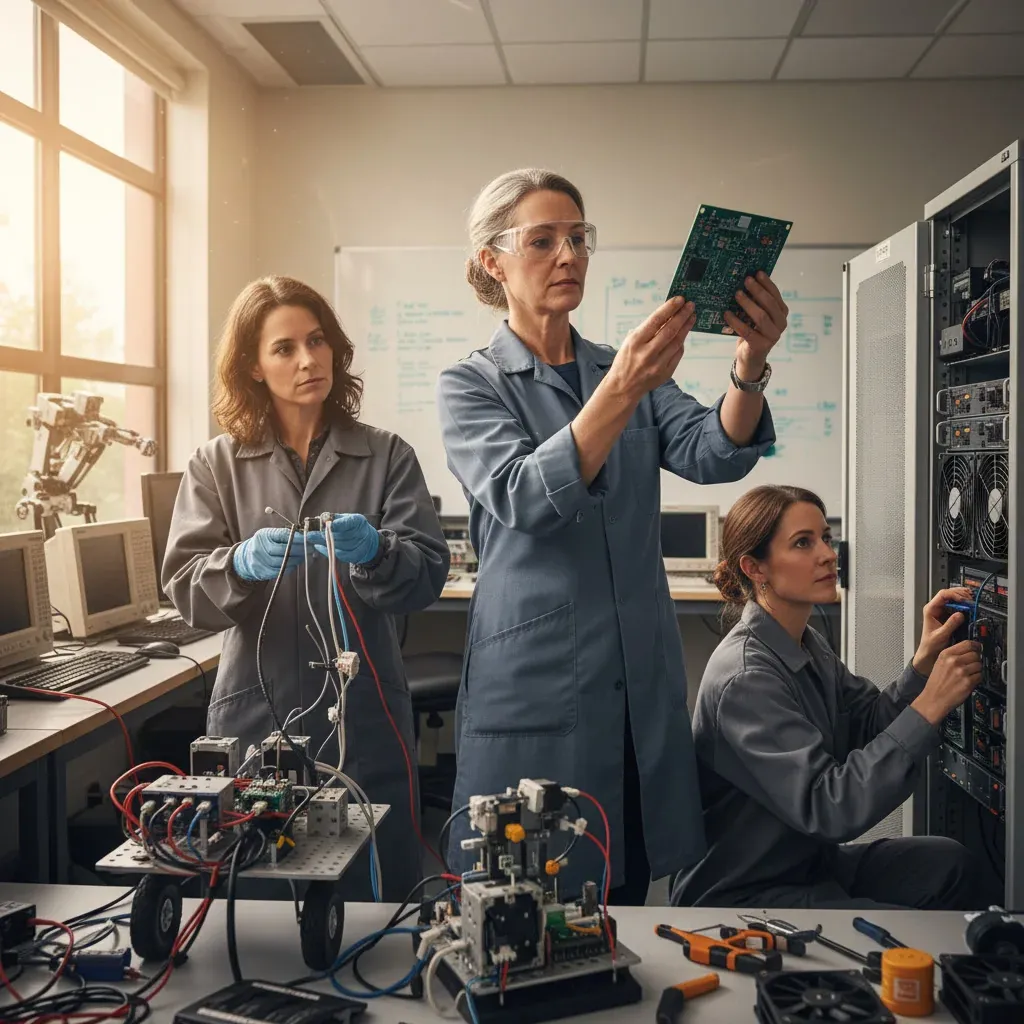
Editorial illustration for Ex-Google Founder Ross Launches Groq to Challenge NVIDIA with New Inference Chip
Groq Challenges NVIDIA with Revolutionary AI Inference Chip
Groq, founded by ex-Google exec Ross, to assist NVIDIA on inference chips
When a startup built to beat the giant chooses to help that giant instead, the industry pays attention. Groq, born from the ambition of ex-Google engineer Jonathan Ross, spent years perfecting its Language Processing Unit, a chip designed expressly for fast, deterministic inference. Its systems outran NVIDIA’s GPUs on key models.
Now Groq is working with NVIDIA on inference chips. The deal reads less like a partnership and more like a strategic chess move. Analysts see NVIDIA absorbing Groq’s architectural secrets to sidestep costly packaging bottlenecks, while Groq gets a seat at the table, and a $750 million vote of confidence from investors.
The question isn’t just why NVIDIA asked for help. It’s what happens when the market leader decides to learn from the disruptor.
After leaving Google, Ross founded Groq to build the Language Processing Unit (LPU), a chip architecture designed for deterministic, low-latency inference. Since its launch, Groq has positioned its systems as delivering higher inference speeds for specific models than NVIDIA's GPUs on certain AI models. The deal has triggered speculation across the industry about NVIDIA's motives.
"What this also says to me is that Nvidia sensed a threat to scaling their own inference business," wrote Naveen Rao, CEO of Unconventional AI and former VP of AI at Databricks, in a post on X. Max Weinbach, an analyst at Creative Strategies, suggested in a post on X that the agreement could help NVIDIA rethink its inference roadmap. "This gets Nvidia the IP they need to bypass CoWoS and HBM for a fast inference-focused chip, and use NVLink for better chip-to-chip interconnect of the LPU," he wrote.
This indicates NVIDIA may be looking to absorb ideas from Groq's LPU architecture to design inference-optimised chips that rely less on costly advanced packaging and memory stacks, while still leveraging its NVLink ecosystem. This would strengthen its position in low-latency, high-throughput AI inference without requiring a complete acquisition of Groq. In September, Groq raised a $750 million funding round at a valuation of $6.9 billion, underscoring investor confidence in its approach to inference-focused hardware.
This is the moment when a rivalry transforms into a quiet merger of minds. NVIDIA doesn’t buy everything it admires, sometimes it borrows, reshapes, and absorbs. By inviting Groq into its fold, NVIDIA sidesteps the brute-force approach of scaling GPUs and instead reaches for the scalpel: deterministic, low-latency inference carved from Groq’s LPU vision.
The deal whispers a deeper truth. CoWoS and HBM are costly bottlenecks. NVLink is the real asset.
Marry that interconnect to a leaner, faster architecture, and you’ve got a chip that doesn’t just compete, it redefines the battlefield. Groq’s $750 million war chest and $6.9 billion valuation were never about going it alone. They were about building something so sharp that even the giant had to take notice.
Now the giant has. And the inference race just got a new engine.
Related Reading
Browse all Google news → Business & Startups
 Nordic pilot adds Gemini for Education, NotebookLM to boost AI literacy
 Business & Startups
 Kling launches Video O1, all-in-one model with MVL bridge using transformer
 Business & Startups
 DeepSeek Seeks More Capital Weeks After USD 7B Funding Round
 Related Topic
 NVIDIA and Google Cloud let developers scale AI from prototype to production
Market Trends
 Related Topic
 Google tests visual 'magazine-style' UI for Gemini 3 Pro users
LLMs & Generative AI
 From Archives
 OpenAI says prompt injection persist, ships adversarial model and safeguards
 From Archives
 Coforge launches EvolveOps.AI, AI-agent platform to curb reactive IT ops
 From Archives
 AlphaFold marks 5 years; new Gemini 2.0 AI co-scientist debates hypotheses
Open Source
 From Archives
 Google highlights AI-driven chip, infrastructure and robotics advances in 2025
Research & Benchmarks
Common Questions Answered
What makes Groq's Language Processing Unit (LPU) different from traditional GPU architectures?
Groq's LPU is designed specifically for deterministic, low-latency AI inference, offering a specialized approach that differs from NVIDIA's general-purpose GPUs. The chip architecture aims to deliver higher inference speeds for specific AI models, potentially challenging the current GPU-dominated landscape.
Who founded Groq and what is his background in AI chip technology?
Groq was founded by Jonathan Ross, a former Google engineering leader with extensive experience in chip design and AI technologies. After leaving Google, Ross launched Groq with the vision of creating a more efficient chip architecture for AI computational tasks.
How is Groq positioning itself as a potential challenger to NVIDIA in the AI chip market?
Groq is challenging NVIDIA by developing the Language Processing Unit (LPU), which promises higher inference speeds for specific AI models compared to traditional GPU solutions. The startup is targeting a niche in the AI chip market by offering a more specialized and potentially more efficient chip architecture.
