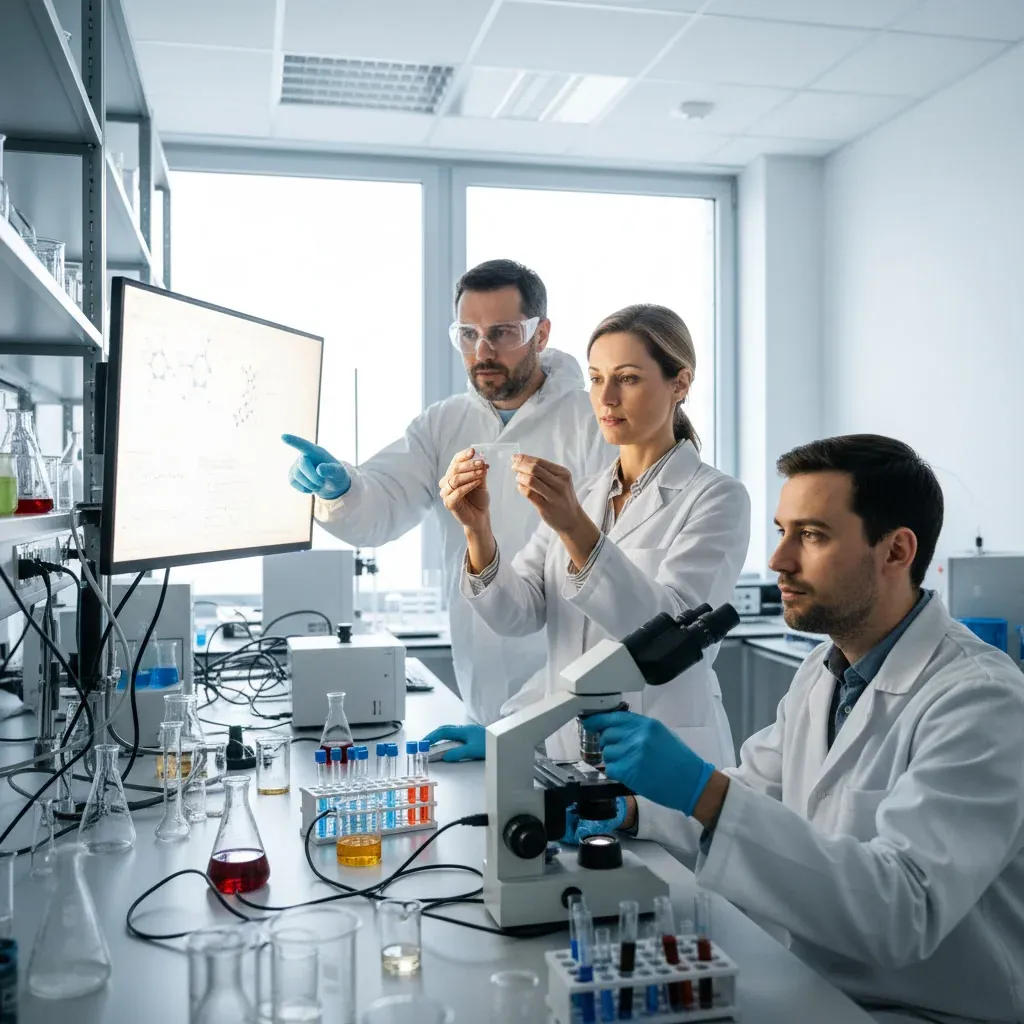
Editorial illustration for Gemini 2.0 AI Co-Scientist Debuts, Challenging Research Hypotheses
AI Research Partner: AlphaFold's 5-Year Scientific Leap
AlphaFold marks 5 years; new Gemini 2.0 AI co-scientist debates hypotheses
AlphaFold wasn't just a better tool. It was a different kind of thing. Five years ago, it solved a concrete, maddening biological problem by predicting protein shapes with terrifying precision.
The shock wasn't the answer, but the fact a machine found it. Now the ambition has jumped from the lab bench to the blackboard.
A new project built on Google's Gemini 2.0 presents itself as an "AI co-scientist." Its party trick is generating scientific hypotheses and then debating them. Not summarizing papers. Arguing.
Proposing a theory, defending it, attacking its own logic. This is a machine that wants to talk about the "why" before anyone does the "how."
You are launching the "AI co-scientist," an agentic system built on Gemini 2.0 that generates and debates hypotheses. This sounds like the scientific method in a box. Are we moving toward a future where the "Principal Investigator" of a lab is an AI, and humans are merely the technicians verifying its experiments?
What I see happening is a shift in how scientists spend their time. Scientists have always played dual roles--thinking about what problem needs solving, and then figuring out how to solve it. With AI helping more on the "how" part, scientists will have more freedom to focus on the "what," or which questions are actually worth asking.
The quiet promise here is not robot overlords. It's the redistribution of intellectual labor. Science is a grind.
The real creative leap is choosing the right question, but that leap is usually buried under an avalanche of procedural work. If an AI handles the method, the testing, the data crunching, it leaves the human with a different and more profound task.
You are left with pure inquiry. The job becomes judgment, intuition, and taste. It becomes deciding which mystery, among infinite possibilities, is actually worth a lifetime.
No model can do that. The spark is still human. The machine just clears away the noise so you can hear it.
Related Reading
Browse all Google news → Open Source
 D&B rebuilds 642 million‑business database after AI agents hit limits
 Open Source
 Box CEO Aaron Levie Says AI Will Drive "Biggest Cybersecurity Upgrade
 Open Source
 Study: 6.7% of Deepfake Requests on Hugging Face Targeted Children
 Related Topic
 Google to End Free Access to Gemini AI for Non-Subscribers
LLMs & Generative AI
 Related Topic
 NVIDIA and Google Cloud let developers scale AI from prototype to production
Market Trends
 From Archives
 Birdfy’s Hum Bloom uses hydraulic feeder to film hummingbirds at 120 fps
 From Archives
 AI Tool Lets Users Design Personalized Christmas Cards with Festive Themes
 From Archives
 Google highlights AI-driven chip, infrastructure and robotics advances in 2025
Research & Benchmarks
 From Archives
 Google and OpenAI chatbots used to strip women to bikinis in deepfakes
LLMs & Generative AI
Common Questions Answered
How does the Gemini 2.0 AI co-scientist challenge traditional scientific research methodologies?
The Gemini 2.0 AI co-scientist goes beyond traditional data analysis by actively generating and debating scientific hypotheses. This approach represents a potential paradigm shift, where AI becomes a collaborative partner in the research process rather than just a tool for data processing.
What potential implications does the AI co-scientist have for the role of human researchers?
The AI co-scientist could fundamentally transform scientific roles, potentially shifting researchers from both hypothesis generation and experimental work to more of a verification and oversight function. This development suggests a future where AI might take a more prominent role in scientific inquiry, with humans potentially becoming technicians who validate AI-generated research concepts.
What makes the Gemini 2.0 system different from previous AI research tools?
Unlike previous AI research tools that primarily analyzed data, the Gemini 2.0 AI co-scientist can actively generate and challenge scientific hypotheses. The system appears capable of engaging in a more dynamic and interactive research process, potentially transforming how scientific investigations are conducted.
Further Reading
- AlphaFold: Five years of impact — Google DeepMind
- Google DeepMind's AlphaFold shows why science may be AI's killer app — Fortune
- AlphaFold Protein Structure Database 2025: a redesigned interface and new features to improve protein structure analysis and discovery — Nucleic Acids Research (Oxford Academic)
- How AlphaFold Has Changed Biology Research, 5 Years On — Science Friday
- Google's year in review: 8 areas with research breakthroughs in 2025 — Google
