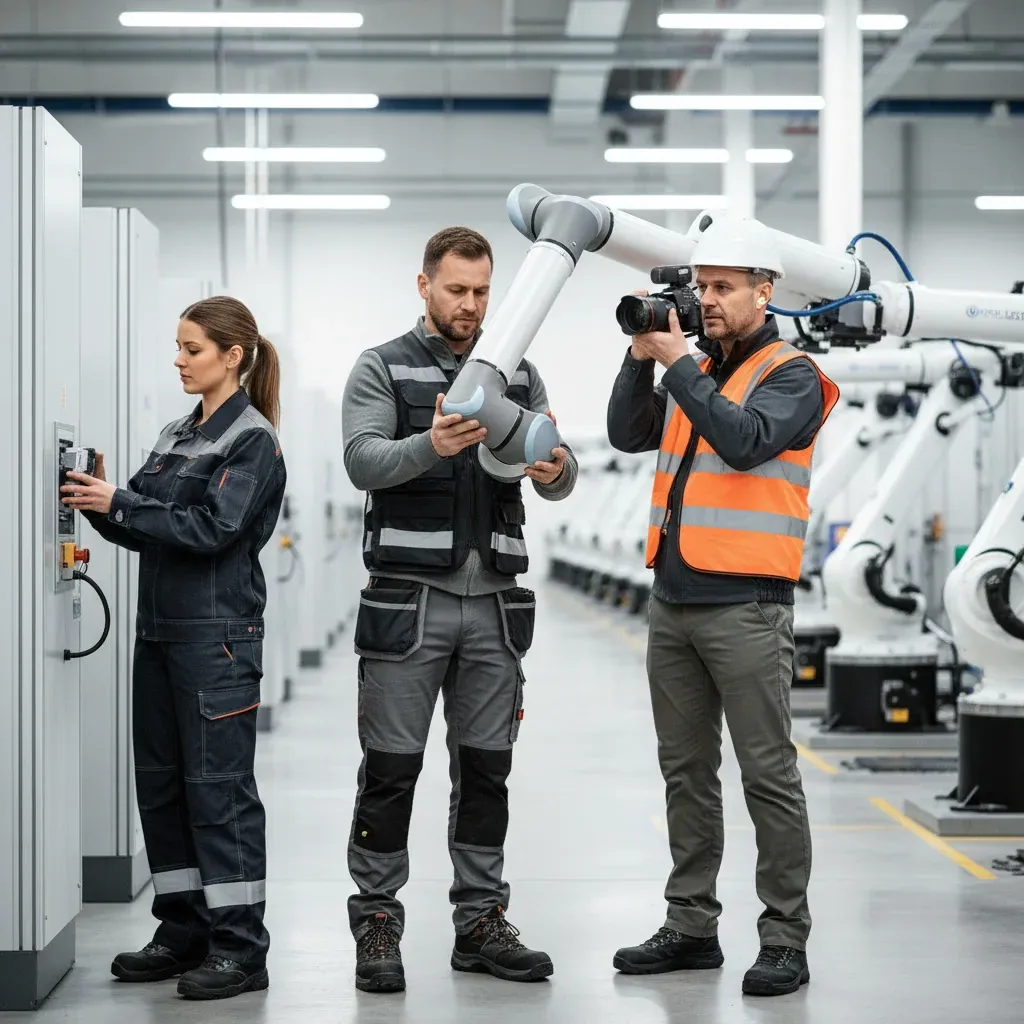
Editorial illustration for Google Reveals AI Breakthroughs in Chips, Robotics, and Infrastructure for 2025
Google's AI Advances Reshape Chips, Robots, Infrastructure
Google highlights AI-driven chip, infrastructure and robotics advances in 2025
Google's 2025 research review reads like an engineering manifesto. It is less about new chatbots and more about AI that builds things, controls things, and makes the systems we already depend on run with a new kind of efficiency.
The company detailed an AI that designs its own specialized computer chips. It showed how artificial intelligence is managing the colossal infrastructure required to run that same AI, a self-optimizing loop aimed at cutting energy waste. The robotics work progressed on two tracks.
Foundational models operate alongside more sophisticated ones. A system called Genie 3 attempts to build a general-purpose model of how the world works.
2025 has been a year of extraordinary progress in research. With artificial intelligence, we can see its trajectory shifting from a tool to a utility: from something people use to something they can put to work.
The ambition here is industrial. The stated goal is applying these tools to large, messy, physical problems like climate and health. This is the unsexy backend of the AI boom.
It is where the real cost and complexity live. For Google, the future is not just a smarter assistant. It is a data center that cools itself, a robot that learns from video, and a chip designed in hours by a machine that never sleeps.
Related Reading
Browse all Google news → Research & Benchmarks
 Microsoft AI Chief: "If It Isn't Safe We Shouldn't Build It
 Research & Benchmarks
 Google's FACTS benchmark shows 70% factuality ceiling across four tests
 Research & Benchmarks
 Nvidia's DLSS 4.5 beta adds 6x Multi Frame Generation for RTX 50 GPUs
 Related Topic
 Google to End Free Access to Gemini AI for Non-Subscribers
LLMs & Generative AI
 Related Topic
 NVIDIA and Google Cloud let developers scale AI from prototype to production
Market Trends
 From Archives
 LeCun and Hassabis dispute meaning of ‘general intelligence’
 From Archives
 Qwen3-4B-Instruct-2507: 4B-parameter model boosts Raspberry Pi AI
 From Archives
 Google and OpenAI chatbots used to strip women to bikinis in deepfakes
LLMs & Generative AI
 From Archives
 Google I/O drives May's top AI announcements in 2025 roundup list
Business & Startups
Common Questions Answered
How is Google advancing AI capabilities in hardware and infrastructure for 2025?
Google is targeting fundamental improvements in chip design, infrastructure, and technological ecosystems through AI-driven innovations. The company is reimagining core technological systems by applying artificial intelligence to redesign how hardware and infrastructure fundamentally operate, moving beyond traditional algorithmic approaches.
What breakthroughs has Google made in robotics with its Gemini models?
Google has developed the Gemini Robotics models, including the foundational Gemini Robotics and the more sophisticated Gemini Robotics 1.5, which aim to bring AI agents into both physical and virtual worlds. These models represent significant advancements in robotic intelligence, enabling more complex interactions and understanding across different environments.
What is the significance of Google's Genie 3 in AI world modeling?
Genie 3 is introduced as a new frontier for general-purpose world models, representing a breakthrough in AI's ability to understand and interact with complex environments. This model suggests Google is pushing the boundaries of AI from pure computational tasks to more comprehensive world representation and interaction capabilities.
Further Reading
- Ironwood: The first Google TPU for the age of inference — Google Cloud Blog
- Google Research 2025: Bolder breakthroughs, bigger impact — Google Research Blog
- Google Enters AI Chip Race with Ambitious Plan to Produce 5 Million TPUs by 2027 — ALM Intelligence
