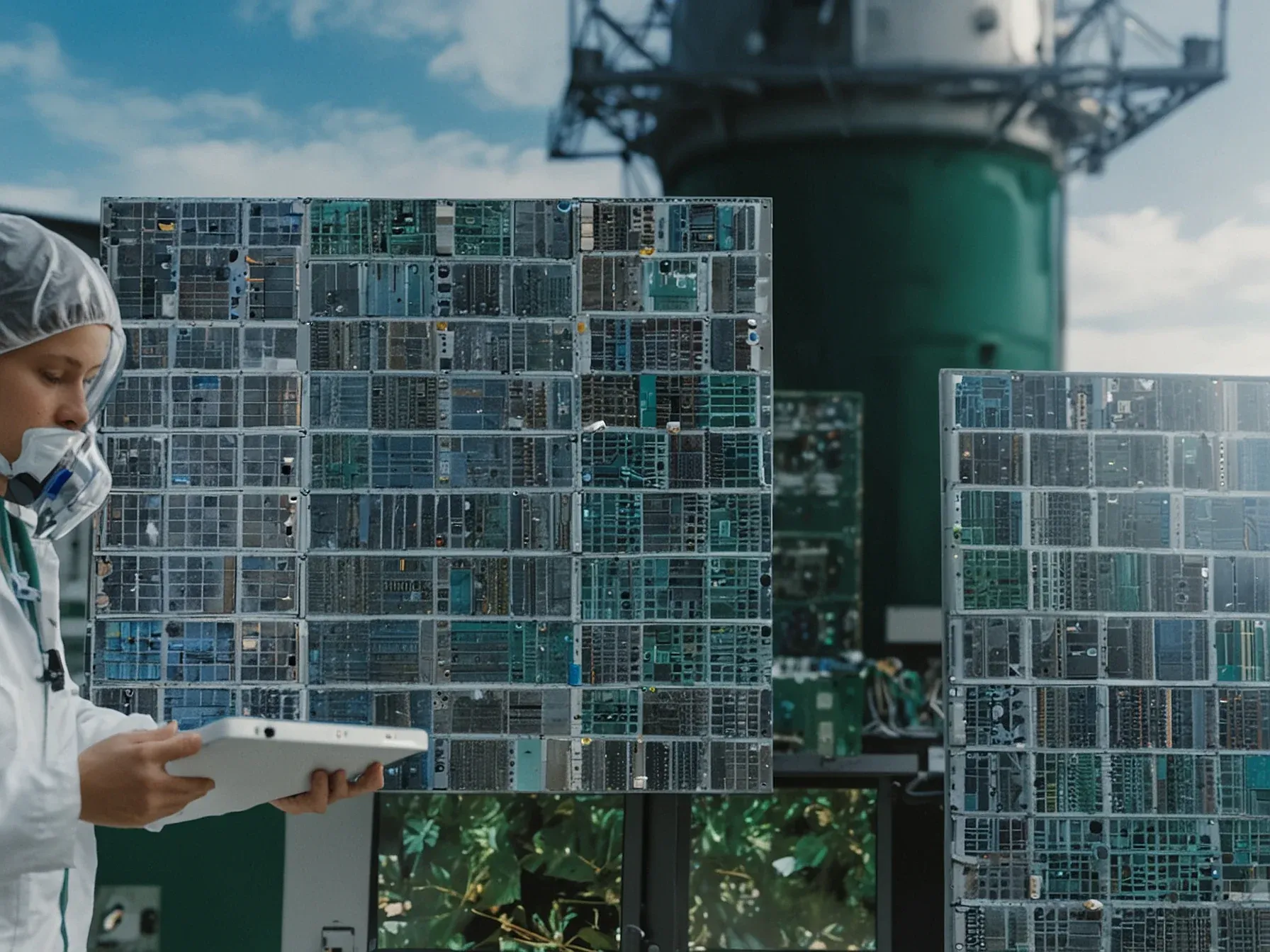
Editorial illustration for Google Eyes Solar-Powered Space TPUs for Unprecedented Data Center Efficiency
Solar Space TPUs: Google's Radical AI Data Center Strategy
Google plans space-based TPUs for solar-powered data centres, preprint says
Google's latest research paper isn't about a better search algorithm. It's a blueprint for launching the company's custom AI hardware, its tensor processing units, into orbit. The goal is audaciously simple: escape Earth's messy, expensive power grids and cooling demands by moving the compute into the void.
The technical investigation, detailed in the preprint "Towards a future space-based, highly scalable AI infrastructure system design," proposes modular satellites packed with TPUs. They wouldn't drift aimlessly. The plan specifies a dawn-dusk sun-synchronous orbit. There, endless sunlight could power them almost constantly, sidestepping the intermittent energy that plagues ground-based solar farms.
It’s a logical endpoint for an efficiency-obsessed industry. The physics promise a massive gain. The engineering is a nightmare.
Google has announced a new research initiative, Project Suncatcher, which aims to explore the feasibility of scaling artificial intelligence (AI) compute in space using solar-powered satellite constellations equipped with Tensor Processing Units (TPUs).
An eight-fold increase in solar productivity changes the math. For AI models with insatiable appetites for megawatts, that figure alone makes the orbital ledger worth a look, even with launch costs that run to tens of thousands per kilogram.
Desperation fuels this vision. The good kind. When your core business—training ever-larger models—demands exponentially more electricity every year, you scrutinize every option. Even the ones 400 kilometers up, where building a data fabric requires inter-satellite links capable of tens of terabits per second.
This won't happen soon. The hurdles around heat dissipation in a vacuum and radiation hardening are immense. But the trajectory is clear.
The frontier of computation isn't just smaller transistors. It's finding stranger, quieter, and sun-drenched places to run them.
Related Reading
Browse all Google news → Research & Benchmarks
 Microsoft AI Chief: "If It Isn't Safe We Shouldn't Build It
 Research & Benchmarks
 Google's FACTS benchmark shows 70% factuality ceiling across four tests
 Research & Benchmarks
 Nvidia's DLSS 4.5 beta adds 6x Multi Frame Generation for RTX 50 GPUs
 Related Topic
 NVIDIA and Google Cloud let developers scale AI from prototype to production
Market Trends
 Related Topic
 Google tests visual 'magazine-style' UI for Gemini 3 Pro users
LLMs & Generative AI
 From Archives
 Arxiv tightens moderation as AI-generated CS review papers swell
 From Archives
 IndQA Targets India's Billion Non-English Users, 2nd-Largest ChatGPT Market
 From Archives
 Google applies AI principles to boost nature protection and restoration
Policy & Regulation
 From Archives
 Google’s Gemma model controversy highlights lifecycle risks, says Blackburn
LLMs & Generative AI
Common Questions Answered
How much more productive are solar panels in space compared to those on Earth?
According to the preprint paper, solar panels in the right orbit can be up to 8 times more productive than Earth-based installations. This increased efficiency allows for nearly continuous power generation, significantly reducing the need for battery storage in space-based data centers.
What is Google's proposed vision for space-based Tensor Processing Units (TPUs)?
Google is exploring the creation of modular, interconnected satellite networks that can function like data centers in orbit, powered by highly efficient solar panels. The initiative aims to revolutionize AI infrastructure by leveraging the unique energy advantages and computational possibilities of space-based computing systems.
What potential challenges does Google face in implementing space-based TPUs?
While the concept of solar-powered TPUs in space is promising, practical challenges remain in developing and deploying such infrastructure. The technical complexities of creating modular satellite networks and ensuring reliable, continuous computing capabilities in the challenging space environment will require significant engineering innovation.
Further Reading
- Google Launches Project Suncatcher: AI Computing in Space by 2027 — TechBuzz
- Meet Project Suncatcher, a research moonshot to scale machine learning compute in space. — Google Blog
- Google to send TPUs to space for solar-powered data centers — News.az
- Techmeme: Google unveils Project Suncatcher to launch two solar-powered satellites, each with four TPUs, into low Earth orbit in 2027 — Techmeme
