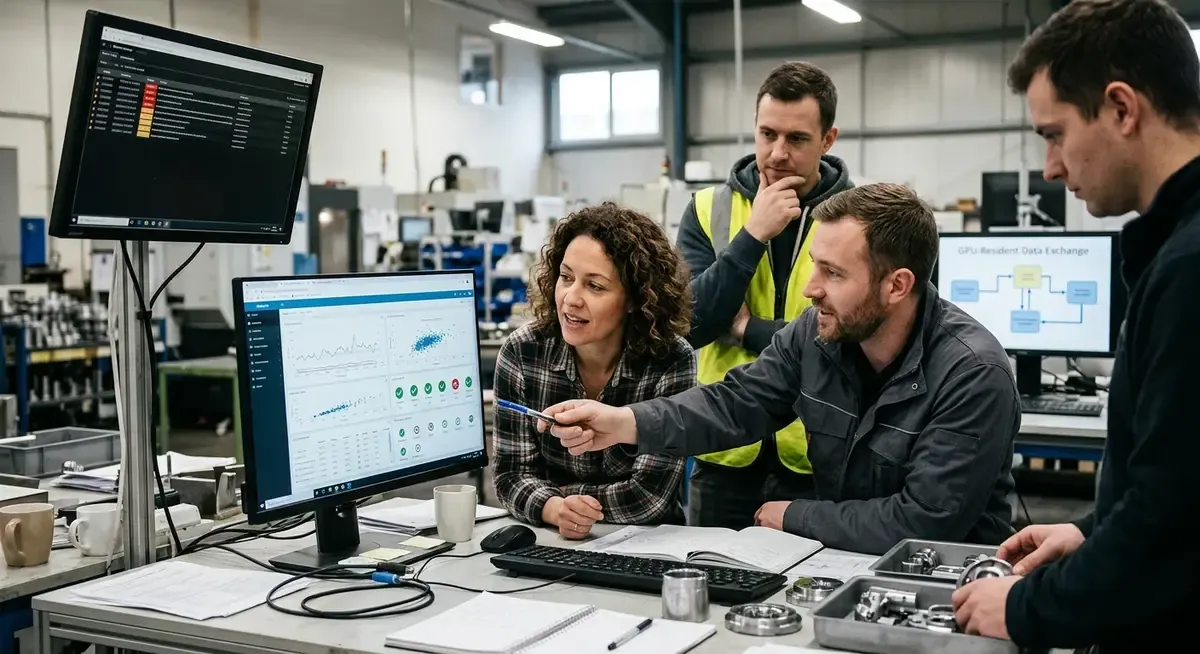
Editorial illustration for AI Agent and NVIDIA Isaac ROS Speed Up ROS 2 Node
NVIDIA Isaac ROS Speeds Up AI Agent Processing
A GPU kernel that runs in microseconds can still sit behind a ROS 2 graph that crawls, because the messages carrying its output often get serialized or copied through CPU memory on the way to the next node. That copy step erases whatever speed a team gained by moving perception or AI workloads onto the GPU in the first place. NVIDIA's answer, contributed upstream to ROS Lyrical, is a new rosidl::Buffer abstraction paired with a CUDA buffer backend, letting nodes pass GPU-resident payloads through zero-copy transport without breaking standard ROS 2 message formats or node boundaries. NVIDIA Isaac ROS 5.0 already runs every node on this backend.
Adopting rosidl::Buffer in an existing node doesn't take much code. Finding the right places to change it does. That means auditing allocations, tracing serialization paths, checking who owns the CUDA stream, and confirming fallback behavior won't quietly undo the gains. A tutorial from NVIDIA turns that audit into a workflow an AI coding agent can run directly, using a purpose-built skill to inspect a CUDA-accelerated node, trace how data actually moves, and plan a refactor that leaves the node's interface intact, before deploying the result on NVIDIA Jetson AGX Thor.
All nodes in NVIDIA Isaac ROS 5.0 have been updated to use the CUDA buffer backend and benefit from the more efficient data movement enabled by rosidl::Buffer .
Why this matters
For anyone building perception pipelines on ROS 2, this closes a gap that's been quietly taxing performance for years. A CUDA kernel that runs fast in isolation means nothing if the ROS graph keeps shuttling data back through CPU memory between nodes. NVIDIA's contribution of the CUDA buffer backend and the rosidl::Buffer abstraction to ROS Lyrical is the kind of infrastructure fix that doesn't generate headlines but changes what's actually possible in production robotics. Zero-copy GPU-resident messaging means teams can stop writing custom workarounds just to keep sensor and inference data off the CPU bus.
We'd flag this as a signal worth tracking for anyone evaluating robotics stacks: upstream, standardized GPU interop in ROS 2 lowers the cost of building AI-heavy robots without vendor lock-in to a specific glue layer. It's a narrow technical fix, not a platform shift, but it's the sort of narrow fix that determines whether your latency budget survives contact with reality. Worth watching how quickly other hardware vendors adopt the same abstraction.
Related Reading
 Industry Applications
 Westinghouse teams with Google Cloud to build AI platform for nuclear power
 Industry Applications
 NVIDIA NeMo powers telco reasoning model for autonomous network workflows
 Industry Applications
 Month-1 Agent Adds Holistic Observability with Trace IDs and Token Tracking
 Related Topic
 NVIDIA and Google Cloud let developers scale AI from prototype to production
Market Trends
 Related Topic
 China offers cheaper electricity to AI firms abandoning NVIDIA chips
Business & Startups
 From Archives
 Redwood Materials Powers AI With Repurposed EV Batteries
 From Archives
 NATO Allies Test Small AI Models for Autonomous Drone Targeting
 From Archives
 ROBOTIS Integrates NVIDIA Isaac ROS Into AI Worker for Vision-Guided Tasks
Open Source
 From Archives
 NVIDIA's SoL-Pi Cuts AI Coding Agent Token Traffic by Up to 44.7%
Research & Benchmarks
Common Questions Answered
What performance bottleneck does the NVIDIA Isaac ROS CUDA buffer backend solve in ROS 2 graphs?
The CUDA buffer backend eliminates the need to serialize or copy GPU-resident data through CPU memory between ROS 2 nodes, which was previously erasing the performance gains from GPU-accelerated workloads. By allowing nodes to pass GPU payloads directly through the rosidl::Buffer abstraction, data movement becomes significantly more efficient and avoids unnecessary CPU bottlenecks.
How does the rosidl::Buffer abstraction improve ROS 2 node communication?
The rosidl::Buffer abstraction paired with a CUDA buffer backend enables GPU-resident payloads to be passed directly between nodes without serialization or CPU memory copies. This infrastructure improvement allows perception and AI workloads to maintain their GPU acceleration benefits throughout the entire ROS 2 graph, rather than losing performance at each message handoff.
What changes were made to NVIDIA Isaac ROS 5.0 to support faster data movement?
All nodes in NVIDIA Isaac ROS 5.0 have been updated to use the CUDA buffer backend, enabling them to benefit from the more efficient data movement enabled by the rosidl::Buffer abstraction. This universal adoption across the platform ensures consistent performance improvements for perception pipelines built on ROS 2.
Why is the CUDA buffer backend contribution to ROS Lyrical significant for production robotics?
This infrastructure fix closes a long-standing performance gap in ROS 2 perception pipelines by ensuring that fast GPU kernels don't get bottlenecked by CPU memory transfers between nodes. For production robotics applications, this means teams can now realize the full performance potential of their GPU-accelerated AI and perception workloads without the hidden tax of repeated CPU serialization.
Further Reading
- NVIDIA Isaac ROS 5.0 Advances Agentic, Open Source Robotics Development - NVIDIA Blog
- Isaac ROS (Robot Operating System) - NVIDIA Developer - NVIDIA Developer
- Release Notes - NVIDIA Isaac ROS - NVIDIA Isaac ROS
- NVIDIA Isaac ROS for Airside Autonomous Vehicles - Industry Research
- NVIDIA Improves Perception Performance for ROS 2 Applications - Robotics 247
