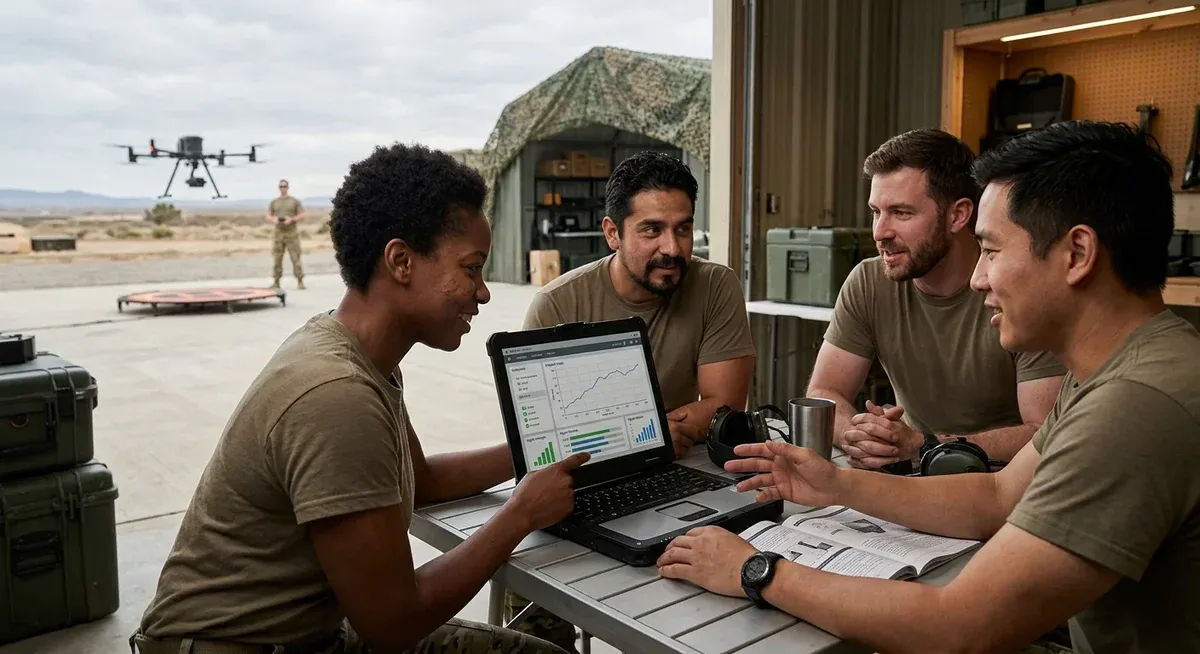
Editorial illustration for NATO Allies Test Small AI Models for Autonomous Drone Targeting
NATO Tests AI Models for Autonomous Drone Targeting
Scaleout Systems started in 2018 as a spinoff from Uppsala University in Sweden, building machine learning tools meant for commercial trucks. Seven years later, its software is being tested for a different job: helping small drones spot and strike targets on their own, without sending video back to a distant server for a human to sort through.
The shift came after February 2022. Russia's invasion of Ukraine pushed European defense planners toward drone warfare fast, and Scaleout's founders saw an opening for the kind of lightweight, edge-based AI they'd already built for vehicles. Rather than deploy massive models like the ones OpenAI or Anthropic sell, the company works with smaller, leaner systems designed to run directly on the limited processors found in battlefield hardware, from handheld drone controllers to workstations set up at forward bases.
That approach caught NATO's attention. In 2025, Scaleout joined the alliance's Defence Innovator Accelerator for the North Atlantic, known as DIANA, through a program called Federated Aerial Intelligence for Recon. The project is now adapting computer vision models to run on the exact kind of constrained hardware drones and their operators carry into the field.
As European militaries adapt to the use of AI and drones in modern warfare, a NATO-backed startup is helping to deploy AI-driven target detection and selection that can run on small drones for surveillance and attack missions.
Why this matters
Scaleout's pivot from truck sensor data to battlefield targeting shows how fast dual-use AI companies can move once a war changes the customer calculus. A federated learning startup out of Uppsala, built for industrial edge computing, is now marketing itself on NATO's need for "strategic advantage." That's the pattern worth watching: small models trained for benign edge use cases get repackaged for autonomous weapons systems the moment a government contract appears, with little public accounting of accuracy rates, failure modes, or who signs off on a kill decision made by a model running on a drone with no real-time human review. For researchers and founders working in edge AI or federated learning, this is a reminder that your architecture choices, especially ones optimized for low-bandwidth, offline inference, are exactly what military integrators are shopping for.
Hellander's framing of "operationalizing sensor data" is a euphemism worth sitting with. The technical story here is genuinely interesting; the governance story is thin to nonexistent, and that gap is where our attention needs to go next.
Related Reading
 Industry Applications
 Westinghouse teams with Google Cloud to build AI platform for nuclear power
 Industry Applications
 NVIDIA NeMo powers telco reasoning model for autonomous network workflows
 Industry Applications
 Month-1 Agent Adds Holistic Observability with Trace IDs and Token Tracking
 From Archives
 Agility’s Digit 5 Robot Works Alongside Humans Without Safety Fences
 From Archives
 Bill Gates Invests USD 1 Billion in AI After Warning of Risks
Common Questions Answered
What was Scaleout Systems originally founded to do before pivoting to drone targeting?
Scaleout Systems was founded in 2018 as a spinoff from Uppsala University in Sweden with the original purpose of building machine learning tools for commercial trucks. The company developed software for edge computing applications in the transportation industry before shifting its focus to autonomous drone systems.
How did Russia's invasion of Ukraine influence Scaleout's business direction?
The February 2022 Russian invasion of Ukraine prompted European defense planners to rapidly accelerate their adoption of drone warfare capabilities. This shift in military priorities led Scaleout's founders to recognize an opportunity to repurpose their AI technology for NATO-backed autonomous drone targeting systems instead of continuing solely with commercial truck applications.
What is the key advantage of running small AI models directly on drones rather than sending video to remote servers?
By running small AI models on the drones themselves, the systems can autonomously identify and select targets without needing to transmit video back to distant servers for human operators to analyze. This edge computing approach enables faster decision-making and reduces dependency on communication infrastructure during battlefield operations.
What does the article identify as the concerning pattern with dual-use AI companies during wartime?
The article highlights that small AI models originally trained for benign edge computing use cases can be rapidly repackaged and deployed as autonomous weapons systems once government military contracts become available. This demonstrates how quickly the commercial calculus can shift for dual-use technology companies when defense spending opportunities emerge, often with minimal oversight or deliberation.
Further Reading
- NATO-backed startup adapts AI for autonomous drone recon and attack missions - Ars Technica
- Svenskt AI-system för självlärande drönare testas av Nato - CIO Analytics
- NATO-backed partnership leverages synthetic data and federated learning to enhance counter-drone AI in combat environments - NOAH News
- Uppsalas AI-drönare i Natos innovationsprogram - Elektroniktidningen
- Innovation and technology adoption - NATO
