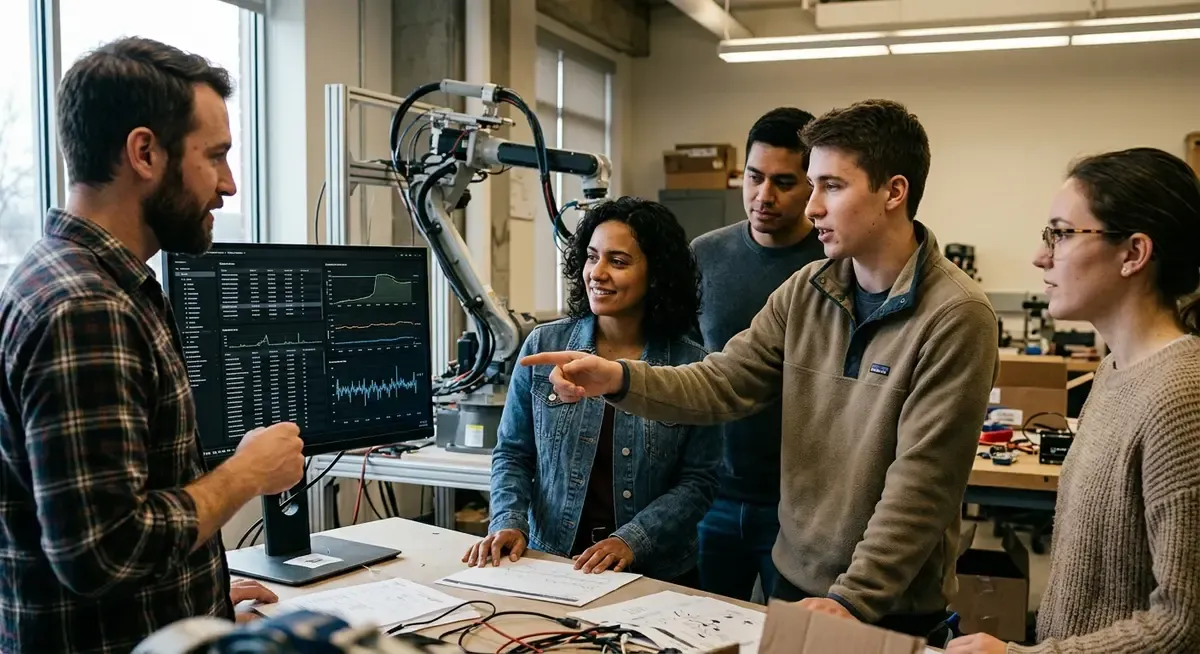
Editorial illustration for ROBOTIS Integrates NVIDIA Isaac ROS Into AI Worker for Vision-Guided Tasks
ROBOTIS Adds NVIDIA Isaac ROS for Vision Tasks
NVIDIA released Isaac ROS 5.0 at ROSCon in Toronto on Wednesday, adding agentic workflows and new platform support to its collection of GPU-accelerated packages built on the open source ROS framework. The release targets a fast-growing base: ROS, maintained by Open Robotics, now counts nearly 1.3 million users building and connecting robot applications with shared tools and standards. Isaac ROS layers NVIDIA's accelerated computing and physical AI models on top of that foundation, giving developers production-ready libraries without abandoning the free, open source tools they already know.
The bigger shift in this release is who's doing the building. AI agents have already reshaped software development broadly, automating repetitive coding tasks and helping engineers move faster through large codebases. NVIDIA is now pushing that same model into robotics, positioning Isaac ROS 5.0 as a toolset that lets AI agents work alongside human developers rather than just serving them. The update also adds support for ROS Lyrical and Ubuntu 24.04, and NVIDIA worked directly with the Open Source Robotics Alliance to contribute a standard data-handling interface into ROS Lyrical itself, aimed at making robotics software run efficiently across different hardware, GPUs included.
By combining an open robotics ecosystem, accelerated computing and new agentic development workflows, Isaac ROS 5.0 helps developers address both sides of the physical AI challenge: building increasingly capable robot applications and efficiently running them in the physical world.
Why this matters
ROBOTIS building TurtleBot3, one of the most widely taught robots in university labs, tells us where Isaac ROS 5.0 is actually headed: classrooms and small-batch manufacturing, not just flagship humanoid demos. Wiring GPU-accelerated object perception into AI Worker for picking, placing and alignment is a mundane but telling use case. It's the kind of repetitive manipulation task that determines whether a robotics platform survives contact with a real production line, not a conference stage.
For developers, the appeal is obvious: NVIDIA is handing you perception primitives so you're not writing pose-estimation code from scratch. That's real time saved. But we'd watch how "agentic workflows" actually performs outside curated demos, since object manipulation in cluttered, unpredictable environments has broken plenty of vision pipelines before.
ROSCon is where the ROS community actually tests these claims against skeptical practitioners, not marketing decks. If ROBOTIS ships this into classrooms and small manufacturers over the next year, that's a better signal of durability than any keynote applause.
Related Reading
 Open Source
 D&B rebuilds 642 million‑business database after AI agents hit limits
 Open Source
 Box CEO Aaron Levie Says AI Will Drive "Biggest Cybersecurity Upgrade
 Open Source
 Study: 6.7% of Deepfake Requests on Hugging Face Targeted Children
 Related Topic
 NVIDIA and Google Cloud let developers scale AI from prototype to production
Market Trends
 Related Topic
 NVIDIA NeMo powers telco reasoning model for autonomous network workflows
Industry Applications
 From Archives
 Xiaomi Credits AI Gains to Expanded Reinforcement Learning
 From Archives
 SpaceXAI's Grok 4.7 Shows Major Benchmark Gains at Same Price
 From Archives
 NVIDIA's SoL-Pi Cuts AI Coding Agent Token Traffic by Up to 44.7%
Research & Benchmarks
 From Archives
 Startups Simulate Scale for Robots Through AI, Says Nvidia's Karpas
LLMs & Generative AI
Common Questions Answered
What new features does Isaac ROS 5.0 add to NVIDIA's robotics platform?
Isaac ROS 5.0 introduces agentic workflows and new platform support to NVIDIA's collection of GPU-accelerated packages built on the open source ROS framework. These additions help developers address the physical AI challenge by building increasingly capable robot applications and efficiently running them in the physical world.
How does ROBOTIS use Isaac ROS 5.0 in their AI Worker for vision-guided tasks?
ROBOTIS integrates Isaac ROS 5.0 into their AI Worker to enable GPU-accelerated object perception for picking, placing, and alignment tasks. This integration demonstrates how the platform handles repetitive manipulation tasks that are critical for real production line operations.
What is the current user base for ROS maintained by Open Robotics?
ROS, maintained by Open Robotics, now counts nearly 1.3 million users who are building and connecting robot applications using shared tools and standards. This growing community represents a significant foundation for NVIDIA's Isaac ROS development.
Why is TurtleBot3 mentioned as significant for Isaac ROS 5.0's direction?
TurtleBot3, built by ROBOTIS and widely taught in university labs, indicates that Isaac ROS 5.0 is targeting classrooms and small-batch manufacturing applications rather than just flagship humanoid demonstrations. This focus on practical, real-world manufacturing tasks shows where the robotics platform is actually headed.
How does Isaac ROS layer NVIDIA's capabilities onto the ROS framework?
Isaac ROS layers NVIDIA's accelerated computing and physical AI models on top of the open source ROS foundation, giving developers access to GPU-accelerated packages for robotics applications. This combination enables developers to build robot applications that are both more capable and efficient to run in physical environments.
Further Reading
- NVIDIA Isaac ROS 5.0 Advances Agentic, Open Source Robotics Development - NVIDIA Blog
- Isaac ROS (Robot Operating System) - NVIDIA Developer - NVIDIA Developer
- Isaac for Manipulation - NVIDIA Isaac ROS Docs
- Release Notes - NVIDIA Isaac ROS - NVIDIA Isaac ROS Docs
- Community Guide to ROSCon 2026 - Toronto - NVIDIA Developer Forums
