
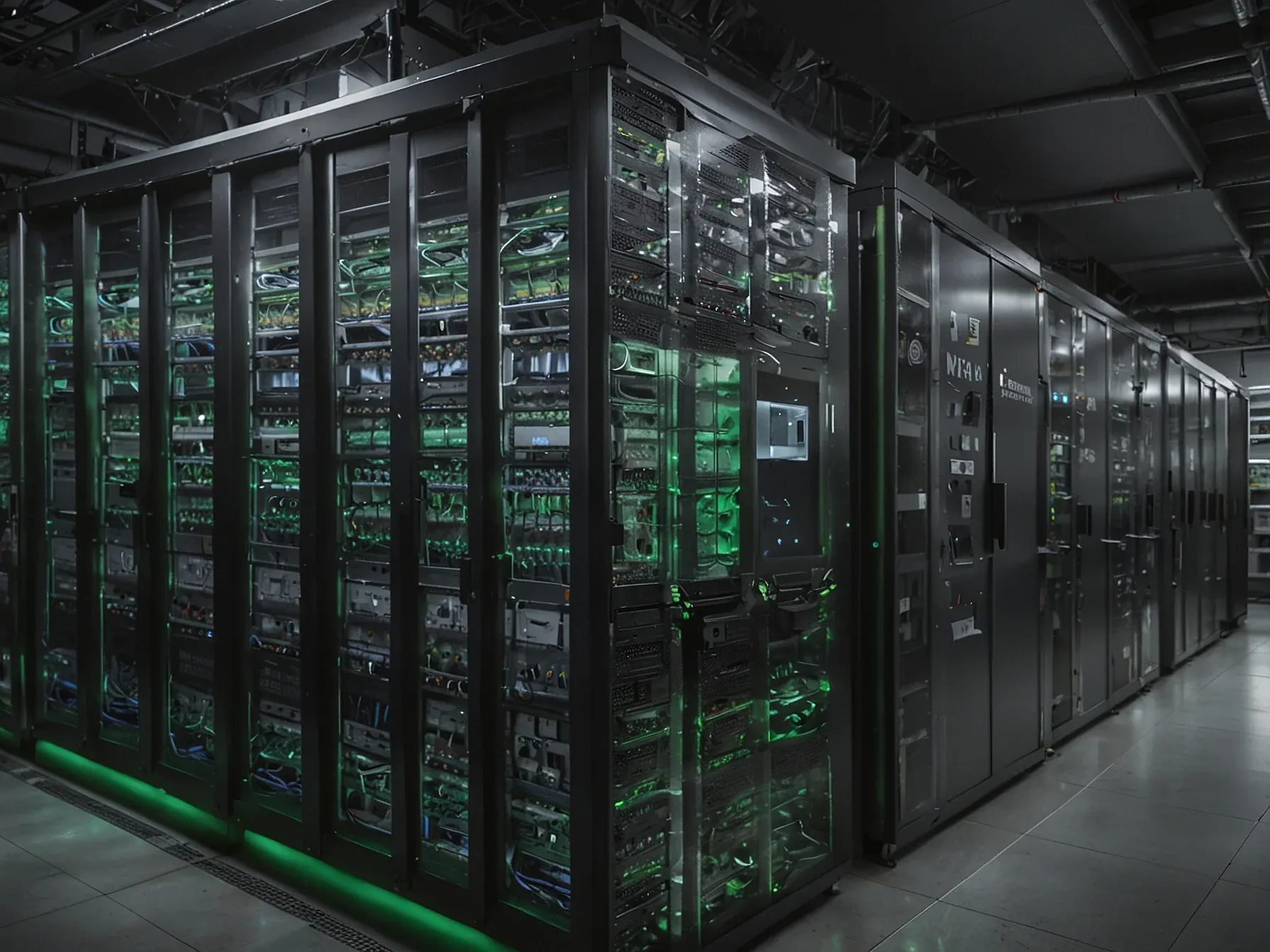
Editorial illustration for 8 NVIDIA DGX Spark Nodes Scale Frontier-Class AI Models With ConnectX-7 RoCE
NVIDIA DGX Spark Scales to 8-Node AI Clusters
8 NVIDIA DGX Spark Nodes Scale Frontier-Class AI Models With ConnectX-7 RoCE
NVIDIA used GTC Berlin to confirm that DGX Spark, its desk-sized AI box introduced earlier this year, now officially scales to eight-node clusters. That pushes unified memory from the single unit's 128 GB up to a full terabyte across eight machines, networked together over ConnectX-7 RoCE. Four nodes already got you to 512 GB, enough for plenty of work, but a terabyte changes what's actually possible on hardware sitting next to a monitor instead of locked in a data center rack.
The timing tracks with how people are actually using these models now. Developers aren't running one model and waiting for an answer anymore. They're chaining inference calls across several models at once, running multi-agent setups, and testing architectures that need hundreds of gigabytes just to load.
NVIDIA Sync, the company's clustering tool, is meant to make linking nodes less of a chore. Its Cluster Assistant manages setup and device coordination automatically, and support for eight-node configurations in Sync is slated to arrive by the end of the year.
That raises an obvious question: what actually runs on this thing, and how fast.
At GTC Berlin, NVIDIA announced official support for eight-node DGX Spark clusters, scaling unified memory to 1 TB and opening the door to frontier-class models, multi-agent workloads, and near-linear pre-training—all running locally.
Why this matters
NVIDIA just handed desk-bound developers a path to cluster-scale memory without the cluster-scale budget. Eight DGX Spark nodes wired through ConnectX-7 and RoCE get you 1 TB of unified memory, enough to load models that previously meant booking time on a data-center rack or renting cloud GPUs by the hour. For researchers prototyping frontier-class architectures, that changes the calculus on where experimentation happens.
You can now chain inference calls and run multiple models in parallel locally, which matters if you're iterating fast and don't want network latency or shared-tenancy quirks muddying your benchmarks. The two-four-eight scaling pattern NVIDIA described suggests they're thinking about this as a real product tier, not a one-off demo rig. Still, worth watching: RoCE performance claims tend to look great in controlled GTC demos and get messier under real workloads with mixed tensor shapes.
Anyone planning to build on this should ask NVIDIA for actual throughput numbers at eight-node scale, not just the memory-capacity headline, before assuming it replaces a cloud cluster.
Related Reading
 Research & Benchmarks
Microsoft AI Chief: "If It Isn't Safe We Shouldn't Build It
 Research & Benchmarks
Google's FACTS benchmark shows 70% factuality ceiling across four tests
 Research & Benchmarks
Nvidia's DLSS 4.5 beta adds 6x Multi Frame Generation for RTX 50 GPUs
 Related Topic
NVIDIA NeMo powers telco reasoning model for autonomous network workflows
Industry Applications
 Related Topic
China offers cheaper electricity to AI firms abandoning NVIDIA chips
Business & Startups
 From Archives
96% of AI teams anticipate needing faster archive retrieval for inference workloads
 From Archives
Perplexity, NVIDIA Researchers Introduce JOLT Joint Teacher-Student RL Method
 From Archives
NVIDIA Cosmos Data Factory Blueprints Speed Physical World Model Training
 From Archives
Shopify Gains 4.5x Speed Boost With NVIDIA AI Software
Common Questions Answered
How much unified memory can eight DGX Spark nodes provide when networked together?
Eight DGX Spark nodes networked together over ConnectX-7 RoCE provide a full terabyte of unified memory, scaling up from the single unit's 128 GB capacity. This represents a significant increase from four nodes, which already provided 512 GB of unified memory for various AI workloads.
What networking technology enables DGX Spark clusters to achieve frontier-class AI model scaling?
DGX Spark clusters utilize ConnectX-7 RoCE (RDMA over Converged Ethernet) networking to connect multiple nodes and scale unified memory across the cluster. This networking solution allows the eight-node configuration to maintain near-linear pre-training performance while supporting frontier-class models and multi-agent workloads.
What are the key advantages of running frontier-class AI models on eight-node DGX Spark clusters instead of data center racks?
Eight-node DGX Spark clusters provide desk-bound developers with cluster-scale memory and capabilities without the associated cluster-scale budget and infrastructure requirements of traditional data center deployments. This enables researchers to prototype frontier-class architectures locally and run multi-agent workloads without needing to book time on data center racks or rent cloud GPUs by the hour.
When did NVIDIA officially announce support for eight-node DGX Spark clusters?
NVIDIA announced official support for eight-node DGX Spark clusters at GTC Berlin, confirming that the desk-sized AI box introduced earlier in the year could now scale to this configuration. This announcement marked a major milestone in making frontier-class AI model capabilities accessible to researchers and developers working outside traditional data center environments.
What types of AI workloads can be run on eight-node DGX Spark clusters with 1 TB of unified memory?
Eight-node DGX Spark clusters with 1 TB of unified memory can support frontier-class AI models, multi-agent workloads, and near-linear pre-training all running locally. The terabyte of unified memory is sufficient to load models that previously required booking time on data center racks or renting cloud GPUs.
Further Reading
- Bringing the Spark to Europe: Local Intelligence Powers Next-Generation AI Development - NVIDIA
- Personal AI Supercomputer Powered by Blackwell: NVIDIA DGX Spark - NVIDIA
- NVIDIA DGX Spark Review: This Is What a Real AI PC Feels Like - Digit
- NVIDIA DGX Spark Review: Price, Specs & Performance - GPU Smith
- NVIDIA DGX Spark: GB10, 128GB Unified Memory - Starry Hope
