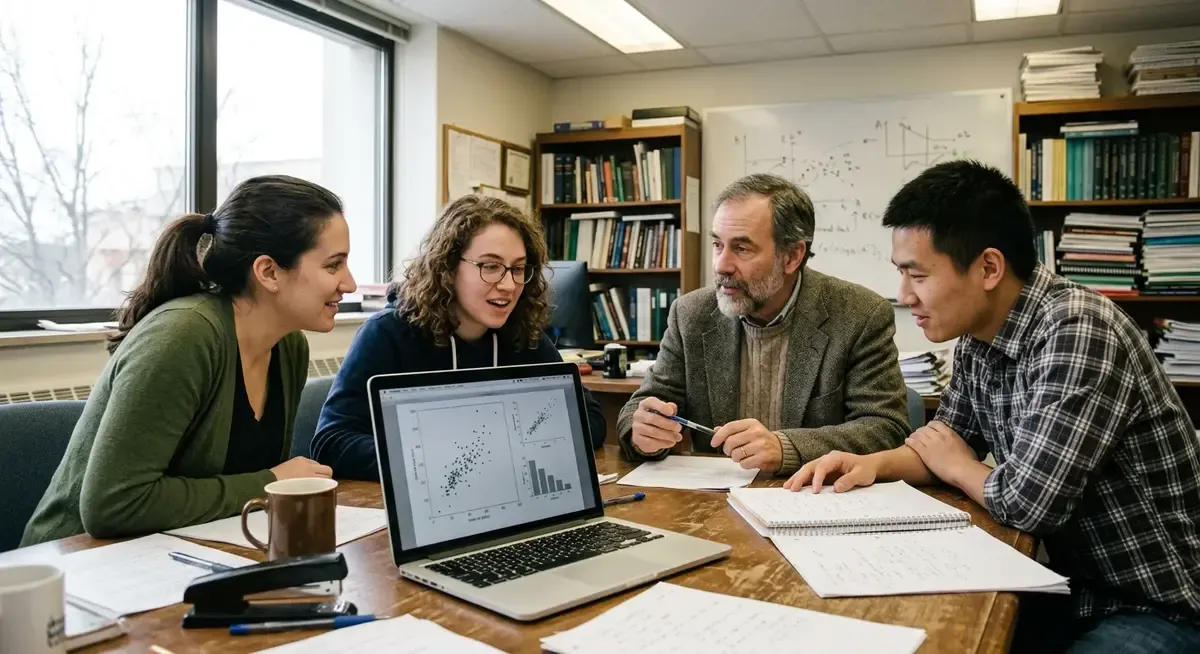
Editorial illustration for Perplexity, NVIDIA Researchers Introduce JOLT Joint Teacher-Student RL Method
Perplexity, NVIDIA Researchers Introduce JOLT Joint...
Researchers at Perplexity and NVIDIA built a reinforcement learning method that asks one model to grade its own homework, literally. The method is called JOLT, short for Joint On-policy Learning and Teaching, and it changes how language models get post-trained after their initial run through data.
The setup splits a single model into two roles. One version acts as a teacher with access to privileged information the student never sees. The other version is the student, learning from that feedback. What makes JOLT different from prior self-distillation approaches is that the teacher itself gets trained during the process, so its guidance doesn't go stale as the student improves.
The payoff shows up in compute. On the MATH benchmark, JOLT matched the accuracy of GRPO, a standard outcome-reward RL method, while processing 6.5 times fewer training tokens. For teams running RL post-training at scale, where GPU hours translate directly into budget, that kind of reduction is the whole pitch. The team tested the method across five models, from Qwen3-0.6B up to Qwen3-30B-A3B-Instruct and DeepSeek-V2-Lite, comparing results against GRPO, OPSD, and π-Distill.
On MATH, the research team fit accuracy curves against training-token budgets. At 63.44% accuracy, GRPO’s checkpoint used 8.40M processed training tokens. JOLT’s fitted curve needed 1.30M, a 6.5x reduction.
Why this matters
A 6.5x reduction in training tokens to match GRPO on MATH is the kind of number that should make any team running RL post-training stop and check their own pipelines. Compute is the budget line that actually constrains how often labs can iterate on reasoning models, and JOLT's bet, that a single model can hold both the privileged teacher and the blind student without the usual distillation decay, is a genuinely different lever than just scaling up rollouts. We'd want to see this replicated outside MATH before treating it as a general recipe; one benchmark and one paper from Perplexity and NVIDIA is a result, not a consensus.
The detail worth watching is the KL penalty keeping the teacher tethered to the student. That's the mechanism preventing the usual failure mode where the teacher's feedback drifts into something the student can't use. If that holds up on harder, messier tasks than MATH, this becomes a real alternative to GRPO rather than a one-off efficiency trick.
Worth tracking whether other labs reproduce the token savings on different domains.
Related Reading
 Research & Benchmarks
Microsoft AI Chief: "If It Isn't Safe We Shouldn't Build It
 Research & Benchmarks
Google's FACTS benchmark shows 70% factuality ceiling across four tests
 Research & Benchmarks
Nvidia's DLSS 4.5 beta adds 6x Multi Frame Generation for RTX 50 GPUs
 Related Topic
NVIDIA NeMo powers telco reasoning model for autonomous network workflows
Industry Applications
 Related Topic
China offers cheaper electricity to AI firms abandoning NVIDIA chips
Business & Startups
 From Archives
NVIDIA Cosmos Data Factory Blueprints Speed Physical World Model Training
 From Archives
Shopify Gains 4.5x Speed Boost With NVIDIA AI Software
 From Archives
Inception Mercury 3: 1,068 tokens/sec on Nvidia GPUs, quality on par or better
LLMs & Generative AI
 From Archives
Mistral and Nvidia Team Up to Speed Industrial Design With Physics AI
AI Tools & Apps
Further Reading
- A Good Self-Teacher Meets the Student Where They Are: Joint On-Policy Learning and Teaching - arXiv
- A good teacher meets the student where they are - Perplexity
- Perplexity and NVIDIA Researchers Introduce JOLT: a Joint Teacher-Student Reinforcement Learning Method - NVIDIA
- Perplexity Publishes JOLT for Efficient Joint Teacher-Student Model Training - HeadsUpAI
