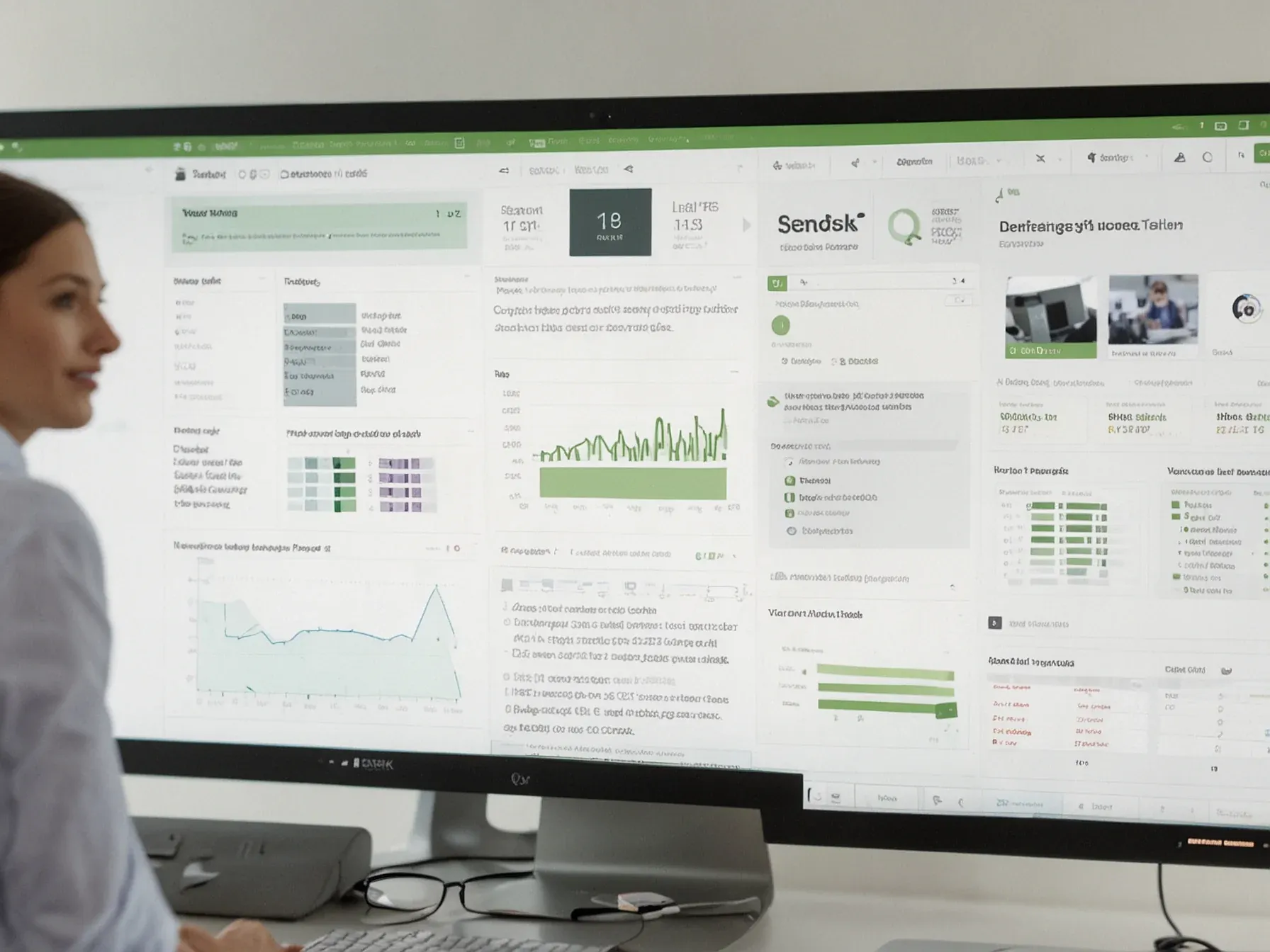
Editorial illustration for Zendesk Unveils GPT-5 and HyperArc for More Reliable AI Customer Support
Zendesk Unleashes GPT-5 for Next-Gen Customer Support AI
Zendesk rolls out GPT-5 and HyperArc for dependable, real-time AI agents
Zendesk announced two new products today. One is a boringly named but cleverly designed system for real-time AI monitoring. The other is a straightforward integration of OpenAI’s latest, most capable model. The company is betting that the combination will make its AI agents for customer service less prone to embarrassing, costly mistakes.
Most AI support tools are either fast or accurate. Rarely both. Zendesk wants to fix that with GPT-5 and HyperArc.
GPT-5 is OpenAI’s new reasoning model. HyperArc is Zendesk’s own system for watching AI conversations as they happen. The pitch is simple: let a powerful model handle complex customer requests, but have a second, separate system standing by to sound the alarm if the conversation goes off the rails.
This matters because customer service is a minefield. A single wrong answer can mean a lost customer, a viral complaint, or a regulatory headache. Automating it with unstable AI is a huge risk.
Zendesk’s solution is a form of automated quality assurance. It suggests the company has learned from the public failures of other AI chatbots. The goal isn’t a tireless digital employee. It’s a controllable tool.
Zendesk, recently named a Leader in the 2025 Gartner Magic Quadrant for the CRM Customer Engagement Center, started implementing AI agents about a year and a half ago.
The quote reveals the core trade-off. GPT-5 brings advanced reasoning and action-taking, like processing a return from start to finish. HyperArc is the safety net. It is an admission that even a 95% reliable model still fails one time in twenty, and those failures need to be caught instantly.
This two-part design is more interesting than a simple model upgrade. It treats AI as a process to be managed, not a silver bullet. The automated QA agent watching for tonal drift or factual errors is a specific, technical answer to a vague but serious problem: how do you stop an AI from going rogue?
It is a sensible approach. Its success depends entirely on how well the monitoring system works. If it’s too sensitive, it will alert human agents constantly, defeating the purpose. If it’s not sensitive enough, mistakes will slip through.
Zendesk is building a leash for its AI. That is probably the only way any company will trust it with their customers.
Related Reading
Browse all OpenAI news → LLMs & Generative AI
 ChatGPT's 'Nerdy' tweak rewards goblin metaphors in answers, study finds
 LLMs & Generative AI
 Google to End Free Access to Gemini AI for Non-Subscribers
 LLMs & Generative AI
 AI Engineers Face Rising Costs, Need New Strategies for Efficiency
 Related Topic
 OpenAI's GPT Transcribe Cuts Error Rate to 3.31%, Improving on GPT-4o
Open Source
 Related Topic
 OpenAI Developer: AI Agent "Swarms" Waste Tokens, Create "Coordination Tax
AI Tools & Apps
 From Archives
 Cognizant deploys Anthropic’s Claude to 350,000 staff, pushes enterprise AI
 From Archives
 Google’s Gemma model controversy highlights lifecycle risks, says Blackburn
 From Archives
 IndQA Targets India's Billion Non-English Users, 2nd-Largest ChatGPT Market
Research & Benchmarks
 From Archives
 Ghibli, Bandai Namco, Square Enix urge OpenAI halt AI; Sora opt-out breach law
Policy & Regulation
Common Questions Answered
How does Zendesk's QA agent improve AI customer support reliability?
Zendesk's QA agent continuously monitors AI conversations in real-time, flagging potential issues with tone or accuracy. If an exchange starts to drift off course, the system immediately alerts a human agent to intervene, ensuring a consistently high-quality customer support experience.
What makes GPT-5 and HyperArc different from other AI customer support tools?
Unlike other AI tools focused solely on speed, Zendesk's GPT-5 and HyperArc prioritize dependability and accountability in customer interactions. The system includes an automated monitoring mechanism that provides an additional layer of assurance, keeping customer conversations accurate and on-track.
What is Zendesk's primary goal with their new AI customer support technology?
Zendesk aims to create AI customer support tools that are not just fast, but fundamentally reliable and aligned with high customer service standards. By integrating real-time monitoring and human intervention capabilities, they're developing a more responsible approach to AI-driven customer interactions.
Further Reading
- Zendesk introduces major new AI capabilities in their Resolution Platform to empower customer service, employee service, and contact centre teams — ChannelBuzz
- Zendesk Unveils Powerful New AI Capabilities within the Resolution Platform to Accelerate Service at Scale — Zendesk Newsroom
- Zendesk Resolution Platform Adds AI Agents and HyperArc — The Letter Two
- Zendesk Unveils Major AI Push – Voice, Admin Co-Pilot, and HyperArc Take Center Stage — CX Today
- Zendesk says its new AI agent can solve 80% of support issues — TechCrunch
