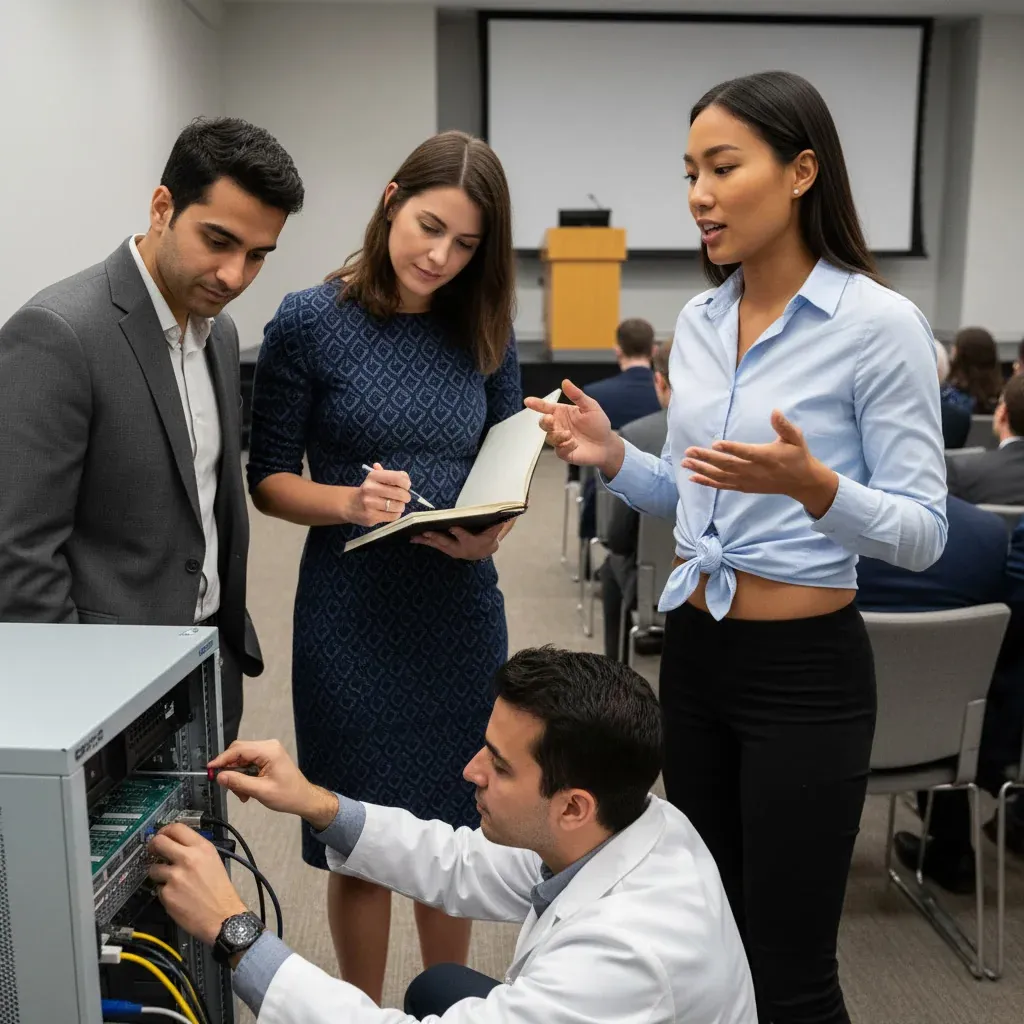
Editorial illustration for UC San Diego Lab Taps NVIDIA DGX B200 for Real-Time Language AI Research
UC San Diego Slashes AI Response Time with NVIDIA DGX B200
UC San Diego Lab Uses NVIDIA DGX B200 to Pursue Low-Latency LLM Serving
Latency is the ghost in the AI machine. Models churn out tokens at a furious pace, but the user experience is often one of waiting. At UC San Diego, researchers are trying to exorcise that ghost.
They are using a new NVIDIA DGX B200 system to attack a fundamental problem. The standard benchmark of tokens per second is a lie. It counts raw output but ignores the human staring at a blank screen.
The lab’s work, led by doctoral candidate Junda Chen, pivots to a different idea called "goodput." Goodput only counts the work a system does that actually meets a real-time latency target. It’s throughput with a stopwatch.
This shifts the entire goal of model serving. The aim is no longer to simply maximize output. It is to orchestrate it.
“DGX B200 is one of the most powerful AI systems from NVIDIA to date, which means that its performance is among the best in the world,” said Hao Zhang, assistant professor in the Halıcıoğlu Data Science Institute and department of computer science and engineering at UC San Diego. “It enables us to prototype and experiment much faster than using previous-generation hardware.”
The DGX B200 provides the physical testbed for this philosophy. Its capacity lets the team experiment with distributed, disaggregated architectures that can handle many requests without making any single one wait too long. This is the practical end of a theoretical shift.
Goodput changes the question. The field has obsessed over how much a system can produce. The real question is how much it can produce responsibly, within the tight window of human patience.
Chen's work suggests the next leap in AI utility won't come from a bigger model. It will come from a smarter, more punctual delivery system.
Related Reading
 LLMs & Generative AI
 ChatGPT's 'Nerdy' tweak rewards goblin metaphors in answers, study finds
 LLMs & Generative AI
 Google tests visual 'magazine-style' UI for Gemini 3 Pro users
 LLMs & Generative AI
 AI Engineers Face Rising Costs, Need New Strategies for Efficiency
 Related Topic
 NVIDIA and Google Cloud let developers scale AI from prototype to production
Market Trends
 Related Topic
 NVIDIA NeMo powers telco reasoning model for autonomous network workflows
Industry Applications
 From Archives
 JPMorgan AI use reaches 50% of staff, driven by connectivity-first architecture
 From Archives
 Gemini 3 Flash Offers Fast Multimodal Reasoning for Video, Data, Visual Q&A
 From Archives
 OpenUSD and NVIDIA Halos Enhance Robotaxi Safety with Synthetic Data, SimReady
Research & Benchmarks
 From Archives
 NVIDIA appoints CloudThat as first Indian education services partner
Business & Startups
Common Questions Answered
How is the NVIDIA DGX B200 helping UC San Diego's Hao AI Labs improve language AI response times?
The NVIDIA DGX B200's powerful hardware specifications are enabling researchers to explore new methods for reducing latency in large language model interactions. By leveraging the system's advanced capabilities, the Hao AI Labs team is working to create near-instantaneous AI responses that feel more like natural conversations.
What is the primary research goal of Junda Chen and the Hao AI Labs team?
The research team is focused on pushing large language models toward real-time responsiveness, specifically targeting the reduction of lag time between a user's query and an AI's answer. Their work aims to develop low-latency LLM serving techniques that can create more fluid and immediate AI interactions.
What approach are UC San Diego researchers using to improve AI interaction speeds?
The researchers are exploring disaggregated inference techniques to enhance large-scale LLM serving engines' performance. By utilizing the NVIDIA DGX B200's advanced specifications, they are investigating innovative methods to make AI responses more instantaneous and conversational.
Further Reading
- UC San Diego Lab Advances Generative AI With NVIDIA DGX B200 — NVIDIA Blog
- UC San Diego Leverages NVIDIA DGX B200 for Advanced AI Research — Blockchain.News
- UC San Diego Packs a Punch of AI Research Power with a Gift from NVIDIA — UC San Diego Today
- UC San Diego's AI Lab Gets NVIDIA's Most Powerful Chip — TechBuzz
- Overlooked 18 Months Ago, Now Dominating AI Inference with Disaggregated Serving — 36Kr Global
