
Editorial illustration for Google's Gemini 3 Flash Boosts AI Reasoning Across Video, Data, and Visual Tasks
Gemini 3 Flash: AI's Fastest Multimodal Reasoning Model
Gemini 3 Flash Offers Fast Multimodal Reasoning for Video, Data, Visual Q&A
Google's newest AI, Gemini 3 Flash, is built for one thing: to think fast without getting stupid.
It processes video, pulls data from visuals, and answers questions about what it sees. The point isn't raw speed for its own sake. It's about making decisions that used to require a human pause.
A developer could use it to build an in-game helper that watches a hand-launched ball and calls a play. Or to instantly A/B test different loading spinner designs, turning a sketch into working code in seconds. It can look at a photo, understand the contents, and suggest interactive buttons or overlays.
Give it one instruction, and it might spit out three completely different design mockups.
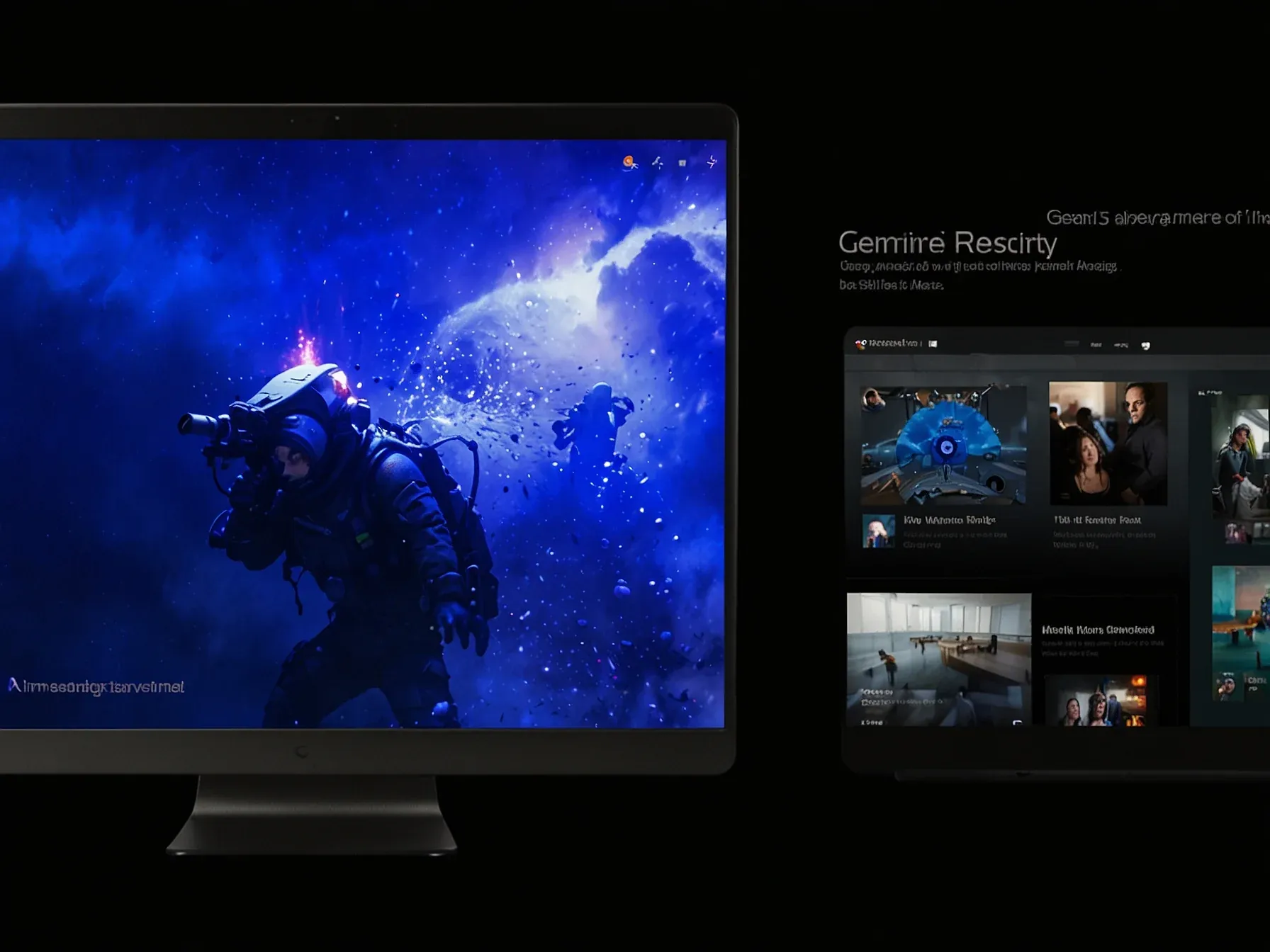
Gemini 3 Flash's strong performance in reasoning, tool use and multimodal capabilities is ideal for developers looking to do more complex video analysis, data extraction and visual Q&A, which means it can enable more intelligent applications -- like in-game assistants or A/B test experiments -- that demand both quick answers and deep reasoning. Gemini 3 Flash enables multimodal reasoning in a hand-tracked "ball launching puzzle game" game providing near real-time AI assistance. Gemini 3 Flash builds and A/B tests new loading spinner designs in near real-time, streamlining the design-to-code process.
Gemini 3 Flash uses multimodal reasoning to analyze and caption an image with contextual UI overlays in near real-time, ultimately transforming a static image into an interactive experience. Gemini 3 Flash takes a single instruction prompt and codes three unique design variations. We've received a tremendous response from companies using Gemini 3 Flash.
The promise here is collapsing an old compromise. You usually pick between a fast, simple model and a slow, smart one. Flash tries to be both.
If it works, it changes what's possible. The tedious middle steps of analysis and translation get compressed. A picture becomes a prototype.
A video becomes a live data stream. Early users seem to like it. The real test is what people build when the AI's reaction time stops being the thing they have to design around.
Related Reading
Browse all Google news → LLMs & Generative AI
 ChatGPT's 'Nerdy' tweak rewards goblin metaphors in answers, study finds
 LLMs & Generative AI
 Google tests visual 'magazine-style' UI for Gemini 3 Pro users
 LLMs & Generative AI
 AI Engineers Face Rising Costs, Need New Strategies for Efficiency
 Related Topic
 NVIDIA and Google Cloud let developers scale AI from prototype to production
Market Trends
 Related Topic
 Google's FACTS benchmark shows 70% factuality ceiling across four tests
Research & Benchmarks
 From Archives
 Gemini 3 Flash launches with faster responses, keeps Pro reasoning
 From Archives
 Google launches Gemini Deep Research agent via new Interactions API
 From Archives
 Google's AI assistant CC sends personalized 'Your Day Ahead' email briefing
AI Tools & Apps
 From Archives
 Google.org funds USD 8 M for AI Centres at IITs, IISc for health, governance, education
Business & Startups
Common Questions Answered
How does Gemini 3 Flash demonstrate its multimodal reasoning capabilities?
Gemini 3 Flash showcases its multimodal reasoning through a hand-tracked 'ball launching puzzle game' that provides near real-time AI assistance. The model can rapidly process and analyze different types of inputs including video, data, and visual tasks with exceptional speed and precision.
What makes Gemini 3 Flash unique for developers working on complex computational tasks?
Gemini 3 Flash offers developers a lightweight yet powerful AI solution that can quickly switch between different input types without compromising performance. Its strong reasoning, tool use, and multimodal capabilities enable the creation of more intelligent applications like in-game assistants and A/B test experiments.
What potential impact could Gemini 3 Flash have on intelligent application development?
Gemini 3 Flash could revolutionize intelligent application development by providing AI systems that can process multiple input types with near real-time reasoning. Its ability to handle video, data, and visual tasks quickly suggests a new frontier of contextually smart and responsive AI applications.
Further Reading
- Google launches Gemini 3 Flash, makes it the default model in the Gemini app — TechCrunch
- Google's Gemini 3 Flash makes a big splash with faster responsiveness and superior reasoning — SiliconANGLE
- Google announces Gemini 3 Flash, rolling out to Gemini app — 9to5Google
- Google's new Gemini 3 Flash is fast, cheap and everywhere — Axios
- Gemini 3 Flash is now available in Gemini CLI — Google Developers Blog
