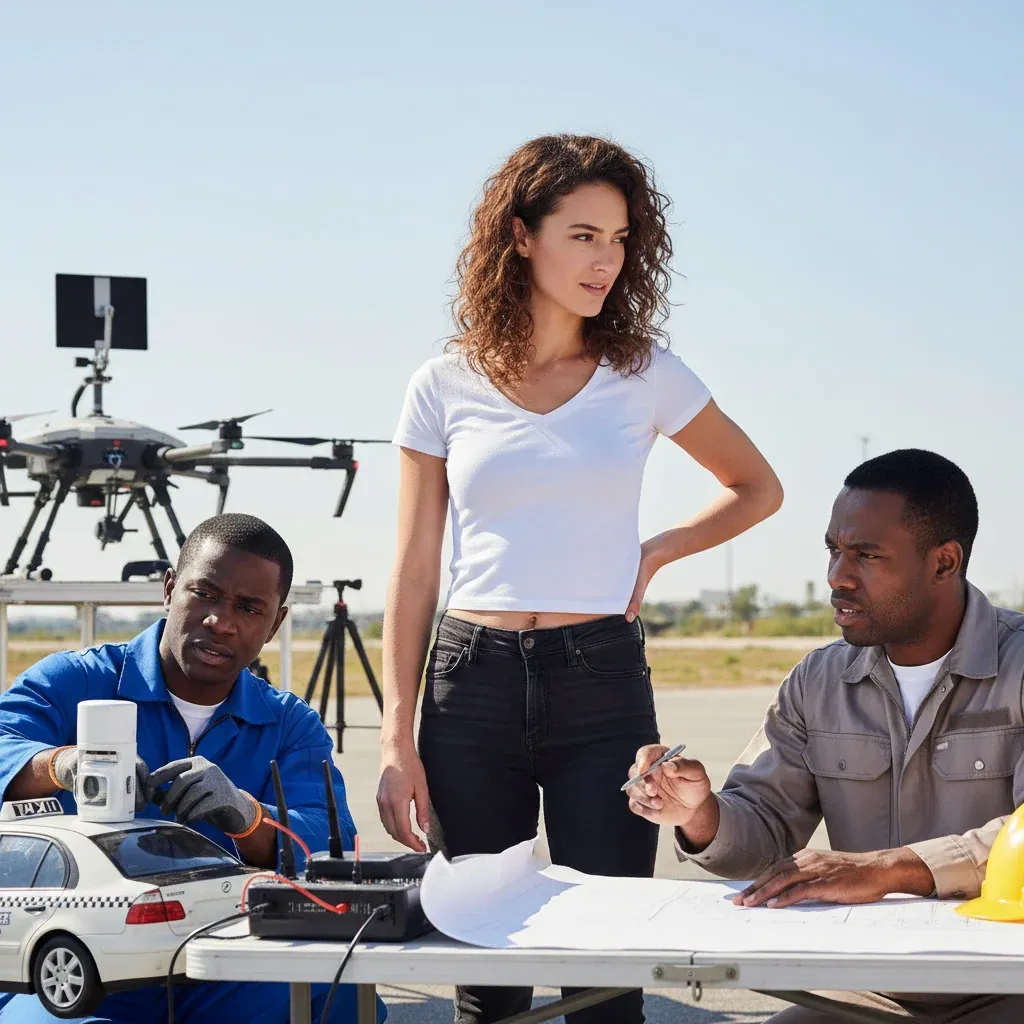
Editorial illustration for NVIDIA and OpenUSD Boost Robotaxi Safety Through Advanced Synthetic Data Techniques
OpenUSD and NVIDIA Boost Robotaxi Safety with AI Data
The road to safe, autonomous mobility has never been more data-hungry. Robotaxis must navigate infinite edge cases, icy crosswalks, jaywalking pedestrians, the chaotic dance of a busy intersection. Real-world testing alone is too slow, too dangerous, too expensive.
Now, two forces are converging to rewrite the rules: OpenUSD and the NVIDIA Halos safety framework. By fusing standards-based synthetic data with SimReady assets, assets built on the OpenUSD Core Specification 1.0, engineers can finally simulate the unimaginable at scale. This isn’t just incremental progress.
It’s the foundation for Physical AI that learns in simulation, validates in simulation, and deploys with a rigor that real miles alone can never guarantee. The result is a clear, cost-effective path to safer robotaxis, one built on interoperability, not lock-in.
NVIDIA researchers, with collaborators at Harvard University and Stanford University, recently introduced the Sim2Val framework to statistically combine real-world and simulated test results, reducing AV developers’ need for costly physical mileage while demonstrating how robotaxis and AVs can behave safely across rare and safety-critical scenarios.
The path forward is clear: standards like OpenUSD don’t just enable interoperability, they forge a common language for safety. When SimReady assets meet the Halos framework, synthetic data stops being a simulation and becomes a proving ground. Robotaxis don’t learn in the real world anymore; they rehearse there.
This convergence isn’t incremental. It’s a reframing of what’s possible, faster validation, lower costs, and a safety architecture that scales from pixel to pavement. Physical AI won’t wait for permission.
It demands a foundation built on precision, not guesswork. OpenUSD and NVIDIA Halos deliver exactly that.
Related Reading
 Research & Benchmarks
 Microsoft AI Chief: "If It Isn't Safe We Shouldn't Build It
 Research & Benchmarks
 Google's FACTS benchmark shows 70% factuality ceiling across four tests
 Research & Benchmarks
 Nvidia's DLSS 4.5 beta adds 6x Multi Frame Generation for RTX 50 GPUs
 Related Topic
 NVIDIA NeMo powers telco reasoning model for autonomous network workflows
Industry Applications
 Related Topic
 China offers cheaper electricity to AI firms abandoning NVIDIA chips
Business & Startups
 From Archives
 Audio Dataset Valuable for Listening Models, Tackles Noise, Accents, Timing
 From Archives
 Fastweb and Vodafone use LangGraph LLM Compiler to automate customer requests
 From Archives
 NVIDIA appoints CloudThat as first Indian education services partner
Business & Startups
 From Archives
 Nvidia's Nemotron 3 ranks among top downloadable models, benchmarks show
Open Source
Common Questions Answered
How does synthetic data generation improve robotaxi safety testing?
Synthetic data generation allows engineers to simulate complex driving scenarios without risking real vehicles or human drivers. By creating hyper-realistic virtual environments, autonomous vehicle developers can extensively test and validate system responses in a completely safe, controlled setting.
What role does the NVIDIA Halos framework play in autonomous vehicle development?
The NVIDIA Halos framework provides a standards-based approach to autonomous vehicle safety and deployment. It helps integrate synthetic data generation, multimodal datasets, and SimReady workflows to create more efficient and potentially more reliable robotaxi technologies.
How does the OpenUSD Core Specification 1.0 contribute to autonomous vehicle technology?
The OpenUSD Core Specification 1.0 establishes a standardized data framework for autonomous vehicle development. By creating open standards, it enables more consistent and collaborative approaches to simulating and testing autonomous systems across different platforms and technologies.
Further Reading
- OpenUSD and NVIDIA Halos Accelerate Safety for Robotaxis and Physical AI — NVIDIA Blogs
- NVIDIA's OpenUSD and Halos Frameworks Enhance Robotaxi and ... — Blockchain News
- Autonomous Vehicle (AV) Safety | NVIDIA Halos — NVIDIA
- NVIDIA Isaac, Omniverse, Halos Aid European Robotics — The Robot Report
