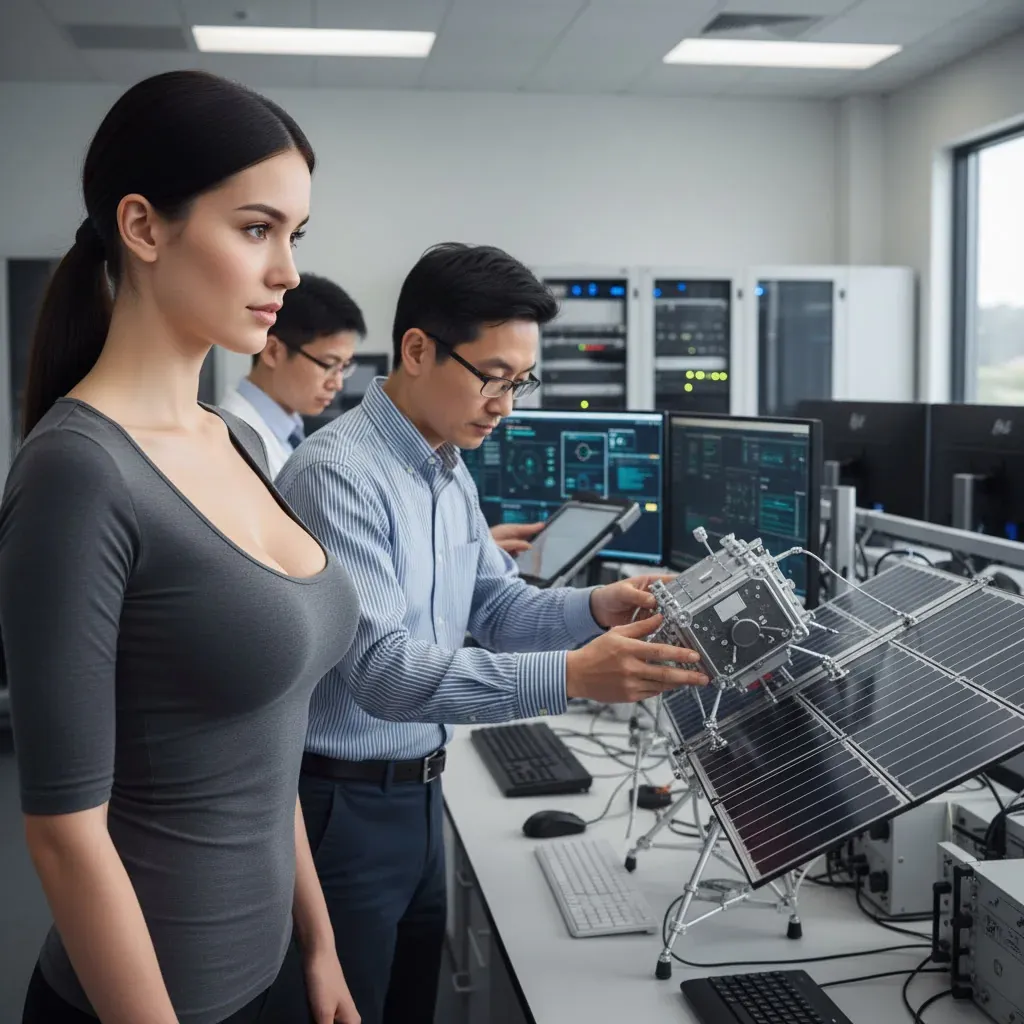
Editorial illustration for Starcloud Launches Space-Based AI Training Using NVIDIA H100 Chips
Space-Based AI Training Launches with NVIDIA H100 Chips
Starcloud Trains LLMs in Space with NVIDIA H100, Data-Center Energy Relief
The planet is running out of juice for its own digital dreams. According to the International Energy Agency, global data center electricity use is set to more than double by 2030. That’s a physical wall.
We’re hitting it. Into this crisis vaults Starcloud, a firm that didn’t even exist before 2024. Their audacious fix?
Launch the entire problem into orbit. The startup’s vision is a four-kilometer-square platform of solar panels in space, generating a constant 5 gigawatts where the sun never sets and heat simply radiates into the void. They have backing from Nvidia, Y Combinator, and Google for Startups.
Crucially, they’ve already executed a key proof-of-concept: successfully training large language models in space using a rack of Nvidia H100 GPUs. This is far beyond a pitch deck. It’s a working prototype.
Founded in 2024, Starcloud argues that orbital compute could ease mounting environmental pressures linked to traditional data centres, whose electricity consumption is expected to more than double by 2030, according to the International Energy Agency. Facilities on Earth also face water scarcity and rising emissions, while orbital platforms can harness uninterrupted solar energy and avoid cooling challenges. The startup, part of NVIDIA 's Inception program and an alumnus of Y Combinator and the Google for Startups Cloud AI Accelerator, plans to build a 5-gigawatt space-based data centre powered entirely by solar panels spanning four kilometres in width and height.
Starcloud’s space-trained model proves the physics. Now for the brutal economics. Rocket launches are wildly expensive.
In-orbit maintenance is a nightmare. Cosmic radiation constantly threatens delicate silicon. Yet the underlying logic is stark.
AI expansion is choked by two planetary limits: energy and cooling. In orbit, energy is infinite. Cooling is free.
A 5-gigawatt array like Starcloud’s draws not a single watt from Earth’s straining grids. It evaporates no drinking water. That’s the clean break.
Every new AI model today deepens our drain on scarce terrestrial resources. The company’s test shows it works. The next step is harder.
They must prove it matters. The true milestone won’t be another model trained in vacuum. It will be a real customer—one willing to pay the astronomical freight for a clean conscience and truly limitless power.
Related Reading
 LLMs & Generative AI
 ChatGPT's 'Nerdy' tweak rewards goblin metaphors in answers, study finds
 LLMs & Generative AI
 Google to End Free Access to Gemini AI for Non-Subscribers
 LLMs & Generative AI
 AI Engineers Face Rising Costs, Need New Strategies for Efficiency
 Related Topic
 NVIDIA and Google Cloud let developers scale AI from prototype to production
Market Trends
 Related Topic
 NVIDIA NeMo powers telco reasoning model for autonomous network workflows
Industry Applications
 From Archives
 Google leases 600,000 TPUs, Anthropic deal adds billions to revenue
 From Archives
 Jules updates enable proactive AI partner, used in Google's Stitch design pod
 From Archives
 Google Gemini's Deep Think tops ARC-AGI-2 benchmark; Nvidia announces new open
Open Source
 From Archives
 SoftBank's Son says he sold NVIDIA shares, cried, to fund OpenAI
Business & Startups
Common Questions Answered
How does Starcloud plan to use NVIDIA H100 chips in space for AI training?
Starcloud aims to deploy NVIDIA H100 chips in orbital environments to train large language models more sustainably. By leveraging uninterrupted solar energy and avoiding Earth-based cooling challenges, the startup seeks to create a more energy-efficient AI computational infrastructure.
What environmental challenges do traditional data centers face that Starcloud hopes to address?
Traditional data centers are projected to double their electricity consumption by 2030 and face significant water scarcity and emissions challenges. Starcloud's orbital compute strategy aims to mitigate these issues by utilizing space-based platforms with continuous solar energy and natural cooling advantages.
What makes Starcloud's approach to AI infrastructure unique in the tech industry?
Starcloud is pioneering a radical approach by proposing to train large language models directly in space, shifting computational infrastructure beyond Earth's boundaries. By using NVIDIA H100 chips in orbital environments, the startup offers a novel solution to the mounting environmental pressures faced by traditional data centers.
Further Reading
- Space Datacenter Startup Starcloud Successfully Trains First LLM In Space — OfficeChai
- nanoGPT Becomes First LLM Trained and Deployed in Space Using Nvidia H100: Breakthrough for AI and Satellite Computing — Blockchain.News
- How Starcloud Is Bringing Data Centers to Outer Space — NVIDIA Blog
- StarCloud Wants to Move the World's Data Centers to Space — AIM Media House
- A Nvidia H100 Is Orbiting Earth Right Now: Here's Why — Awaz Live
