
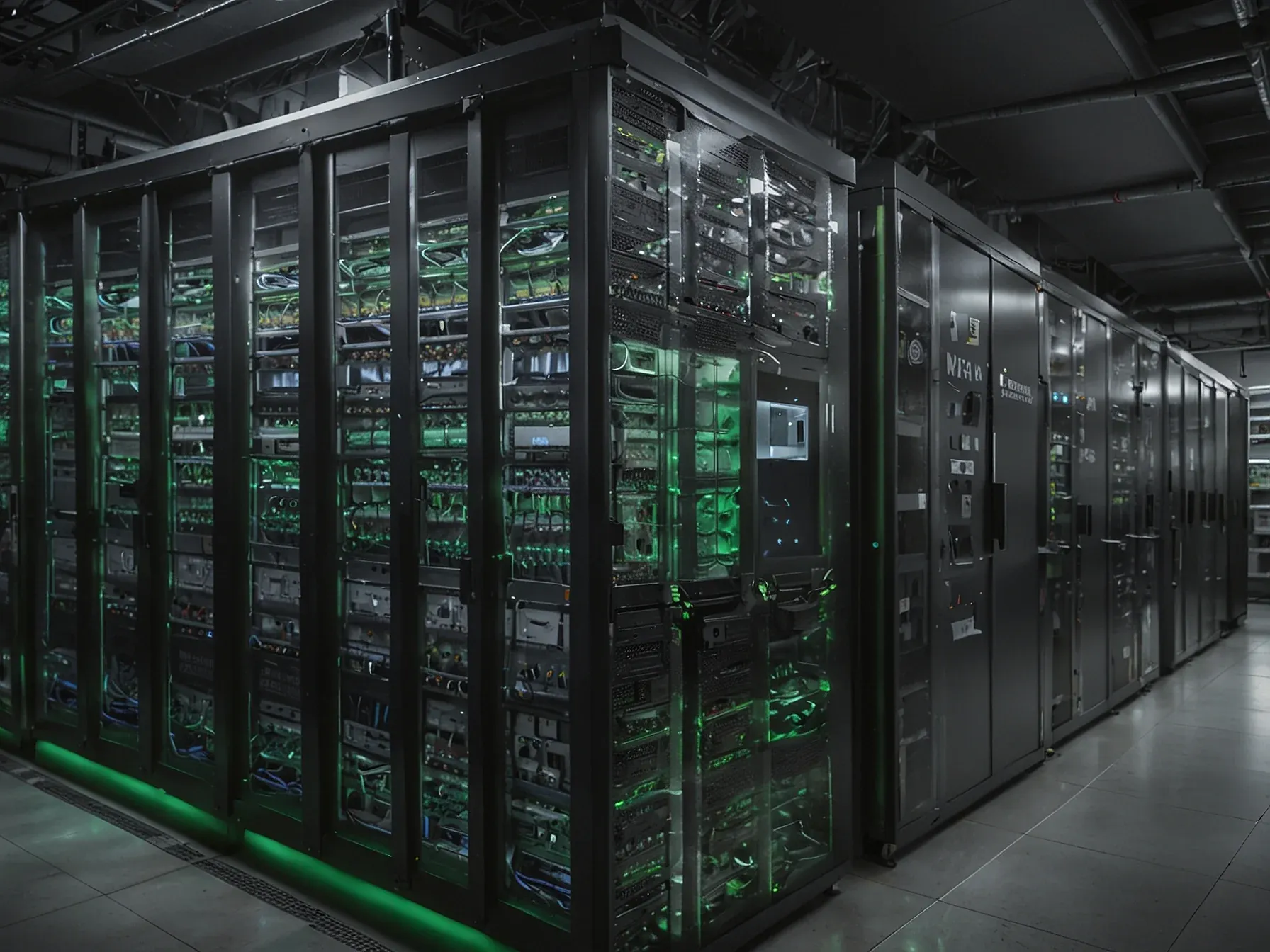
Editorial illustration for NVIDIA Cosmos Transfer Enables Scalable Synthetic Data for Physical AI
NVIDIA Cosmos: AI Synthetic Data Revolution
Teaching robots to navigate our world demands a torrent of visual data. Real footage is costly and scarce. So the industry relies on simulations, but their tell-tale artificiality is a problem—the AI models can spot it.
NVIDIA’s answer is Cosmos Transfer. Built on the company’s Omniverse platform, the tool takes a detailed 3D scene and generates endless permutations, toggling lighting, weather, and textures. Every output includes precise annotations, telling an algorithm exactly what it sees.
The objective is stark: forge a synthetic bridge so convincing that a model trained on it won’t falter in reality.
NVIDIA Cosmos addresses this challenge by accelerating world foundation model (WFM) development. At the core of its platform, Cosmos WFMs speed up synthetic data generation and act as a foundation for post-training, to develop downstream domain or task-specific physical AI models to solve these challenges. This post explores the latest Cosmos WFMs, their key capabilities that advance physical AI, and how to use them.
Now, Cosmos Transfer 2.5 is here. Its real test isn’t a benchmark score. It’s a warehouse robot successfully gripping a novel object under harsh, unfamiliar light.
It’s an autonomous car navigating a sudden downpour because its model trained on a million synthetic storms. The promise is a fundamental shift: stop painstakingly collecting real-world data and start systematically engineering it. The entire pipeline for physical AI is being remade, one generated scene at a time.
Related Reading
 Research & Benchmarks
 Microsoft AI Chief: "If It Isn't Safe We Shouldn't Build It
 Research & Benchmarks
 Google's FACTS benchmark shows 70% factuality ceiling across four tests
 Research & Benchmarks
 Nvidia's DLSS 4.5 beta adds 6x Multi Frame Generation for RTX 50 GPUs
 Related Topic
 NVIDIA NeMo powers telco reasoning model for autonomous network workflows
Industry Applications
 Related Topic
 China offers cheaper electricity to AI firms abandoning NVIDIA chips
Business & Startups
 From Archives
 Trump Administration Signals Possible Additional Sanctions on Anthropic at Hearing
 From Archives
 YouTube extends AI deepfake detection to politicians, journalists
 From Archives
 NVIDIA Warp Enables Reverse‑Mode AD for Production‑Scale Gradient Optimization
LLMs & Generative AI
 From Archives
 Nvidia's Nemotron 3 Super merges 3‑arch design, MTP to outpace GPT‑OSS, Qwen
Open Source
Common Questions Answered
How does NVIDIA Omniverse enable synthetic data generation for physical AI?
NVIDIA Omniverse uses generative AI APIs and SDKs built on the OpenUSD standard to create detailed 3D environments that simulate real-world physics, lighting, and sensor conditions. These synthetic scenes provide a comprehensive training sandbox for robots and autonomous systems, allowing developers to generate ground truth data without the high costs of physical trials.
What is Cosmos Transfer and how does it improve synthetic data creation?
Cosmos Transfer is an NVIDIA technology that enhances synthetic data generation by combining 3D scene simulations with annotations and text instructions. The technology aims to improve photorealism and create more accurate training data for physical AI applications, potentially addressing the challenges of collecting real-world datasets for robotics and autonomous vehicles.
What advantages does OpenUSD offer in creating synthetic training environments?
OpenUSD (Universal Scene Description) provides a standardized framework for creating complex 3D environments with precise physical interactions and realistic sensory details. This standard allows developers to generate consistent and controllable synthetic scenes that can accurately mimic real-world conditions for AI training purposes.
Further Reading
- Scale Synthetic Data and Physical AI Reasoning with NVIDIA Cosmos World Foundation Models — NVIDIA Developer Blog
- NVIDIA Announces Major Release of Cosmos World Foundation Models and Physical AI Data Tools — NVIDIA Newsroom
- NVIDIA’s Physical AI Stack at CES 2026: Cosmos, GR00T, and the Full Path to Robotics — Programming Helper
- NVIDIA Unveils New Open Models, Data and Tools to Advance AI Across Every Industry — Edge AI and Vision Alliance
