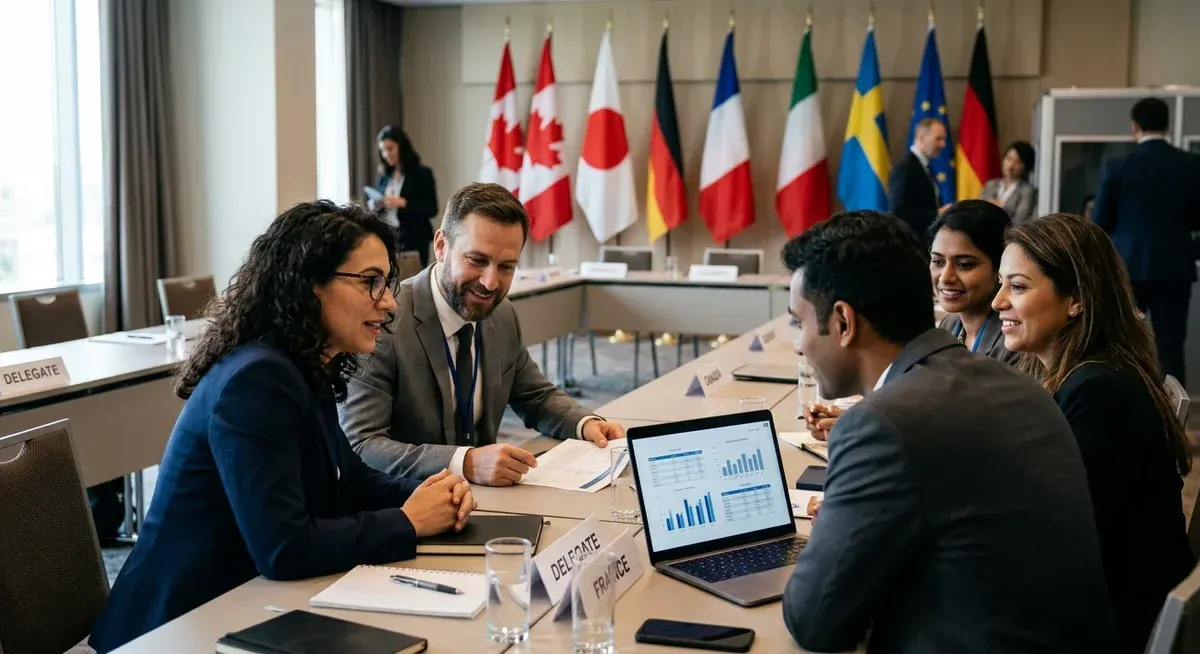
Editorial illustration for Sam Altman outlines three possible endings for the AI safety race
Altman Reveals Three Possible Endings for AI Safety Race
Sam Altman spent part of last week walking OpenAI staff through what happens after the current phase of AI safety ends. According to a report from The Information, the talk covered what Altman called "pacing 1.0": the existing approach of testing models, shipping them, and flagging problems as they surface. That system has a shelf life, and Altman reportedly told employees OpenAI has about a year to figure out what replaces it.
The replacement, in Altman's telling, comes down to three scenarios. One involves a global watchdog modeled on nuclear regulators, an idea OpenAI has pushed publicly since 2023. Another folds the top AI labs into a single merged entity, a plan reportedly nicknamed after DeepMind co-founder Demis Hassabis. The third is blunter: one lab pulls ahead of everyone else and simply out-competes them on compute, an outcome Altman described in stark terms.
Which path OpenAI picks, or gets pushed toward, matters well beyond its own offices. Here's how Altman framed the stakes to his own staff.
Altman reportedly gave staff three possible outcomes: a global watchdog, a single super-lab merger, or one lab racing ahead to “melt everyone else’s GPUs,” an outcome he called “terrible.” OpenAI now has a year to choose its own path.
Why this matters
Altman laying out three endings, a watchdog, a merger, or one lab melting everyone else's GPUs, is less a roadmap than an admission that OpenAI doesn't control which future it gets. For builders, that uncertainty is the real headline. If "pacing 1.0" is just ship-and-flag until something forces a change, the rules governing model releases could look completely different in twelve months, and not because of careful policy design.
A merger scenario means fewer labs setting standards; a watchdog means regulation you'll need to plan around now, not later; the race-ahead outcome means whatever safety norms exist today get steamrolled by whoever moves fastest. None of these are hypothetical governance exercises, they're business conditions. Founders building on top of frontier models should treat this as a signal to diversify dependencies rather than bet on one lab's current safety posture staying stable.
Researchers should note that Altman himself is framing the "terrible" outcome as plausible, not just a thought experiment. The next thing to watch: who else at OpenAI, or at competing labs, starts talking about this timeline in public rather than in leaked staff memos.
Related Reading
 Policy & Regulation
Akamai Proposes SAFE Cybersecurity Guidelines for AI Threats
 Policy & Regulation
After ditching AI fitness apps and a Fitbit, I return to Peloton classes
 Policy & Regulation
Sony Music, Warner Chappell Sue Anthropic Over "Blatant Theft
 From Archives
1Password lets AI agents use your passwords without seeing them
 From Archives
Anthropic pitches AI safety bill to block models if 50+ could be killed
Common Questions Answered
What is 'pacing 1.0' according to Sam Altman's talk to OpenAI staff?
Pacing 1.0 is OpenAI's current approach to AI safety that involves testing models, shipping them to users, and flagging problems as they surface during real-world use. According to Altman, this system has a limited shelf life, and OpenAI has approximately one year to develop a replacement strategy before this approach becomes obsolete.
What are the three possible endings for the AI safety race that Altman outlined?
Altman described three scenarios: the establishment of a global watchdog to oversee AI development, a merger between multiple AI labs into a single super-lab, or one lab racing ahead and gaining such dominance that it could 'melt everyone else's GPUs.' Altman characterized the third scenario as a 'terrible' outcome that would represent an extreme concentration of AI power.
Why does Altman believe OpenAI has only about a year to choose its path forward?
Altman indicated that the current 'pacing 1.0' model of testing, shipping, and flagging problems has a limited operational window before it becomes insufficient for managing AI safety risks. The timeline suggests that external pressures or technological developments will force a transition to a new regulatory or structural framework within approximately twelve months.
What does the article suggest about OpenAI's control over its future in AI safety?
The article argues that by laying out these three endings, Altman is essentially admitting that OpenAI does not fully control which future scenario will actually occur. Rather than careful policy design determining the outcome, the rules governing model releases could change dramatically in twelve months due to external forces and circumstances beyond OpenAI's control.
Further Reading
- Papers with Code - Latest NLP Research - Papers with Code
- Hugging Face Daily Papers - Hugging Face
- ArXiv CS.CL (Computation and Language) - ArXiv
