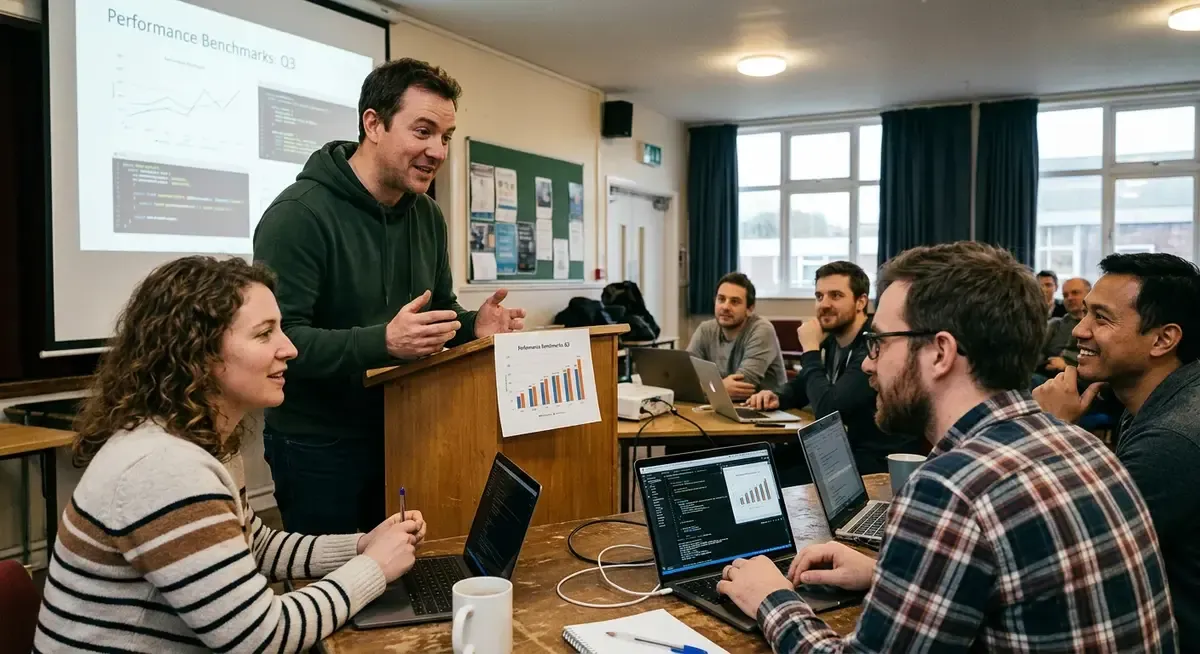
Editorial illustration for SpaceXAI's Grok 4.7 Shows Major Benchmark Gains at Same Price
Grok 4.7 Boosts Performance, Keeps Same Pricing
SpaceXAI's Grok 4.7 Shows Major Benchmark Gains at Same Price
SpaceXAI put out Grok 4.7 this week, and the pitch is unusual for an AI launch: same price, bigger model. Developers pay the same $2 per million input tokens and $6 per million output tokens they paid for Grok 4.6, but the company says they're now getting a larger base model trained through a longer reinforcement learning run weighted toward tasks that take hours to finish, not seconds.
The model is live now, not a preview. Anyone can call grok-4.7 through the xAI API today, and it's already wired into Cursor, Grok Build, OpenRouter, Vercel, and Cloudflare. SpaceXAI frames it as the new default for coding, agentic work, and knowledge tasks, built on top of a fresh base model rather than a fine-tune of 4.6.
Four changes separate it from the last version: the new base model itself, the longer and harder RL run, upgraded self-verification and long-context handling, and native support for the Grok Bot harness used in conversational and knowledge work. SpaceXAI backed the release with a benchmark table stacking Grok 4.7 against Grok 4.6, GPT-5.6 Sol Max, and Fable 5.1 Max, with one result standing out immediately.
SpaceXAI has released Grok 4.7, its new flagship model for coding, agentic tasks, and knowledge work. Grok 4.7 is built on a larger base model and a longer reinforcement learning run. It still ships at the same price and speed as Grok 4.6.
Why this matters
For teams building on Grok, this is the rare upgrade that doesn't force a budget conversation. Same $2/$6 pricing, same speed, but a jump on Terminal-Bench from 20.3% to 38.0% is the kind of number that actually changes what you'd trust the model to do unsupervised in a terminal. That's the benchmark that matters most for agentic coding tools like Cursor and Grok Build, where xAI already has distribution locked in.
The EEBench lead at 64.0% and the Harvey legal benchmark gap (19.6% versus Fable 5.1 Max's 6.7%) suggest xAI is chasing specific verticals, not just general chat quality. Worth noting the summary admits Grok 4.7 "does not lead across" every category, so this isn't a clean sweep against competitors, just a real step up from its own predecessor at no extra cost. For founders weighing model providers, the calculus shifts a little: if xAI keeps shipping free-tier gains like this, switching costs for staying put just went down.
Watch whether OpenRouter and Vercel usage data show developers actually migrating workloads, or if this stays a Grok-loyalist upgrade.
Related Reading
 Open Source
 D&B rebuilds 642 million‑business database after AI agents hit limits
 Open Source
 Box CEO Aaron Levie Says AI Will Drive "Biggest Cybersecurity Upgrade
 Open Source
 Study: 6.7% of Deepfake Requests on Hugging Face Targeted Children
 Related Topic
 Musk merges xAI with SpaceX, forming USD 1.25 trillion private giant
Business & Startups
 Related Topic
 X users can no longer tag @grok for image edits; feature not paywalled
Policy & Regulation
 From Archives
 AWS Agent Harness Cuts Token Costs 28% Without Accuracy Loss
 From Archives
 OpenAI Reveals Three-Part Process for Handling AI Model Reports
 From Archives
 xAI's Grok 4.7 priced at USD 2 per million tokens, lags rivals in benchmarks
Business & Startups
 From Archives
 SpaceXAI's Grok Voice Transcribe 2.0 Claims Double Accuracy at USD 0.10 per Hour
Research & Benchmarks
Common Questions Answered
What are the pricing changes for Grok 4.7 compared to Grok 4.6?
Grok 4.7 maintains the same pricing structure as Grok 4.6 at $2 per million input tokens and $6 per million output tokens. Despite the identical pricing, SpaceXAI has delivered a larger base model trained through an extended reinforcement learning process, making this an upgrade that doesn't require budget adjustments for existing users.
How does Grok 4.7's Terminal-Bench performance compare to previous versions?
Grok 4.7 achieved a significant jump in Terminal-Bench performance, improving from 20.3% to 38.0%. This substantial benchmark improvement is particularly meaningful for agentic coding tools like Cursor and Grok Build, where reliable unsupervised terminal execution is critical for practical applications.
What training improvements were made to Grok 4.7's base model?
Grok 4.7 is built on a larger base model and underwent a longer reinforcement learning training run specifically weighted toward complex tasks that take hours to complete rather than seconds. This extended training approach enables better performance on demanding coding, agentic tasks, and knowledge work applications.
Is Grok 4.7 available now or still in preview?
Grok 4.7 is live and available immediately, not in preview status. Developers can access the model through the xAI API by calling grok-4.7 today without waiting for a broader rollout.
What are the key use cases where Grok 4.7 excels according to the article?
Grok 4.7 is positioned as a flagship model for coding, agentic tasks, and knowledge work. The benchmark improvements, particularly in Terminal-Bench and legal benchmarks like Harvey, demonstrate its strength in scenarios requiring complex reasoning and autonomous task execution.
Further Reading
- Grok 4.7 improves agent benchmarks, but task costs complicate the pitch - OpenTools
- Grok 4.7 — xAI's most capable model for coding… - AI/TLDR
- SpaceXAI releases Grok 4.7 for coding and knowledge work - TestingCatalog
- SpaceXAI ships Grok 4.7 at Grok 4.6 prices for longer agent work - Runtime Wire
- Grok 4.7 Brings Big Coding Upgrades to Challenge Claude AI at Unchanged Pricing - Android Headlines
