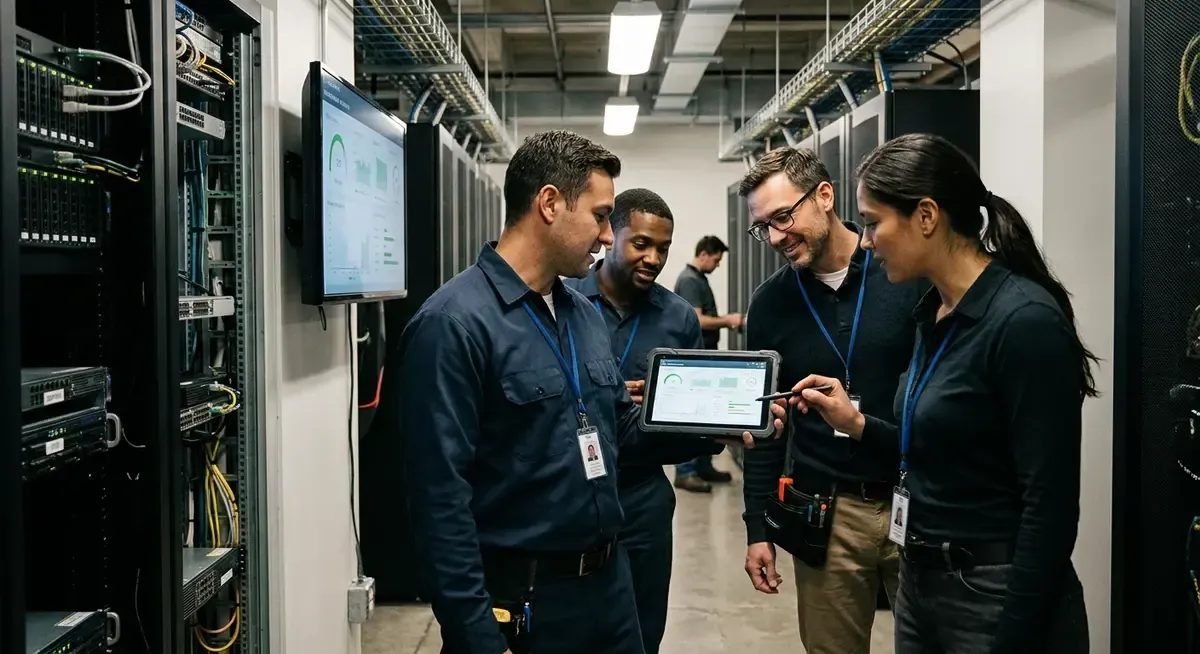
Editorial illustration for Startups Simulate Scale for Robots Through AI, Says Nvidia's Karpas
AI Helps Startups Scale Robot Training, Nvidia Says
Startups Simulate Scale for Robots Through AI, Says Nvidia's Karpas
Nvidia has spent the past few years telling anyone who'll listen that robots are the next big platform shift. Jensen Huang has said it from keynote stages repeatedly. But unlike large language models, which went from research curiosity to household habit the moment ChatGPT launched in November 2022, physical AI hasn't had its breakthrough. Robots have been built, funded, and demoed for decades without the kind of overnight adoption that reshaped how people work and search for information.
Les Karpas, Global Head of Physical AI at Nvidia Inception, is set to address that gap directly at TechCrunch Disrupt 2026. His session, titled "Robots Are Waiting for Their ChatGPT Moment. Here Is What Is Standing in the Way," lands on the Real World AI Stage at San Francisco's Moscone West, running October 13-15.
Karpas will lay out what's actually blocking general-purpose robots from scaling the way chatbots did, and what founders working in the space need to understand before betting on a similar inflection point. Tickets are discounted up to $200 through September 25, with group rates available for teams attending together.
Why this matters
Karpas is describing a workaround, not a breakthrough. Robotics never got a ChatGPT moment because you can't scrape a billion physical interactions the way you scraped the internet for text, so Nvidia and a wave of startups are trying to fake that scale with simulation and synthetic data instead. That's a reasonable bet, but it's still a bet on whether digital training transfers cleanly to physical bodies with joints, friction, and gravity that don't behave like tokens.
For founders building in this space, the real question isn't whether foundation models trained across many robot forms sound impressive on stage, it's whether they hold up outside curated demos. For researchers, the sim-to-real gap has been the graveyard of robotics promises for over a decade, and betting the field's breakthrough moment on solving it now deserves scrutiny, not applause. Nvidia has obvious incentive to hype this narrative since it sells the compute simulation runs on.
Watch what Karpas actually shows at Disrupt, not just what he claims.
Related Reading
 LLMs & Generative AI
 ChatGPT's 'Nerdy' tweak rewards goblin metaphors in answers, study finds
 LLMs & Generative AI
 Google tests visual 'magazine-style' UI for Gemini 3 Pro users
 LLMs & Generative AI
 AI Engineers Face Rising Costs, Need New Strategies for Efficiency
 Related Topic
 NVIDIA and Google Cloud let developers scale AI from prototype to production
Market Trends
 Related Topic
 NVIDIA NeMo powers telco reasoning model for autonomous network workflows
Industry Applications
 From Archives
 Google Home devices can now be controlled by AI agents
 From Archives
 Nunchux AI Debuts VC-Attention, a Training-Free Kernel for Faster Video DiTs
 From Archives
 Apple Reportedly Building AI Servers With M8 Ultra Chips, Nvidia NVLink
Open Source
 From Archives
 NVIDIA's Vera Rubin NVL72 Leads MLPerf Inference Debut
Research & Benchmarks
Common Questions Answered
Why haven't general-purpose robots achieved a breakthrough moment like ChatGPT did for language models?
According to Nvidia's Les Karpas, the core limitation is that there is no internet-wide dataset for physical AI comparable to what OpenAI and Anthropic had for training large language models. Unlike text data that can be scraped from the internet at scale, physical robot interactions cannot be collected in the same way, making it difficult for robots to achieve rapid adoption and capability improvements.
How are Nvidia and startups attempting to overcome the lack of physical AI training data?
Nvidia and a wave of startups are using simulation and synthetic data to artificially create the scale of training data that physical robots need. This approach aims to generate billions of virtual physical interactions that can be used to train robot models, though it remains uncertain whether digital training will transfer effectively to real physical bodies with joints, friction, and gravity.
What is the key difference between the adoption trajectory of large language models versus physical robots?
Large language models like ChatGPT experienced rapid mainstream adoption after their launch in November 2022, transitioning from research curiosity to household habit almost overnight. In contrast, robots have been built, funded, and demonstrated for decades without achieving similar breakthrough adoption, despite Nvidia's repeated assertions that robots represent the next major platform shift.
What challenge does synthetic data training present for physical robot development?
While simulation and synthetic data generation is a reasonable approach to scaling robot training, it remains uncertain whether digital training will transfer cleanly to physical bodies that must contend with real-world physics like joints, friction, and gravity that behave differently than digital tokens. This represents a fundamental bet on whether virtual training environments can adequately prepare robots for real-world deployment.
Further Reading
- Nvidia's Les Karpas joins the agenda lineup at Disrupt 2026 - TechCrunch
- TechCrunch Disrupt 2026's new Real World AI Stage features Nvidia, robots and extinct animals - TechCrunch
- NVIDIA Accelerates Robotics Research and Development With New Open Models and Simulation Libraries - NVIDIA News
- From Simulation to Production: How to Build Robots With AI - NVIDIA Blog
- NVIDIA Advances Physical AI With Accelerated Robotics Research on AWS - NVIDIA Blog
