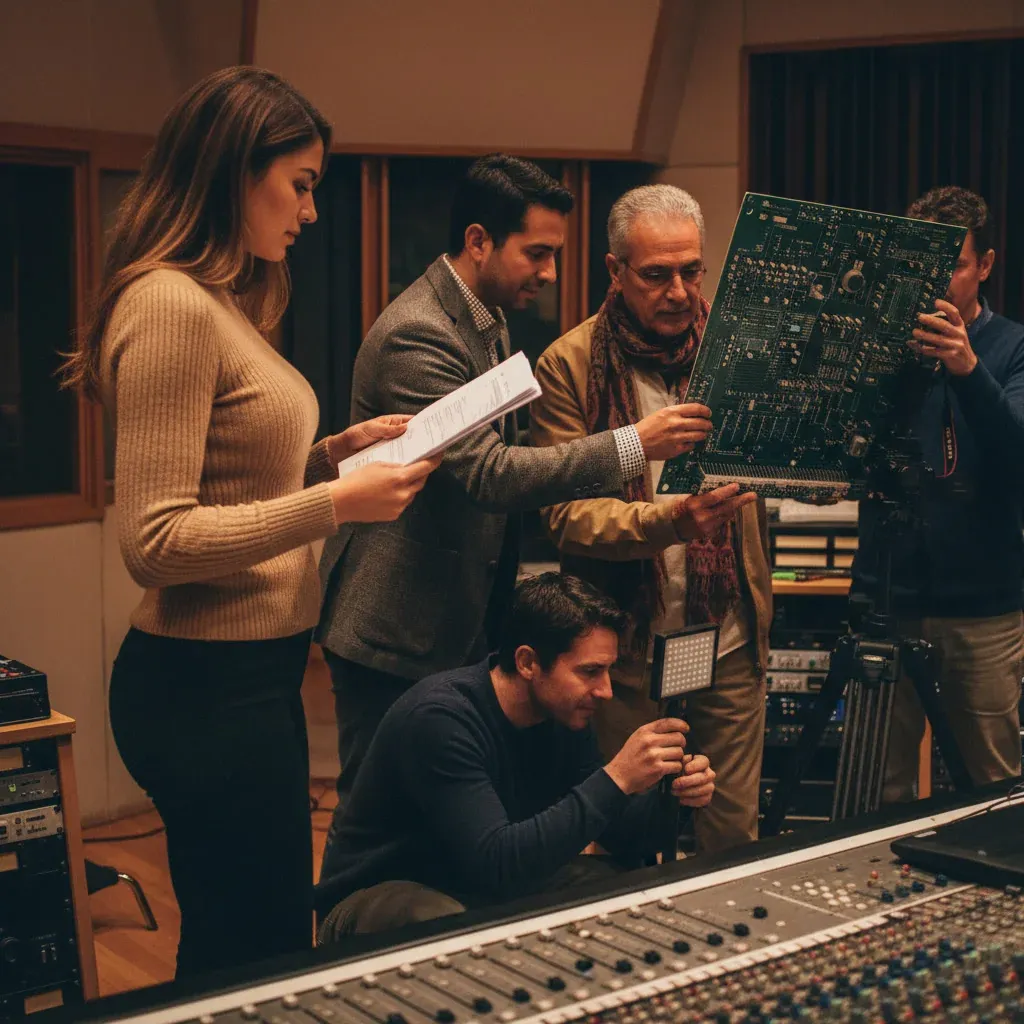
Editorial illustration for AI Breakthrough: Quilter Designs 843-Part Linux Board That Boots First Time
Linux Board Design Triumph: Quilter's 843-Part Success Story
Quilter's AI designs 843-part Linux board that boots on first try, defying 10% success norm
The hardware industry has long accepted a grim statistic: roughly nine out of ten first-pass board designs fail. That 10% success rate is baked into timelines, budgets, and resigned sighs. But Quilter’s AI just shattered that expectation.
In a challenge dubbed Project Speedrun, the system engineered an 843-component Linux computer that booted on the very first try, no respins, no costly do-overs. The board, built around NXP’s i.MX 8M Mini platform, didn’t just blink to life; it ran applications, browsed the web, and proved that machine-driven design can outperform human trial-and-error at a scale previously reserved for experienced engineering teams. Hardware will never be the same.
Quilter's AI completed the layout with approximately 98 percent routing coverage and zero design rule violations. Both boards passed power-on testing and successfully booted Debian Linux on the first attempt.
The 10% norm has been shattered. Not by a better engineer, a bigger team, or a longer timeline, but by an algorithm that treats complexity as a solvable problem, not a risk to be managed. Project Speedrun didn’t just prove the AI could route 843 components; it proved that the old rules of hardware iteration are voluntary.
When a machine can design a board that boots Linux on the first pass, the entire economics of hardware development shift. The cost of a respin becomes an artifact of the past. The weeks of debugging turn into hours of verification.
This isn’t a faster way to do the same thing. It’s a different kind of creation, one where the first draft can be the final product. Hardware will never be the same.
And that’s not hype. It’s a new baseline.
Related Reading
 Business & Startups
 Nordic pilot adds Gemini for Education, NotebookLM to boost AI literacy
 Business & Startups
 Kling launches Video O1, all-in-one model with MVL bridge using transformer
 Business & Startups
 DeepSeek Seeks More Capital Weeks After USD 7B Funding Round
 From Archives
 Virtusa Acquires SmartSoC, Adds Semiconductor Chip Design to Cloud Services
 From Archives
 Amazon to invest USD 35 B in India by 2030, add 1 M jobs, digitise 1.2 cr small firms
Common Questions Answered
How did Quilter's AI challenge traditional computer board design expectations?
Quilter's AI successfully designed an 843-component computer board that booted on the first try, dramatically defying the industry standard where only 10% of first board revisions work correctly. This breakthrough demonstrates AI's potential to revolutionize hardware design by reducing costly and time-consuming design iterations.
What specific capabilities does the Quilter Project Speedrun computer system possess?
The Project Speedrun system consists of two boards based on NXP's i.MX 8 processor and can boot Linux, browse the internet, and run applications. This complex computer system represents a significant technical achievement in AI-driven hardware design.
Why is the 10% first-revision success rate significant in computer board engineering?
The typical 10% first-revision success rate means that most computer board designs require multiple expensive and time-consuming iterations before functioning correctly. Quilter's AI breakthrough challenges this long-standing engineering assumption by creating a fully functional 843-part board on its first attempt.
Further Reading
- Quilter’s 843‑Part Linux Board: How AI Routed a Production‑Ready Design That Booted First Try — Skywork.ai
- Quilter Raises $25M Series B to Build Physics‑Driven AI for Electronics Design — Quilter AI
- A Review of the Most Efficient PCB Layout Software in 2025 – How Quilter Stacks Up — Quilter AI
- Automating Circuit Board Design With Help from AI | Quilter AI — YouTube
- FPGA to AI: Ben on Curiosity, Integrity, and Building Better Boards — Quilter AI
