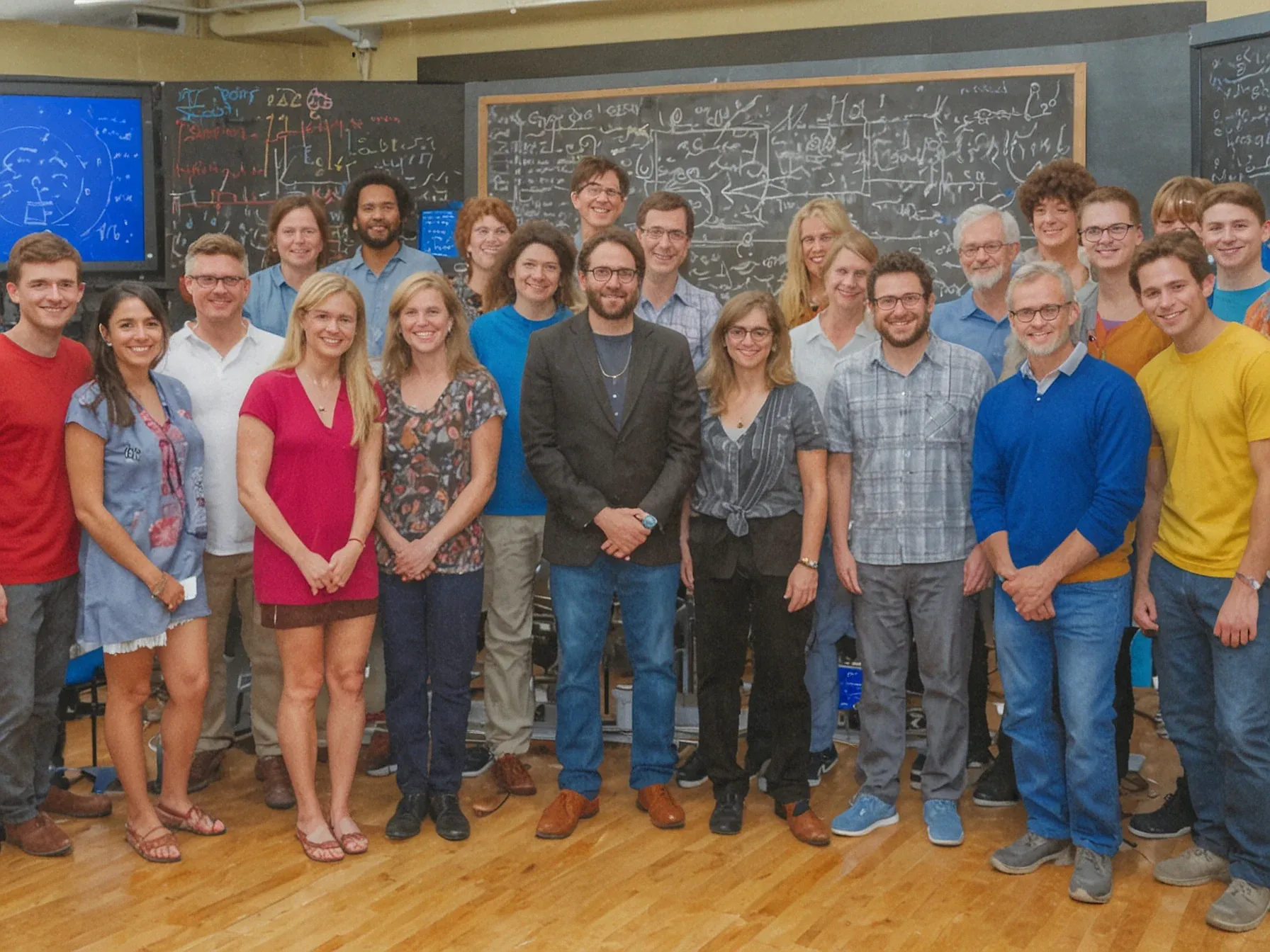
Editorial illustration for OpenAI Launches New Team to Accelerate Scientific Breakthroughs in Physics and Math
OpenAI Launches AI Team to Revolutionize Physics Research
OpenAI forms ‘OpenAI for Science’ team to speed physics, math discoveries
OpenAI is building a lab to do its homework. Announcing a new "OpenAI for Science" team led by former Instagram product VP Kevin Weil, the company has one directive: apply AI models to physics and math. This isn't about drafting emails. They want the software to rediscover laws of nature.
Scientific research moves at a glacial pace. Decades pass; dead ends multiply. OpenAI's pitch is pure computational brute force. Point a supercharged language model at a dense problem and see if it finds a path everyone else missed.
It sounds like marketing. But they have a recruit in black hole researcher Alex Lupsasca.
OpenAI is expanding its research efforts with a new program called OpenAI for Science, created to develop AI systems that can support scientific reasoning and speed up discoveries in physics and mathematics. The initiative is led by Kevin Weil, who has taken on the role of VP of AI for Science and posted about the program about a month ago. Now one of the first outside scientists to join the team is black hole researcher Alex Lupsasca, who will continue to hold his professorship at Vanderbilt University.
In an X thread, Lupsasca shared that his decision to join OpenAI was influenced by recent advances in the company’s technology. While he had previously considered AI to be far from capable of matching human researchers, his view changed after working with GPT-5 Pro. In his paper "Why there is no Love in black holes", which describes new conformal symmetries in Kerr perturbations, Lupsasca found that GPT-5 Pro was able to rediscover the central symmetry in about half an hour after minimal setup.
Alex Lupsasca’s experience is the entire argument. A theoretical physicist, skeptical of AI's utility, gave a model a crack at his own work. It found a key symmetry in thirty minutes.
That’s a compelling demo. Scaling that to novel discovery, however, is the trillion-dollar question.
This new team declares a different ambition. OpenAI has consumer products and corporate partners, but this is about legacy. They want a footnote in future textbooks.
The move is pragmatic, too: physics and math problems have clean, verifiable answers, unlike the murky subjective tasks plaguing other AI benchmarks. Success here would be undeniable.
They won't upend science next year. But they might build a tool that shaves a decade off a career-long struggle. For a company whose core technology is pattern recognition, finding new patterns in the universe is the ultimate test.
Related Reading
Browse all OpenAI news → Research & Benchmarks
 Microsoft AI Chief: "If It Isn't Safe We Shouldn't Build It
 Research & Benchmarks
 Google's FACTS benchmark shows 70% factuality ceiling across four tests
 Research & Benchmarks
 Nvidia's DLSS 4.5 beta adds 6x Multi Frame Generation for RTX 50 GPUs
 Related Topic
 OpenAI researcher quits, citing distrust over ad‑driven engagement metrics
LLMs & Generative AI
 Related Topic
 OpenAI launches GPT-Image 1.5 with precise editing for enterprise visuals
LLMs & Generative AI
 From Archives
 Developers say Sora, unlike Vine/TikTok, is not about people in social media
 From Archives
 Run ML Notebooks on Databricks: Spark-Powered, Scalable Experiment Platform
 From Archives
 Google’s Veo 3.1 defeats Sora 2 in Kurukshetra-style battle scene
LLMs & Generative AI
 From Archives
 OpenAI reportedly offered $500 million for world-model technology
Business & Startups
Common Questions Answered
What is OpenAI's new 'OpenAI for Science' initiative focused on?
OpenAI for Science is a dedicated program aimed at developing AI systems to support scientific reasoning and accelerate discoveries in physics and mathematics. The initiative seeks to leverage AI's computational power to help researchers solve complex problems in fundamental scientific disciplines.
Who is leading the OpenAI for Science research team?
Kevin Weil has been appointed as the VP of AI for Science and is spearheading the new initiative. One of the first outside scientists to join the team is Alex Lupsasca, a black hole researcher from Vanderbilt University who will continue to maintain his academic position while contributing to the program.
How does OpenAI plan to use AI to support scientific research?
OpenAI aims to create advanced AI systems that can enhance scientific reasoning and computational analysis in fields like physics and mathematics. By developing AI tools that can process complex data and potentially generate new insights, the company hopes to speed up scientific discoveries and push the boundaries of current research capabilities.
Further Reading
- Inside OpenAI's big play for science - MIT Technology Review
- Early experiments in accelerating science with GPT-5 - OpenAI
- An OpenAI model has disproved a central conjecture in discrete geometry - OpenAI
- Kevin Weil - AI for Mathematical and Scientific Discovery - YouTube (Bhaumik Public)
- OpenAI says new GPT-5 model speeds up research in maths and science - Financial Times
