
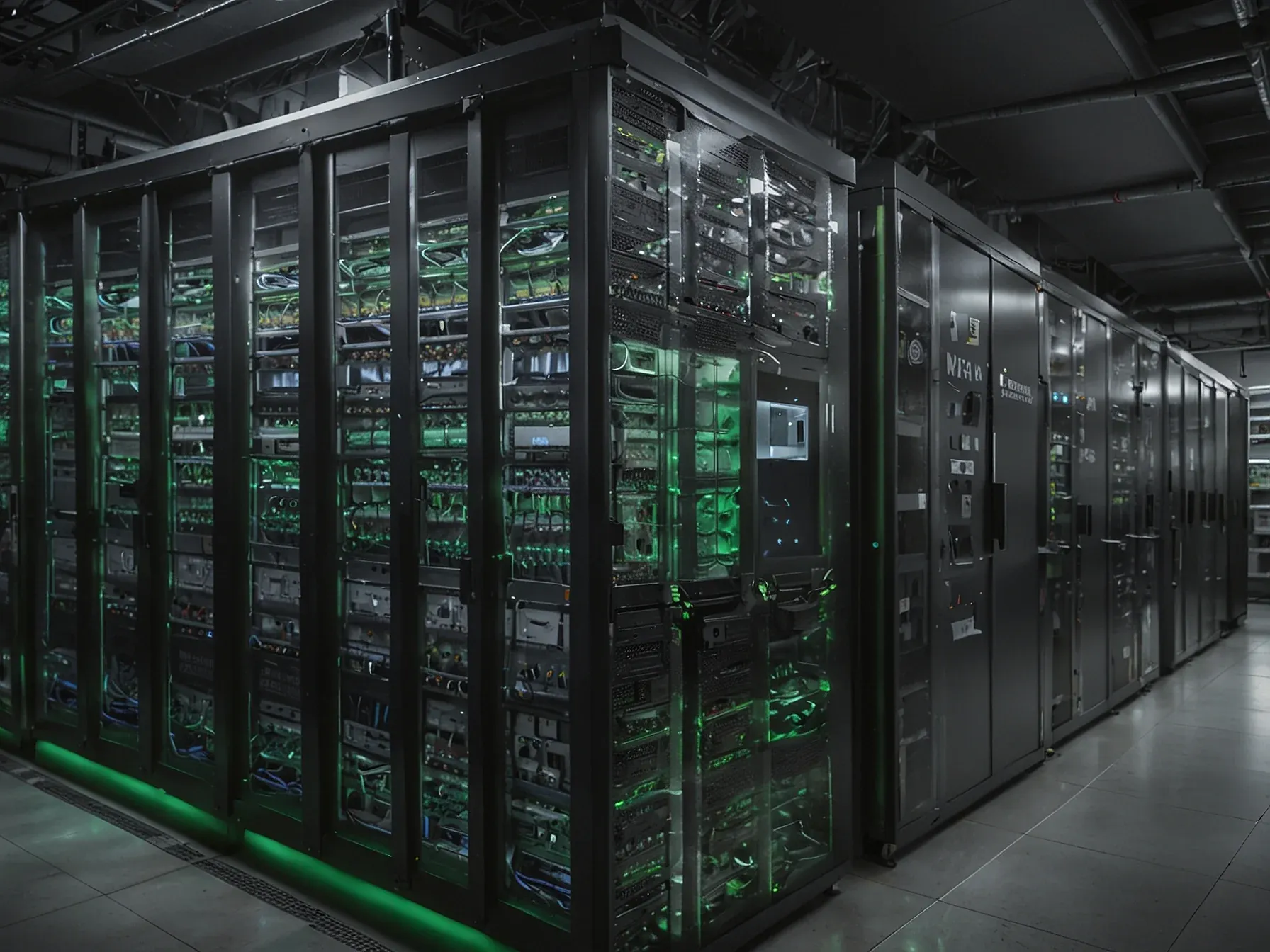
Editorial illustration for Nvidia's Blackwell Chips Reportedly Overheated in Server Racks
Nvidia's Blackwell Chips Reportedly Overheated in Server...
Nvidia's Blackwell-based server racks ran hot enough to trigger reliability problems for at least one customer, according to reports circulating ahead of the company's push for its next chip system, Vera Rubin. The timing is awkward. Nvidia spent last week in Santa Clara showing off Vera Rubin's performance numbers to journalists, framing it as the successor to Grace Blackwell and the next foundation for AI data centers.
The pitch: one Vera CPU for every two Rubin GPUs, with 36 CPUs paired to 72 GPUs in a single NVL72 rack. Nvidia has also started selling the Vera CPU on its own, telling customers in China it could ship by August.
The bigger strategic move is Nvidia trying to become the default supplier of CPUs, not just GPUs, as AI workloads shift toward agents that need orchestration, networking, and data-flow management alongside raw training power. That ambition puts more pressure on the physical engineering behind these systems, cooling, power delivery, rack density, right as Nvidia races to get Vera Rubin out before AMD's product event in San Francisco on Thursday. Reports of overheating in current Blackwell racks raise questions about whether Nvidia's hardware can keep pace with its own sales pitch.
The biggest takeaway: Nvidia, which has long specialized in making GPUs, is increasingly trying to position itself as a supplier of CPUs that can power AI agents.
Why this matters
Nvidia's Blackwell overheating problem is a reminder that the AI buildout runs on hardware that's being pushed past its comfort zone, not some abstract compute curve. When racks that customers paid millions for need a redesign mid-shipment, the cost lands on cloud providers and, eventually, on every startup renting GPU hours to train models. Vera Rubin's rollout, timed to overshadow AMD's San Francisco event on Thursday, tells us Nvidia is racing to lock in the next generation of buyers before questions about the last one settle.
For developers and founders planning compute budgets, that urgency should read as a flag: benchmarks delivered to a handful of journalists in Santa Clara are marketing, not independent verification. We'd want to see how Vera Rubin performs once it's actually stacked in production racks, not in a controlled demo. Nvidia's push to control GPUs, CPUs, and now more of the data center stack raises the stakes if thermal issues recur.
Watch for real deployment reports before trusting the pitch.
Related Reading
 Research & Benchmarks
 Microsoft AI Chief: "If It Isn't Safe We Shouldn't Build It
 Research & Benchmarks
 Google's FACTS benchmark shows 70% factuality ceiling across four tests
 Research & Benchmarks
 Nvidia's DLSS 4.5 beta adds 6x Multi Frame Generation for RTX 50 GPUs
 Related Topic
 NVIDIA NeMo powers telco reasoning model for autonomous network workflows
Industry Applications
 Related Topic
 China offers cheaper electricity to AI firms abandoning NVIDIA chips
Business & Startups
 From Archives
 Alibaba's Qwen Audio 3.0 TTS Plus Leads Rankings Over Gemini, Sonic
 From Archives
 Army AI Tool Ask Sage Used to Reclassify Personnel Job Descriptions
 From Archives
 NVIDIA GB300 NVL72 Achieves Record MoE Pre-Training Performance
LLMs & Generative AI
 From Archives
 NVIDIA's Cosmos 3 Edge Maps Robot Actions Into Compact Geometric Vectors
Open Source
Further Reading
- New Nvidia AI chips face issue with overheating servers, Information reports - Reuters
- Nvidia redesigns 72-GPU AI server racks after Blackwell GPUs overheat report - Data Center Dynamics
- Nvidia's Blackwell AI GPU overheating issues are seemingly overhyped, semiconductor analysts reveal cooling issues have been mostly addressed - Tom's Hardware
- Nvidia's data center Blackwell GPUs reportedly overheat, requiring rack redesigns and causing delays for customers - Yahoo Tech
- Nvidia's Blackwell AI chips overheat in server racks - Notebookcheck
