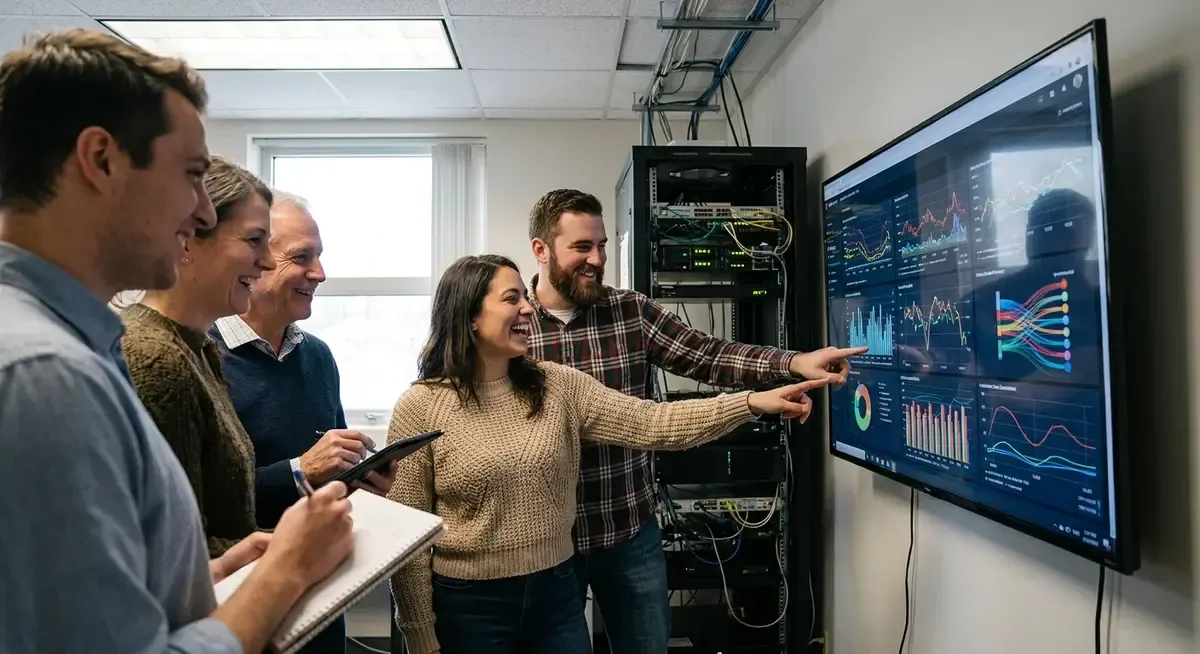
Editorial illustration for Naval Postgraduate School Activates NVIDIA AI Supercomputer for In-House Training
Naval Postgraduate School Launches NVIDIA AI Supercomputer
Jensen Huang flew into Monterey, California, on Wednesday to flip the switch on a DGX GB300 supercomputer at the Naval Postgraduate School, the Pentagon's graduate university for officers and defense researchers. The NVIDIA CEO's visit coincided with Converge @ NPS, a three-day event the school runs to showcase how it's folding AI into military education. The system, running NVIDIA's Mission Control software, gives NPS's 1,500-plus resident students and 600 faculty direct, on-site access to large-scale computing for training and running AI models, work that touches weather forecasting, cybersecurity, and planning for disaster response.
The hardware sits inside an NVIDIA AI Technology Center already built on the Monterey campus, a facility set up specifically for AI research and coursework. The GB300 commissioning extends a partnership between NVIDIA and NPS that's been running for some time, aimed at building AI tools with direct military use, not just classroom exercises. NPS trains officers from every branch alongside civilian defense researchers, so equipping the campus with frontier computing has implications well beyond Monterey. Huang addressed the crowd at the event, framing the stakes in terms of what the technology means for the people who rely on it most.
The DGX GB300 supercomputer with NVIDIA Mission Control software gives NPS’s more than 1,500 in-resident students and 600 faculty on-premises access to large-scale AI computing, including model training and inference capability for applications spanning weather prediction, cybersecurity, and disaster resilience and response planning.
Why this matters
A DGX GB300 sitting inside a military graduate school is a different signal than one landing at a startup or a cloud provider. NPS students are officers who rotate back into fleets, commands and Pentagon offices within a few years, so whatever they build on this machine, foundation models trained on classified or sensitive data, simulations run at scale, doesn't stay academic for long. That's the real story here, not the hardware spec sheet.
For researchers watching the AI-defense pipeline, this is a marker of how fast frontier compute is migrating from Silicon Valley labs into institutions that answer directly to national security priorities. Huang's line about technology being "just tools" is the kind of modest framing companies use when they'd rather not dwell on what those tools get pointed at. Worth tracking: what NPS publishes, what stays sealed, and whether other service academies or the broader DoD research apparatus follow with their own in-house clusters rather than leaning on contractors.
Related Reading
 Research & Benchmarks
 Microsoft AI Chief: "If It Isn't Safe We Shouldn't Build It
 Research & Benchmarks
 Google's FACTS benchmark shows 70% factuality ceiling across four tests
 Research & Benchmarks
 Nvidia's DLSS 4.5 beta adds 6x Multi Frame Generation for RTX 50 GPUs
 Related Topic
 NVIDIA NeMo powers telco reasoning model for autonomous network workflows
Industry Applications
 Related Topic
 China offers cheaper electricity to AI firms abandoning NVIDIA chips
Business & Startups
 From Archives
 Britain's AI safety tests find models 'cheating' on cybersecurity evaluations
 From Archives
 AMD's Spur Scheduler Adds Kubernetes Operator for HPC and AI Jobs
 From Archives
 Nvidia's Blackwell Chips Reportedly Overheated in Server Racks
 From Archives
 NVIDIA GB300 NVL72 Achieves Record MoE Pre-Training Performance
LLMs & Generative AI
Common Questions Answered
What is the DGX GB300 supercomputer that NVIDIA activated at Naval Postgraduate School?
The DGX GB300 is a supercomputer installed at the Naval Postgraduate School running NVIDIA's Mission Control software, providing direct on-site access to large-scale AI computing capabilities. It enables the school's 1,500-plus resident students and 600 faculty members to perform model training and inference for applications including weather prediction, cybersecurity, and disaster resilience planning.
Why is the DGX GB300 deployment at NPS significant for military AI development?
The supercomputer's significance lies in its placement within a military graduate school rather than a commercial entity, since NPS students are officers who rotate back into fleets, commands, and Pentagon offices within years. This means AI models trained on classified or sensitive data and simulations run on this machine will directly influence military operations and defense strategies beyond the academic environment.
What applications can NPS students and faculty develop using the DGX GB300 supercomputer?
NPS users can leverage the DGX GB300 for diverse applications spanning weather prediction, cybersecurity, and disaster resilience and response planning. The supercomputer's model training and inference capabilities enable researchers to build and deploy AI solutions addressing critical military and defense challenges at scale.
Who attended the activation event for the DGX GB300 at Naval Postgraduate School?
NVIDIA CEO Jensen Huang flew to Monterey, California to activate the DGX GB300 supercomputer at the Naval Postgraduate School on Wednesday. His visit coincided with Converge @ NPS, a three-day event showcasing how the school is integrating AI into military education and training.
Further Reading
- Papers with Code Benchmarks - Papers with Code
- Chatbot Arena Leaderboard - LMSYS
