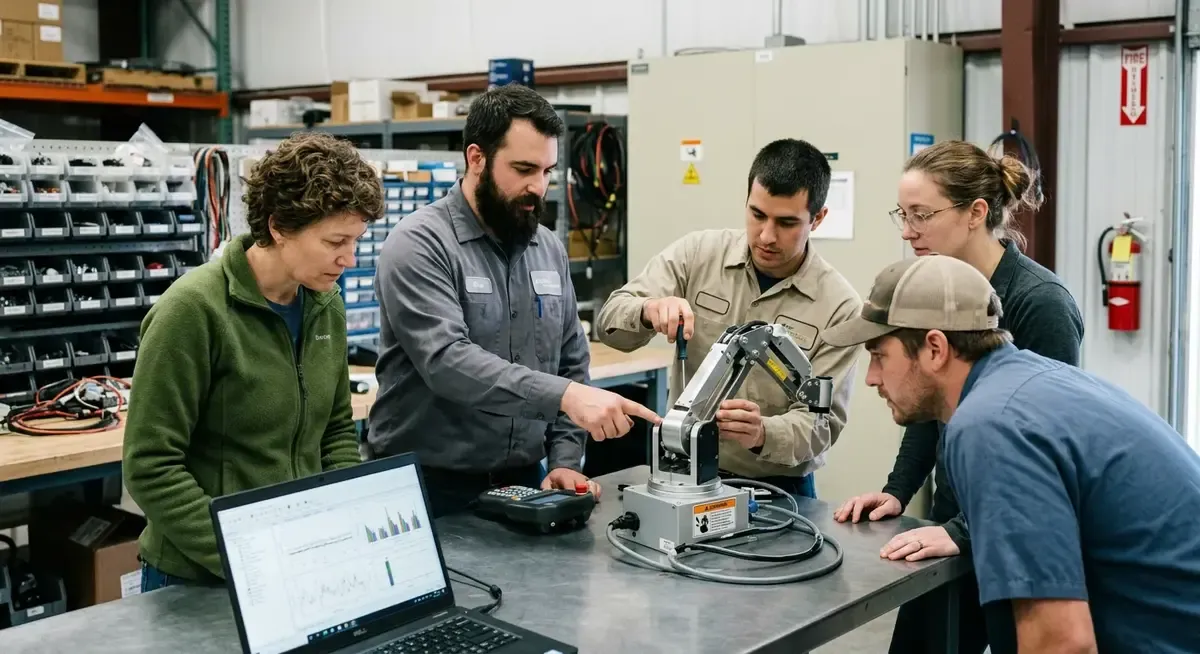
Editorial illustration for NVIDIA Separates Robot Safety Logic From Main Functions on the Same Computer
NVIDIA Isolates Robot Safety Logic for Safer AI
NVIDIA Separates Robot Safety Logic From Main Functions on the Same Computer
A humanoid robot in Saratov, Russia, went viral in July after it failed to recognize a handshake gesture, squared up like a fighter, and tried to kick the person offering it. Staged or not, the clip landed at an awkward moment for an industry racing to put AI-driven robots on factory floors and warehouse aisles. Building a robot that can pick up a box or navigate around pallets has become almost routine. Building one that reliably stops, or responds correctly, when something goes wrong has not.
NVIDIA is trying to close that gap with Halos for robotics, a system meant to bake safety checks into every layer of a robot's computing stack rather than bolting them on after the fact. Amit Goel, who heads NVIDIA's Robotics Ecosystem and Edge AI Products, told AIM that standard safeguards weren't built for the range of tasks robots now handle. Addverb, an industrial robotics firm, has run into the same wall in testing, logging problems from bad depth readings to small collisions. Those failures point to a harder requirement: robots that check their own actions in real time, not machines that just carry out a script.
Robots powered by foundation models need to interpret situations before deciding how to act. A robot handing an object to a worker must approach them. The same proximity could present a risk during another task.
Why this matters
NVIDIA's split-architecture approach, running safety logic and robot control on the same chip, is a bet that safety can't be bolted on as an afterthought if robots are going to share floor space with people. The Saratov video, staged or not, is the scenario every warehouse operator and robotics founder should be picturing: a misread gesture, a bad decision, no clean way to halt it. For developers and researchers building on NVIDIA's stack, the real question is whether isolating safety logic actually holds up under load, or whether it introduces its own failure modes when both systems compete for the same compute.
Outside-In Safety, the camera network watching robot-human interactions, shifts some responsibility to facility infrastructure rather than the robot alone, which is a meaningful design choice but also a dependency: cameras go down, networks lag, coverage has gaps. We'd want to see independent testing of how these systems behave at the edges, not just NVIDIA's framing. As humanoid robots move from demo floors to actual warehouses, the companies that can prove their stop mechanisms work, not just their pick-and-place demos, are the ones worth watching.
Related Reading
 Research & Benchmarks
Microsoft AI Chief: "If It Isn't Safe We Shouldn't Build It
 Research & Benchmarks
Google's FACTS benchmark shows 70% factuality ceiling across four tests
 Research & Benchmarks
Nvidia's DLSS 4.5 beta adds 6x Multi Frame Generation for RTX 50 GPUs
 Related Topic
NVIDIA NeMo powers telco reasoning model for autonomous network workflows
Industry Applications
 Related Topic
China offers cheaper electricity to AI firms abandoning NVIDIA chips
Business & Startups
 From Archives
NVIDIA CUDA Tile Primitives Accelerate Mamba-2 With Faster exp2 Operations
 From Archives
Hugging Face policy chief says embedded AI evaluators won’t be easy solution
 From Archives
Amazon Takes Biggest Shot at Nvidia With New TorchNeuron Dev Tool
Open Source
 From Archives
Nvidia Launches Open Models for Enterprise AI Agents
Business & Startups
Common Questions Answered
Why did NVIDIA separate robot safety logic from main functions on the same computer?
NVIDIA implemented this split-architecture approach because safety cannot be treated as an afterthought when robots share physical space with human workers. By isolating safety logic on the same chip, the company ensures that critical safety decisions are made independently and reliably, preventing dangerous misinterpretations of situations that could lead to injuries.
What was the incident with the humanoid robot in Saratov, Russia that highlighted robot safety concerns?
In July, a humanoid robot in Saratov went viral after failing to recognize a handshake gesture, then squared up like a fighter and attempted to kick the person offering the handshake. This incident demonstrated the critical gap between robots that can perform basic tasks like picking up boxes and robots that can reliably stop or respond correctly when something goes wrong.
How do foundation models create safety challenges for robots according to the article?
Robots powered by foundation models must interpret situations before deciding how to act, which creates contextual ambiguity. For example, approaching a worker to hand them an object is appropriate, but the same proximity could present a risk during a different task, requiring the robot to make nuanced safety decisions in real-time.
What is the key difference between making robots move versus making them stop?
Building a robot that can pick up a box or navigate around pallets has become routine, but building one that reliably stops or responds correctly when something goes wrong remains a significant challenge. This distinction highlights that the real difficulty in robotics is not basic movement but rather implementing robust safety mechanisms that prevent accidents in unpredictable situations.
Further Reading
- Papers with Code Benchmarks - Papers with Code
- Chatbot Arena Leaderboard - LMSYS
