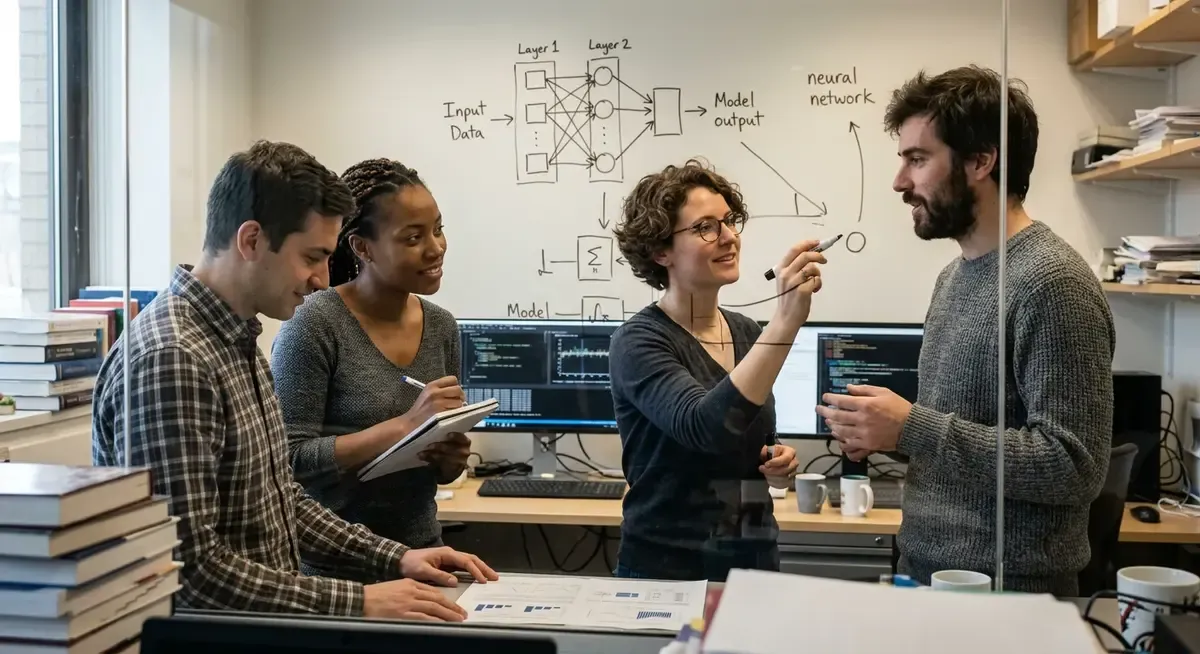
Editorial illustration for NVIDIA's Astra AI Generates Code for SimReady Robot Assets
NVIDIA Astra AI Generates Code for Robot Simulations
Frank DeLise spent part of his week asking an AI model to build him a warehouse. Not a real one: a SimReady digital environment where a humanoid robot could walk, pick up objects, and respond to commands from first- and third-person camera views. DeLise, an Omniverse product manager at NVIDIA, didn't write the animation or rendering code by hand. He described what he wanted in plain language, and GPT-6 Astra generated it.
That workflow sits at the center of a broader shift NVIDIA is tracking across its Omniverse ecosystem. Developers assembling physics-based simulations used to spend most of their time wiring together assets, renderers, and sensor models by hand. Now they're directing frontier AI agents through natural-language instructions, then reviewing and correcting the output rather than writing every line themselves.
The appeal is speed on tasks that once took real engineering time: standing up a scene, connecting GPU-accelerated physics and rendering libraries, and checking that a robot or vehicle behaves the way it's supposed to before anyone trusts it near real hardware. DeLise's warehouse project is one entry in a growing set of examples NVIDIA is documenting, including work on autonomous-driving test pipelines built the same way.
Turning a simulation idea into a working application means assembling assets, connecting physics and rendering, and checking that the scene behaves as intended. Developers are combining frontier AI models with NVIDIA Omniverse libraries to help carry out that work — building applications for exploring scenarios, investigating failures and improving designs.
Why this matters
For developers building robotics and autonomous-driving simulations, the appeal here is obvious: natural-language prompts that turn into working animation and application code cut out a chunk of the tedious scaffolding work that normally eats days of engineering time. Astra generating code to tie together SimReady robot assets is a real step toward letting researchers test scenarios instead of just building the rigs to test them. But we'd push back on treating this as a solved problem.
The article itself notes that changing a single sensor or driving model can significantly alter outcomes, which means the heavy lifting of validation still falls on humans reviewing what the AI agent produced. That's the part worth watching: NVIDIA is selling the assembly process as streamlined, but "generated code" and "correct code" aren't the same claim. Anyone building on Omniverse libraries and frontier models should treat Astra's output as a draft worth checking, not a finished simulation.
The real test is whether these agents hold up once scenes get more complex than the demo.
Related Reading
 Research & Benchmarks
 Microsoft AI Chief: "If It Isn't Safe We Shouldn't Build It
 Research & Benchmarks
 Google's FACTS benchmark shows 70% factuality ceiling across four tests
 Research & Benchmarks
 Nvidia's DLSS 4.5 beta adds 6x Multi Frame Generation for RTX 50 GPUs
 Related Topic
 NVIDIA NeMo powers telco reasoning model for autonomous network workflows
Industry Applications
 Related Topic
 China offers cheaper electricity to AI firms abandoning NVIDIA chips
Business & Startups
 From Archives
 OpenAI disputes firings were over safety concerns after misconduct probe
 From Archives
 AI Proofs Flood Math, Prompting Calls for OpenAI Boycott
 From Archives
 Nvidia's Halos for Robotics aims for safer autonomous systems
Business & Startups
 From Archives
 Microsoft Debuts Surface Laptop Ultra with Nvidia's First Arm PC Chip
Open Source
Common Questions Answered
How does NVIDIA's Astra AI help developers create SimReady robot environments?
NVIDIA's Astra AI generates animation and rendering code from plain language descriptions, allowing developers like Frank DeLise to build digital warehouse environments without manually writing code. This enables humanoid robots to walk, pick up objects, and respond to camera commands in simulated environments, significantly reducing the time spent on tedious scaffolding work.
What is the workflow that Frank DeLise demonstrated with GPT-6 Astra and Omniverse?
DeLise described his desired warehouse simulation in plain language, and GPT-6 Astra automatically generated the necessary animation and rendering code to create a working SimReady digital environment. This workflow demonstrates how frontier AI models combined with NVIDIA Omniverse libraries can streamline the development process for robotics simulations.
What are the key benefits of using Astra-generated code for robotics and autonomous-driving simulations?
Natural-language prompts that generate working animation and application code eliminate days of engineering time spent on tedious scaffolding work. This approach allows researchers to focus on testing scenarios and investigating failures rather than spending time building the infrastructure needed to test them, accelerating the development cycle for robotics and autonomous-driving applications.
What tasks does Astra help automate when turning simulation ideas into working applications?
Astra assists with assembling assets, connecting physics and rendering systems, and checking that scenes behave as intended. By automating these components of the simulation development process, developers can more quickly move from concept to functional application for exploring scenarios and improving designs.
Further Reading
- Into the Omniverse: How Developers Turn Ideas Into Simulations With Frontier AI Agents - NVIDIA Blog
- NVIDIA Expands Omniverse With Generative Physical AI - NVIDIA Newsroom
- Developers Build Fast and Reliable Robot Simulations with NVIDIA Omniverse Libraries - NVIDIA Technical Blog
- Build Synthetic Data Pipelines to Train Smarter Robots with NVIDIA Isaac Sim - NVIDIA Developer Blog
