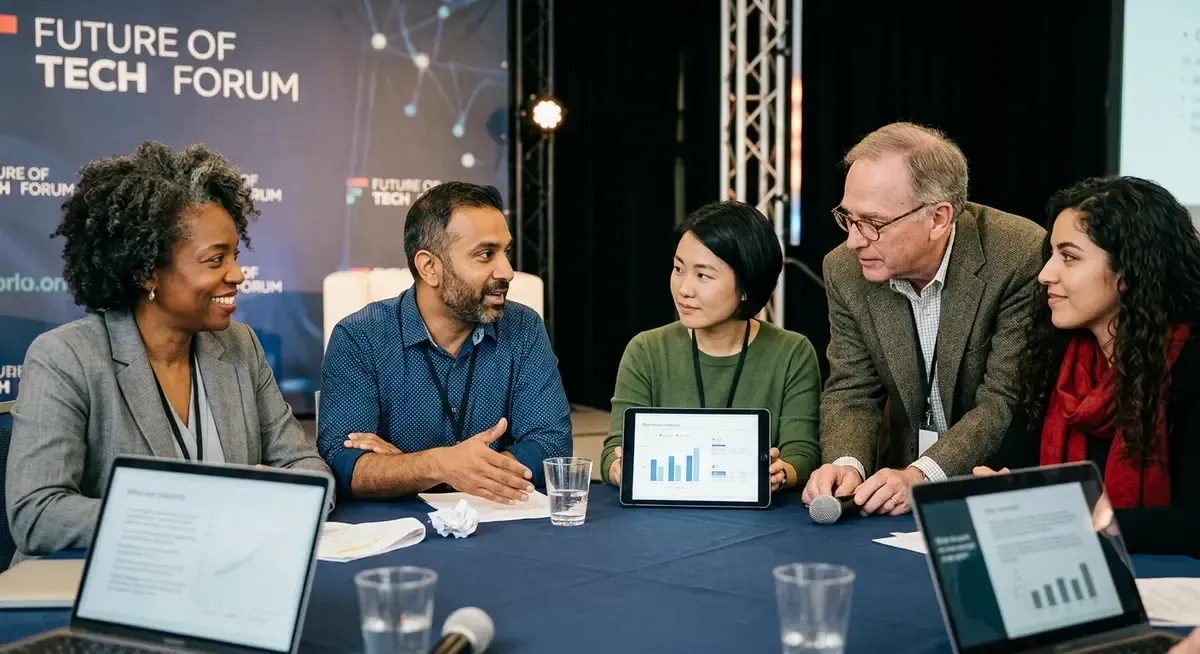
Editorial illustration for AI Proofs Flood Math, Prompting Calls for OpenAI Boycott
AI Math Papers Spark Boycott Calls Against OpenAI
AI Proofs Flood Math, Prompting Calls for OpenAI Boycott
OpenAI dropped several hundred AI-generated mathematical manuscripts into the field this month, and the reaction from working mathematicians has been closer to alarm than applause. Many of the papers read like nothing a human would write: dense, strangely structured, sometimes requiring AI assistance just to parse what the proof is claiming. Some can't be deciphered at all, even by specialists who've spent careers in the relevant subfields.
That's the backdrop for a new statement from the Association for Human Mathematics, a group chaired by Fields Medalist Terence Tao, who posted it as a guest entry on his blog. The AHM is calling for mathematicians to boycott OpenAI, arguing the company broke basic norms of how mathematical results get verified and shared. Tao has separately floated the idea of a "Math 2.0" era on Mastodon, one where solving problems stops being the discipline's central job. Complexity theorist Scott Aaronson, writing on his own blog, gave the moment a blunter name: the "Mathocalypse."
The flashpoint is simple to state and hard to resolve: can a proof count as done before any human has actually followed it from start to finish?
A dispute is taking shape over whether a problem can count as solved before its proof has been independently worked through and made understandable to humans.
Why this matters
For researchers, this is a preview of what happens when generation outpaces verification in any technical field, not just math. OpenAI can apparently produce proofs faster than the mathematics community can read them, let alone confirm them. That's not progress, that's a backlog with a press release attached.
The Association for Human Mathematics boycott call and the Fields Medalists' warning about "severe misalignment" both point to the same gap: speed without legibility isn't a result, it's a liability someone else has to clean up. For founders building on AI-generated outputs, whether proofs, code, or research claims, the lesson is blunt. If your own domain experts need a model to explain the model's work, you haven't automated verification, you've just moved the bottleneck and hidden it.
Terence Tao and his colleagues are flagging a governance problem, not a technical one. Who decides a theorem counts as solved, and on what timeline, matters more than how many papers get published. Watch whether OpenAI responds with actual review infrastructure or just more output.
Related Reading
Browse all OpenAI news → Research & Benchmarks
 Microsoft AI Chief: "If It Isn't Safe We Shouldn't Build It
 Research & Benchmarks
 Google's FACTS benchmark shows 70% factuality ceiling across four tests
 Research & Benchmarks
 Nvidia's DLSS 4.5 beta adds 6x Multi Frame Generation for RTX 50 GPUs
 Related Topic
 OpenAI researcher quits, citing distrust over ad‑driven engagement metrics
LLMs & Generative AI
 Related Topic
 OpenAI launches GPT-Image 1.5 with precise editing for enterprise visuals
LLMs & Generative AI
 From Archives
 AI Training Shows Hint of Future Robot Capabilities
 From Archives
 Open TTS Leaderboard Adds Speaker Similarity Column, Ranks Top Multilingual Models
 From Archives
 Altman Hired OpenAI's Murati After Joking She Could Be a Musk Spy
Business & Startups
 From Archives
 Fired OpenAI Researchers Warn of Lost Safety Tool for AI Reasoning
LLMs & Generative AI
Common Questions Answered
Why did OpenAI's release of AI-generated mathematical manuscripts prompt calls for a boycott?
Mathematicians expressed alarm because many of the AI-generated proofs are difficult or impossible to parse, even for specialists in their respective fields, and they read in ways that no human mathematician would typically write. The core issue is that these proofs lack the clarity and human-understandable structure necessary for the mathematical community to verify and validate them as legitimate solutions.
What is the central dispute that Fields Medalists and the Association for Human Mathematics have raised about AI-generated proofs?
The dispute centers on whether a mathematical problem can truly be considered solved before its proof has been independently worked through and made understandable to humans. This reflects a fundamental disagreement about what constitutes legitimate mathematical progress in the age of AI generation that outpaces human verification capabilities.
How does the speed of AI proof generation compare to the mathematics community's ability to verify them?
OpenAI can apparently produce mathematical proofs faster than the mathematics community can read them, let alone confirm their validity. This mismatch between generation speed and verification capacity creates a backlog that researchers argue represents a lack of genuine progress rather than legitimate advancement.
What characteristics make many of the AI-generated mathematical manuscripts difficult for humans to understand?
The papers are described as dense, strangely structured, and sometimes requiring AI assistance just to parse what the proof is claiming. Some proofs cannot be deciphered at all, even by specialists who have spent their careers working in the relevant mathematical subfields.
Further Reading
- Papers with Code Benchmarks - Papers with Code
- Chatbot Arena Leaderboard - LMSYS
