
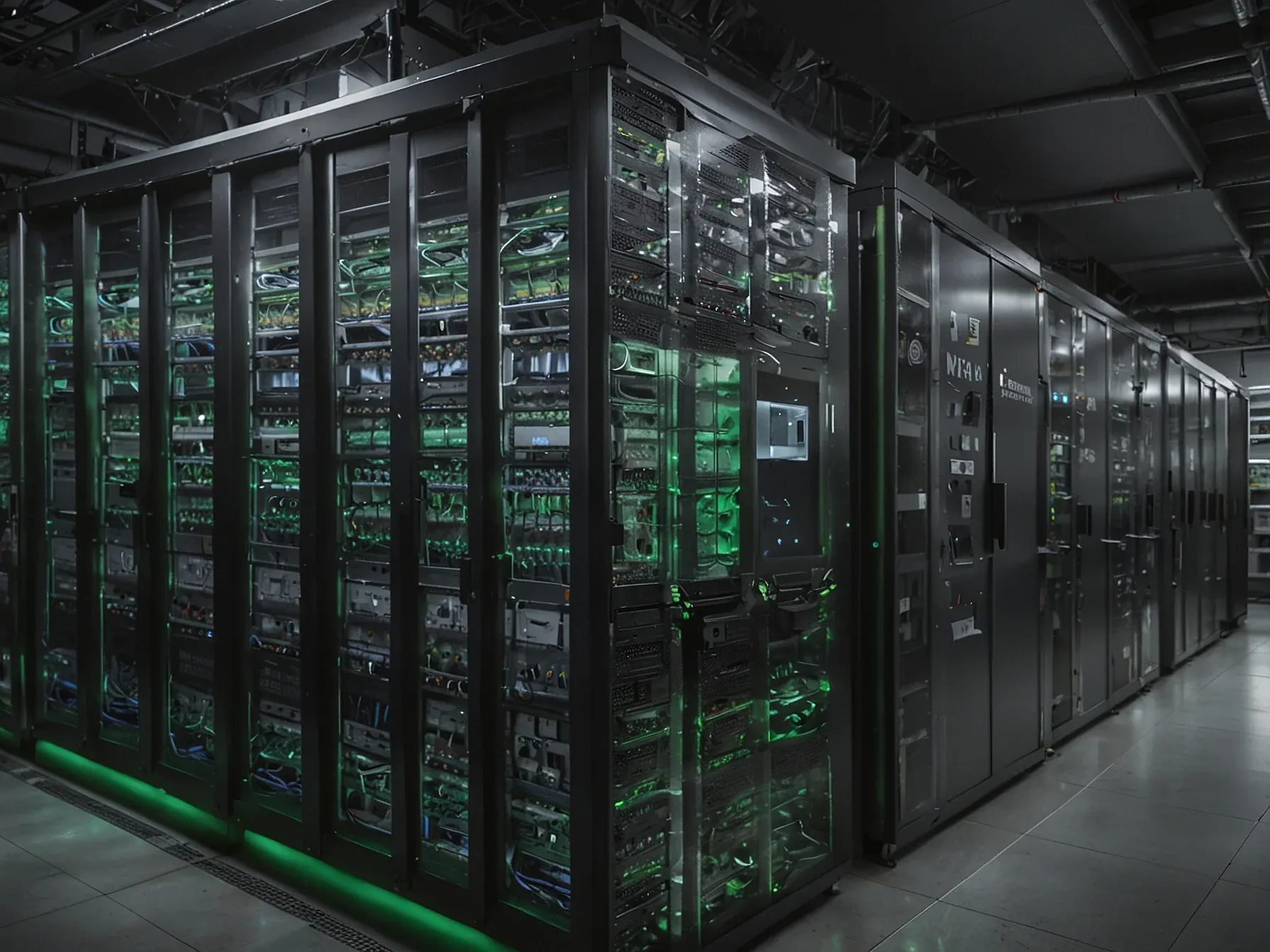
Editorial illustration for NVIDIA Vera Rubin NVL72 Kubernetes AI-Ready: Network Operator, DMA Topology
NVIDIA Vera Rubin NVL72 Gets Kubernetes Ready
NVIDIA is moving to get Kubernetes clusters ready for Vera Rubin NVL72 compute trays before the hardware even ships in volume. The company has been testing its GPU Operator and Dynamic Resource Allocation driver against early Vera Rubin access, alongside a new piece of the DSX AI Factory Platform called the AI Cluster Runtime, or AICR. The problem AICR is built to solve isn't exotic: drivers, kernels, container runtimes, network plumbing, operators and schedulers all have to agree with each other and with the hardware underneath them, and on a new GPU architecture that agreement doesn't happen by accident. Miss a setting and a workload either won't launch or will run at a fraction of its potential speed.
For teams running GB200 NVL72 today, Vera Rubin NVL72 isn't a clean break. It's the third generation of the same MGX rack-scale design, which means some of the lessons and tooling carry forward. But the orchestration layer still needs updates reaching from low-level hardware bindings up through Kubernetes scheduling, and NVIDIA is documenting what specifically changes, what's already been validated, and how AICR packages those changes into something platform teams can reproduce.
Both the training and inference recipe variants now validate end to end for deployment and conformance. For training, an initial performance gate: a cross-node NCCL all-reduce over the NVIDIA NVLink fabric, running through an IMEX ComputeDomain and gated on a bus-bandwidth floor.
Why this matters
For teams planning to run Vera Rubin NVL72 clusters, the DMA topology change isn't a footnote, it's the thing that decides whether your I/O-heavy jobs actually hit the performance numbers on the spec sheet. GB200 assumptions about GPU-to-NIC affinity and NUMA placement don't carry over, and NVIDIA is explicit that Network Operator compatibility is its own qualification step, not something AICR's recipes automatically absorb. That's a useful warning for anyone tempted to treat AI Cluster Runtime as a drop-in abstraction layer: it standardizes a lot of the driver, kernel, and scheduler coordination, but hardware-specific wiring still needs separate validation against the DOCA 3.3.0 release notes.
For developers and infra teams eyeing early Vera Rubin deployments, the practical takeaway is to budget real time for topology verification before workloads go live, not after they underperform. Research groups chasing low-latency, high-throughput training runs should treat this as a checklist item, not an assumption. The bundling of tuned configs into reusable recipes is genuinely useful, but "Day One ready" still comes with homework attached.
Related Reading
 Research & Benchmarks
Microsoft AI Chief: "If It Isn't Safe We Shouldn't Build It
 Research & Benchmarks
Google's FACTS benchmark shows 70% factuality ceiling across four tests
 Research & Benchmarks
Nvidia's DLSS 4.5 beta adds 6x Multi Frame Generation for RTX 50 GPUs
 Related Topic
NVIDIA NeMo powers telco reasoning model for autonomous network workflows
Industry Applications
 Related Topic
China offers cheaper electricity to AI firms abandoning NVIDIA chips
Business & Startups
 From Archives
Barzilay, Collins Win Pritzker Prize for AI-Enabled Antibiotic Discovery
 From Archives
Manas AI Rebrands After Launching 240M-Parameter Model
 From Archives
NVIDIA Releases Auto Ontology, Open Semantic Layer to Ground AI Agent SQL
Open Source
 From Archives
New NVIDIA RTX Laptops Run AI Models Locally on CUDA
Common Questions Answered
What is the AI Cluster Runtime (AICR) and why did NVIDIA develop it for Vera Rubin NVL72?
The AI Cluster Runtime is a new component of NVIDIA's DSX AI Factory Platform designed to ensure that drivers, kernels, container runtimes, network plumbing, operators, and schedulers all work together seamlessly. AICR was created to solve the compatibility and coordination challenges that arise when deploying Vera Rubin NVL72 compute trays in Kubernetes clusters before the hardware ships in volume.
How does the DMA topology change in Vera Rubin NVL72 affect I/O-heavy job performance?
The DMA topology change is critical for achieving the performance numbers specified on the Vera Rubin NVL72 spec sheet, particularly for I/O-heavy workloads. Unlike GB200 assumptions about GPU-to-NIC affinity and NUMA placement, the new topology requires different configurations, making it essential for teams to validate their deployments against the actual hardware topology.
What performance validation does NVIDIA conduct for Vera Rubin NVL72 training deployments?
NVIDIA validates training deployments through a cross-node NCCL all-reduce test that runs over the NVIDIA NVLink fabric through an IMEX ComputeDomain, with a performance gate based on a bus-bandwidth floor requirement. Both training and inference recipe variants are tested end-to-end for deployment and conformance to ensure they meet performance standards.
Why is Network Operator compatibility a separate qualification step for Vera Rubin NVL72?
Network Operator compatibility is treated as its own qualification step rather than being automatically absorbed by AICR's recipes because the DMA topology changes in Vera Rubin NVL72 require specific network configuration validation. This separation ensures that teams explicitly verify their network setup works correctly with the new hardware topology, rather than assuming generic recipes will handle all compatibility requirements.
What tools is NVIDIA using to test Vera Rubin NVL72 Kubernetes readiness?
NVIDIA is testing its GPU Operator and Dynamic Resource Allocation driver against early Vera Rubin access to ensure Kubernetes cluster compatibility. These tools, combined with the new AI Cluster Runtime component, help validate that all system components work together properly before the hardware ships in volume.
Further Reading
- Making Kubernetes AI-Ready for NVIDIA Vera Rubin on Day One - NVIDIA Developer Blog
- DRA Driver for NVIDIA GPUs - NVIDIA Documentation
- Dynamic Resource Allocation (DRA) Support for NIM - NVIDIA Documentation
- GPU Operators - RKE2 Documentation
- LLM Inference on NVIDIA GB200 NVL72: A Cross-Architecture Experimental Analysis - Springer
