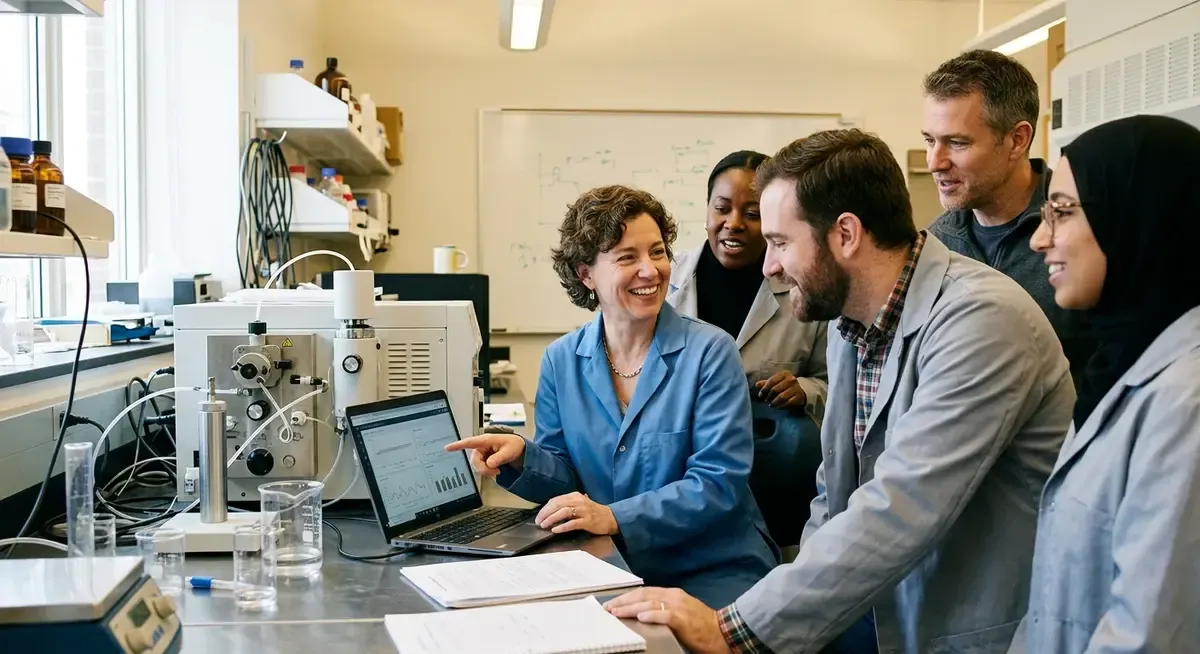
Editorial illustration for Barzilay, Collins Win Pritzker Prize for AI-Enabled Antibiotic Discovery
Barzilay, Collins Win Pritzker Prize for AI-Enabled...
Regina Barzilay and Jim Collins will receive the 2026 Pritzker Prize for AI in Science Research Excellence, an award given jointly by the University of Chicago and Caltech since 2024. The prize cites their work pairing deep learning with bioengineering to find new antibacterial candidates, research that has already produced a drug-resistant pathogen fighter named after a fictional computer.
Barzilay holds the title of Distinguished Professor of AI and Health in MIT's School of Engineering. Collins is the Termeer Professor of Medical Engineering and Science. Both serve as
A broad-spectrum antibiotic that was originally studied as a potential diabetes drug, halicin was identified by a deep learning model trained on 2,500 molecules. Upon testing, the research team found that halicin was able to kill antibiotic-resistant bacteria (i.e., “superbugs”) such as Clostridium difficile, Acinetobacter baumannii, and Mycobacterium tuberculosis. A discovery process that once took years was completed in just a few weeks.
Why this matters
Barzilay and Collins have spent nearly a decade building the case that machine learning models can do real chemistry work, not just predict it in a vacuum. Their lab's track record, halicin in 2020 and abaucin in 2023, already showed deep learning flagging antibacterial candidates that human researchers hadn't prioritized. The Pritzker committee rewarding that approach, barely two years after the prize itself was created in 2024, tells us the field is done treating "AI drug discovery" as a slide-deck pitch and started treating it as a lab discipline with results that hold up under experimental validation.
For researchers, the lesson is specific: the win went to the combination of deep learning, bioengineering, and wet-lab testing, not to a model alone. Founders pitching AI-for-biology should take note that credibility now gets built on validated candidates against drug-resistant pathogens, not benchmark scores. Antibiotic resistance is a slow-moving crisis with few new drug classes in decades.
If AI-guided discovery keeps producing candidates that survive contact with actual bacteria, that's the metric worth watching, not the headlines.
Related Reading
 Research & Benchmarks
Microsoft AI Chief: "If It Isn't Safe We Shouldn't Build It
 Research & Benchmarks
Google's FACTS benchmark shows 70% factuality ceiling across four tests
 Research & Benchmarks
Nvidia's DLSS 4.5 beta adds 6x Multi Frame Generation for RTX 50 GPUs
 From Archives
Manas AI Rebrands After Launching 240M-Parameter Model
 From Archives
Adobe Tests AI Agent EditAgent Using Editing Tools Like Photoshop Pros
Further Reading
- AI is taking on antibiotic resistance — here's how - MIT Jameel Clinic
- The University of Chicago Announces 2026 Recipients of the Pritzker Prize for AI in Science Research Excellence - MIT Jameel Clinic
- MIT Team Uses AI to Discover 9 Antibiotic Candidates - HyperAI
- Antibiotics-AI Project - Collins Lab, MIT
- An Unexpected Ally in the War With Bacteria - The Atlantic
