
Editorial illustration for NVIDIA Toolkit Accelerates OpenFold3 Co-Folding Workflow
NVIDIA Speeds Up OpenFold3 Protein Folding Analysis
NVIDIA Toolkit Accelerates OpenFold3 Co-Folding Workflow
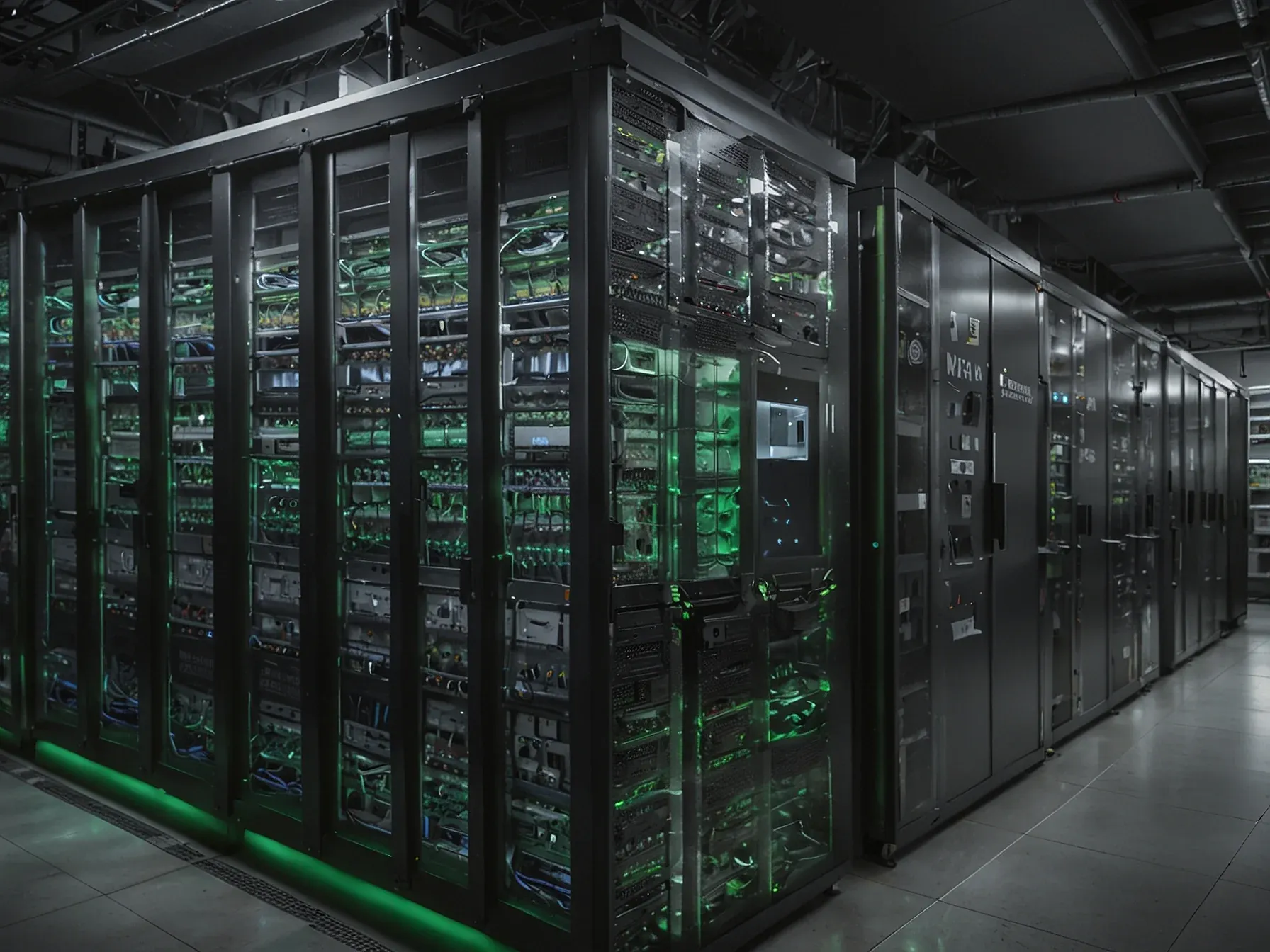
Virtual screening runs against millions to billions of compounds, and co-folding models like OpenFold3 often produce the most accurate structures in the batch. The catch is cost. Running a full co-folding model on every candidate in a billion-compound library is impractical on current hardware, which forces drug discovery teams to trade accuracy for throughput. NVIDIA has been building tools aimed at closing that gap.
The problem isn't limited to screening speed. Co-folding runtime scales cubically with the number of amino acid residues, so predicting large multi-protein assemblies gets expensive fast. Memory is the harder constraint: single GPU memory puts a hard ceiling on how big a complex can be predicted in one pass, regardless of how much time you're willing to spend. Without ways to cut memory use and spread the work across multiple GPUs, entire classes of large-assembly predictions stay out of reach.
NVIDIA's answer touches every stage of the pipeline, from Multiple Sequence Alignment generation through inference, serving, and multi-GPU scale-out, since a slowdown at any single step caps throughput for the whole workflow. The BioNeMo Agent Toolkit is built to address that end to end.
Why this matters
For anyone building drug discovery pipelines, the MSA step has long been the part nobody wants to talk about: slow, CPU-bound, and easy to ignore until it wrecks your throughput numbers. A 177x speedup on homology search through MSA Search NIM changes the math on what "end-to-end" actually means for agent-driven co-folding. If NVIDIA's numbers hold up outside the benchmark slides, teams running OpenFold3 at scale can stop treating alignment generation as a fixed tax and start treating it as a tunable variable, which matters a lot once you're paying by the GPU-hour.
The memory-efficiency angle is worth watching too: bigger biological assemblies modeled without new hardware is a real unlock for researchers working on large complexes, not just single proteins. We'd still want independent benchmarks before treating these figures as gospel, since vendor-reported speedups tend to shrink under real workloads. But if the toolkit performs anywhere close to this in production, it's a meaningful shift in what "fast enough for an autonomous agent" looks like in structural biology.
Related Reading
 Research & Benchmarks
 Microsoft AI Chief: "If It Isn't Safe We Shouldn't Build It
 Research & Benchmarks
 Google's FACTS benchmark shows 70% factuality ceiling across four tests
 Research & Benchmarks
 Nvidia's DLSS 4.5 beta adds 6x Multi Frame Generation for RTX 50 GPUs
 Related Topic
 NVIDIA NeMo powers telco reasoning model for autonomous network workflows
Industry Applications
 Related Topic
 China offers cheaper electricity to AI firms abandoning NVIDIA chips
Business & Startups
 From Archives
 Hanns Christoph Nägerl’s team finds quantum heating defies classical intuition
 From Archives
 AI-Run Ransomware Attack Still Required Human Involvement
 From Archives
 NVIDIA’s New Nemotron Model Achieves 2.03x Server Throughput
Open Source
 From Archives
 NVIDIA launches Nemotron‑Labs‑TwoTower diffusion model with 128‑expert MoE
Open Source
Common Questions Answered
Why is running OpenFold3 co-folding models on every compound in a billion-compound library impractical?
Running full co-folding models on every candidate compound is impractical because of the significant computational cost and time required on current hardware. This forces drug discovery teams to make a difficult trade-off between accuracy and throughput, as co-folding runtime scales cubically with input size.
What specific speedup does NVIDIA's MSA Search NIM provide for homology search?
NVIDIA's MSA Search NIM delivers a 177x speedup on homology search through the Multiple Sequence Alignment (MSA) step. This dramatic improvement changes the economics of end-to-end co-folding workflows by eliminating the MSA step as a computational bottleneck that previously limited throughput.
How does the NVIDIA BioNeMo Agent Toolkit help accelerate drug discovery workflows?
The NVIDIA BioNeMo Agent Toolkit provides agents with seamless access to tools needed to accelerate biology and chemistry workflows, including structure prediction and co-folding processes. It enables drug discovery teams to build more efficient pipelines by optimizing each step of the co-folding workflow.
What was the historical challenge with the MSA step in drug discovery pipelines?
The MSA (Multiple Sequence Alignment) step has traditionally been slow, CPU-bound, and easy to overlook until it significantly impacts throughput numbers in drug discovery pipelines. Teams have long treated alignment generation as a fixed computational tax rather than an optimizable component of their workflows.
Further Reading
- Accelerating End-to-End Co-Folding Performance with NVIDIA BioNeMo Agent Toolkit - NVIDIA Developer Blog
- NVIDIA BioNeMo Agent Toolkit Accelerates End-to-End Co-Folding Workflow - Hyper.ai
- OpenFold3: Open Reproduction of AlphaFold3-Style Biomolecular Co-Folding - Neurosnap AI
- OpenFold3 | Fully Open-Source Cofolding AI for Drug Discovery - SandboxAQ
- OpenFold3 and Co-Folding with Templates - Rowan Newsletter
