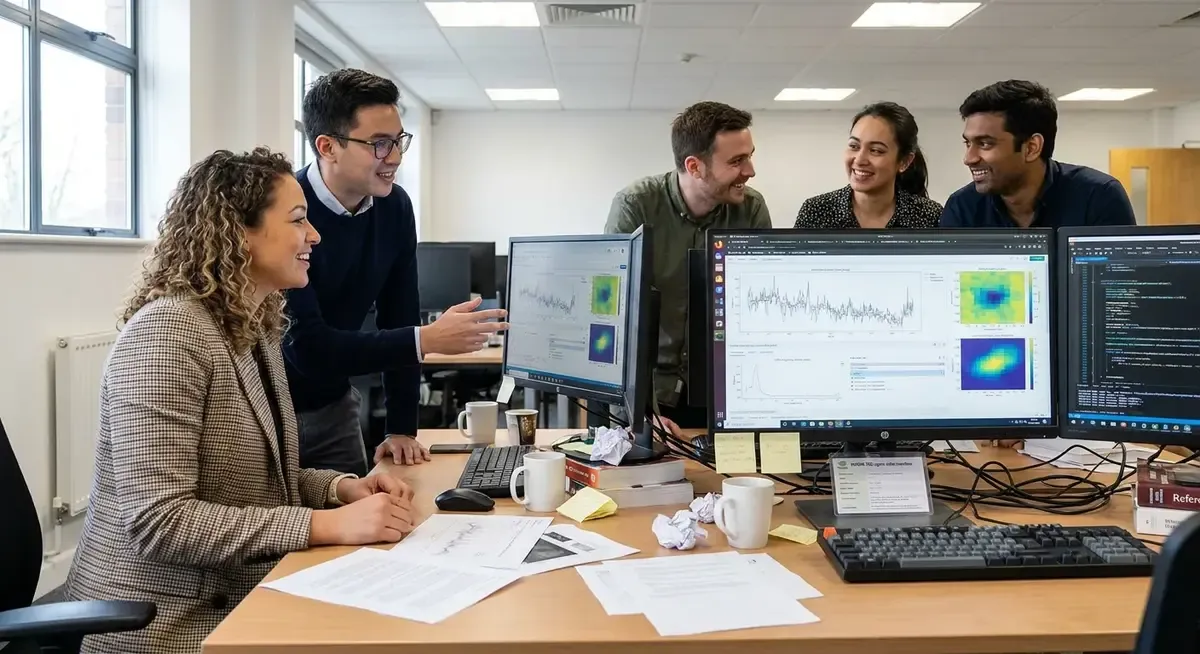
Editorial illustration for NVIDIA TAO Agent Skills Accelerate Vision Model Post-Training
NVIDIA TAO Agents Boost Vision Model Accuracy to 93%
NVIDIA TAO Agent Skills Accelerate Vision Model Post-Training
NVIDIA has pushed a fine-tuning run on its Cosmos 3 Nano model from 54.41% exact-match accuracy to 93.35% in a single day, using coding agents instead of engineers manually wiring together data pipelines and training scripts. The company detailed the workflow in a technical post covering how its TAO library of agentic fine-tuning skills handles the grunt work of post-training vision reasoning models: formatting data, setting up containers, writing training scripts, running baseline evaluations, and sweeping hyperparameters.
Cosmos 3 itself is built as an omnimodal world model, linking understanding, generation, simulation, and action through a mixture-of-transformers architecture that handles text, image, video, sound, and action tracking in one system. NVIDIA positions it as strong out of the box, but notes that any real deployment, whether it's a warehouse camera angle or an unusual edge case, still needs domain-specific adaptation.
That's the gap TAO agent skills are meant to close, pairing Low-Rank Adaptation with AutoML sweeps so a handful of natural language prompts can replace what NVIDIA describes as a multiday engineering slog. The results raise a specific question about why the underlying architecture matters for this kind of rapid specialization.
The NVIDIA experiments show that by using Low-Rank Adaptation (LoRA), the workflow efficiently adapted the model, instantly boosting the zero-shot baseline from 54.41% exact-match accuracy (4-way multiple-choice) to an impressive 87.14% in a single run.
Why this matters
NVIDIA is betting that the bottleneck in vision model post-training isn't compute, it's the grunt work: config files, launcher scripts, baseline runs, hyperparameter sweeps. Packaging that knowledge into agent skills for TAO and Cosmos 3 turns a multi-day setup slog into something a coding agent can chew through, at least for the model families NVIDIA has already mapped out. That's a real time save for teams building physical AI or video reasoning systems who don't want to burn a week just to find out if post-training even helps.
But the claimed one-day, 90%-accuracy result comes from NVIDIA's own writeup, on their own hardware and model stack, so we'd want to see independent teams replicate it before treating this as a general post-training shortcut. The bigger question for developers is portability: agent skills tied tightly to Cosmos 3 and TAO's launcher behavior won't help you if your pipeline lives outside NVIDIA's ecosystem. Worth watching whether this pattern of "skills as packaged workflow knowledge" spreads to other frameworks, or stays a walled-garden convenience.
Related Reading
 Research & Benchmarks
 Microsoft AI Chief: "If It Isn't Safe We Shouldn't Build It
 Research & Benchmarks
 Google's FACTS benchmark shows 70% factuality ceiling across four tests
 Research & Benchmarks
 Nvidia's DLSS 4.5 beta adds 6x Multi Frame Generation for RTX 50 GPUs
 Related Topic
 NVIDIA NeMo powers telco reasoning model for autonomous network workflows
Industry Applications
 Related Topic
 China offers cheaper electricity to AI firms abandoning NVIDIA chips
Business & Startups
 From Archives
 Meta Shuts Down AI Token Leaderboard Amid Rising Cost Concerns
 From Archives
 DeepMind CEO Advocates Guardrails Amid AI Uncertainty
 From Archives
 NVIDIA Decoding Cuts Color Code Error Rates by Over 300X
Market Trends
 From Archives
 NVIDIA Toolkit Accelerates OpenFold3 Co-Folding Workflow
Common Questions Answered
How much did NVIDIA improve the Cosmos 3 Nano model's accuracy using TAO Agent Skills?
NVIDIA increased the Cosmos 3 Nano model's exact-match accuracy from 54.41% to 93.35% in a single day using coding agents instead of manual engineering. The workflow leveraged Low-Rank Adaptation (LoRA) to efficiently adapt the model, with an initial boost to 87.14% accuracy in the first run, demonstrating significant performance gains through automated post-training.
What is the primary advantage of using TAO library agentic fine-tuning skills for vision model post-training?
TAO library automates the grunt work of vision model post-training by handling tasks like formatting data, setting up containers, writing training scripts, and running baseline evaluations without manual engineer intervention. This automation transforms what would typically be a multi-day setup process into something coding agents can efficiently complete, enabling teams to focus on higher-level optimization rather than configuration and infrastructure work.
What does NVIDIA identify as the real bottleneck in vision model post-training?
NVIDIA argues that the bottleneck in vision model post-training is not compute power, but rather the time-consuming grunt work of managing config files, launcher scripts, baseline runs, and hyperparameter sweeps. By packaging this knowledge into agent skills for TAO and Cosmos 3, NVIDIA has eliminated the multi-day setup process that previously hindered teams building physical AI or video reasoning systems.
How does Low-Rank Adaptation (LoRA) contribute to the efficiency of NVIDIA's TAO workflow?
Low-Rank Adaptation (LoRA) enables the TAO workflow to efficiently adapt the Cosmos 3 model by reducing the computational overhead of fine-tuning while maintaining performance improvements. This technique allowed NVIDIA to achieve a boost from 54.41% to 87.14% exact-match accuracy in a single run, demonstrating how LoRA makes rapid model post-training feasible within the automated agent-driven workflow.
Further Reading
- NVIDIA Enables the Next Era Of Physical AI Research With Agent Skills - NVIDIA Blog
- NVIDIA Releases Major Collection of Open Source Agent Tools and Skills for Physical AI - NVIDIA Newsroom
- Vision-Language Model (VLM) Fine-Tuning with NVIDIA TAO Toolkit - NVIDIA Documentation
- Overview — Tao Toolkit: Agent-Based AI Toolkit for Accelerated Model Training - NVIDIA Documentation
- Automate 3D Pipelines With AI Agents and Vision-Language Models (VLMs) - NVIDIA YouTube
