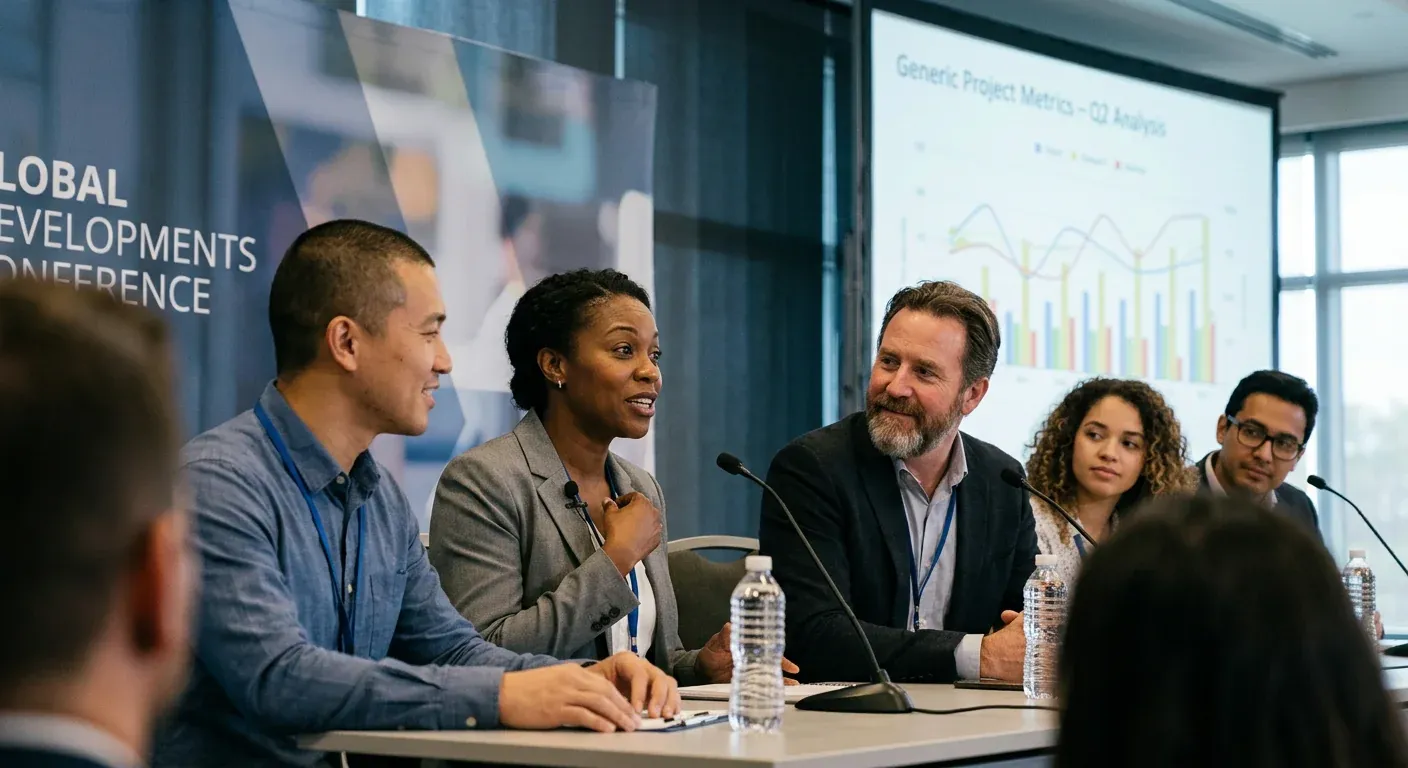
Editorial illustration for NVIDIA Nemotron for Science SFT adds 12%, RL post-training lifts 17%
NVIDIA Nemotron Boosts Science AI by 17% With RL
NVIDIA Nemotron for Science SFT adds 12%, RL post-training lifts 17%
Scientific agents now plan experiments, run simulations, and check their own work across multiple iterations, with no human in the loop until the final answer. That independence raises the stakes for accuracy at every step. A model that gets a molecular property wrong in step three of a drug-metabolism workflow doesn't just fail once, it feeds that error into every subsequent calculation, and the compute burns while the agent keeps going anyway.
NVIDIA built Nemotron for Science to address that problem directly: a set of models, datasets, and tools aimed at agentic research workloads, anchored by Nemotron 3.5 Super VL, a multimodal model tuned for scientific tasks, and Nemotron Litmus-Bench V2.0, an open chemistry-reasoning benchmark for testing LLMs on molecular properties. Out of the box, NVIDIA says Nemotron hits frontier-level scores on scientific benchmarks and the fastest time to solution for scientific coding.
The more practical question is what happens when a lab wants to push accuracy higher for its own narrow domain. NVIDIA's answer is post-training, using NeMo Gym to build a custom reinforcement learning environment and NeMo RL to run it, with drug-metabolism prediction as the worked example starting from raw experimental data.
Researchers communicate complex scientific hypotheses in natural language and let autonomous agents independently plan tasks, execute simulations, evaluate results, and self-correct across multiple iterations. Scientific agents are taking on longer, more complex, and increasingly visual workflows. Accuracy and inference efficiency matter at every step.
Why this matters
The 29-point combined gain here (12% from SFT, another 17% from RL) tells us something practical: instruction-tuned models aren't finished products for specialized domains, they're starting points. For teams building scientific agents, that's the real takeaway, not the specific drug-metabolism benchmark. If a model already capable of following instructions still has this much headroom at a fixed 16,384-token budget, every lab running agents on chemistry, biology, or materials workflows should be asking whether their base model is leaving accuracy on the table.
The RLVR environment matters too. Verifiable rewards are what make this kind of post-training possible, since in domains where agents plan, simulate, and self-correct across iterations, you need a way to check correctness, not just fluency. That's a harder engineering problem than it sounds.
We'd want to see these gains replicated outside drug metabolism before treating this as a general law, but the direction is clear: as scientific agents take on longer and more visual tasks, the gap between "sounds right" and "is right" becomes the thing worth optimizing for.
Related Reading
 Research & Benchmarks
Microsoft AI Chief: "If It Isn't Safe We Shouldn't Build It
 Research & Benchmarks
Google's FACTS benchmark shows 70% factuality ceiling across four tests
 Research & Benchmarks
Nvidia's DLSS 4.5 beta adds 6x Multi Frame Generation for RTX 50 GPUs
 Related Topic
NVIDIA NeMo powers telco reasoning model for autonomous network workflows
Industry Applications
 Related Topic
China offers cheaper electricity to AI firms abandoning NVIDIA chips
Business & Startups
 From Archives
NVIDIA Vera Rubin NVL72 Leads MLPerf Endpoints v1.0 Agentic Inference
 From Archives
NVIDIA Vera Rubin NVL72 Hits Up to 2x Blackwell Ultra in MLPerf Training
 From Archives
Meituan releases 1.6T LongCat-2.5 agent model that never touched an Nvidia GPU
Open Source
 From Archives
Former OpenAI researcher maps six Chinese AI models to Nvidia Blackwell
Common Questions Answered
How much accuracy improvement does NVIDIA Nemotron for Science achieve through SFT and RL post-training combined?
NVIDIA Nemotron for Science achieves a combined 29-point accuracy gain, with 12% improvement from supervised fine-tuning (SFT) and an additional 17% improvement from reinforcement learning (RL) post-training. This substantial combined improvement demonstrates that instruction-tuned models still have significant headroom for optimization in specialized scientific domains.
What is the key problem that error propagation creates in autonomous scientific agents?
When a scientific agent makes an error in one step of a multi-step workflow, such as calculating a molecular property incorrectly, that error feeds into every subsequent calculation in the pipeline. This cascading error effect means the agent continues consuming computational resources while propagating inaccuracies throughout the entire workflow, making accuracy critical at every step.
What capabilities do scientific agents now perform independently without human intervention?
Scientific agents can now independently plan experiments, run simulations, evaluate results, and self-correct across multiple iterations without human involvement until the final answer is delivered. These autonomous agents handle increasingly complex and visual workflows by allowing researchers to communicate scientific hypotheses in natural language and letting the agents execute the entire process autonomously.
Why is the 29-point accuracy gain significant for teams building scientific agents beyond the specific benchmark results?
The 29-point combined gain reveals that instruction-tuned models are not finished products for specialized domains but rather starting points with substantial optimization potential. For labs running agents on chemistry, biology, or materials science at a fixed 16,384-token budget, this demonstrates that even capable instruction-following models have significant headroom for improvement through proper post-training techniques.
Further Reading
- Nemotron 3: Efficient and Open Intelligence - arXiv
- Nemotron 3 Super: Open, Efficient Mixture-of-Experts Hybrid Mamba-Transformer Model for Agentic Reasoning - arXiv
- Nemotron 3 Ultra: Open, Efficient Mixture-of-Experts Hybrid Mamba-Transformer Model for Agentic Reasoning - arXiv
- Nemotron 3.5 Super and Lightning: Open, Efficient Mixture-of-Experts Hybrid Mamba-Transformer Models for Agentic AI - arXiv
