
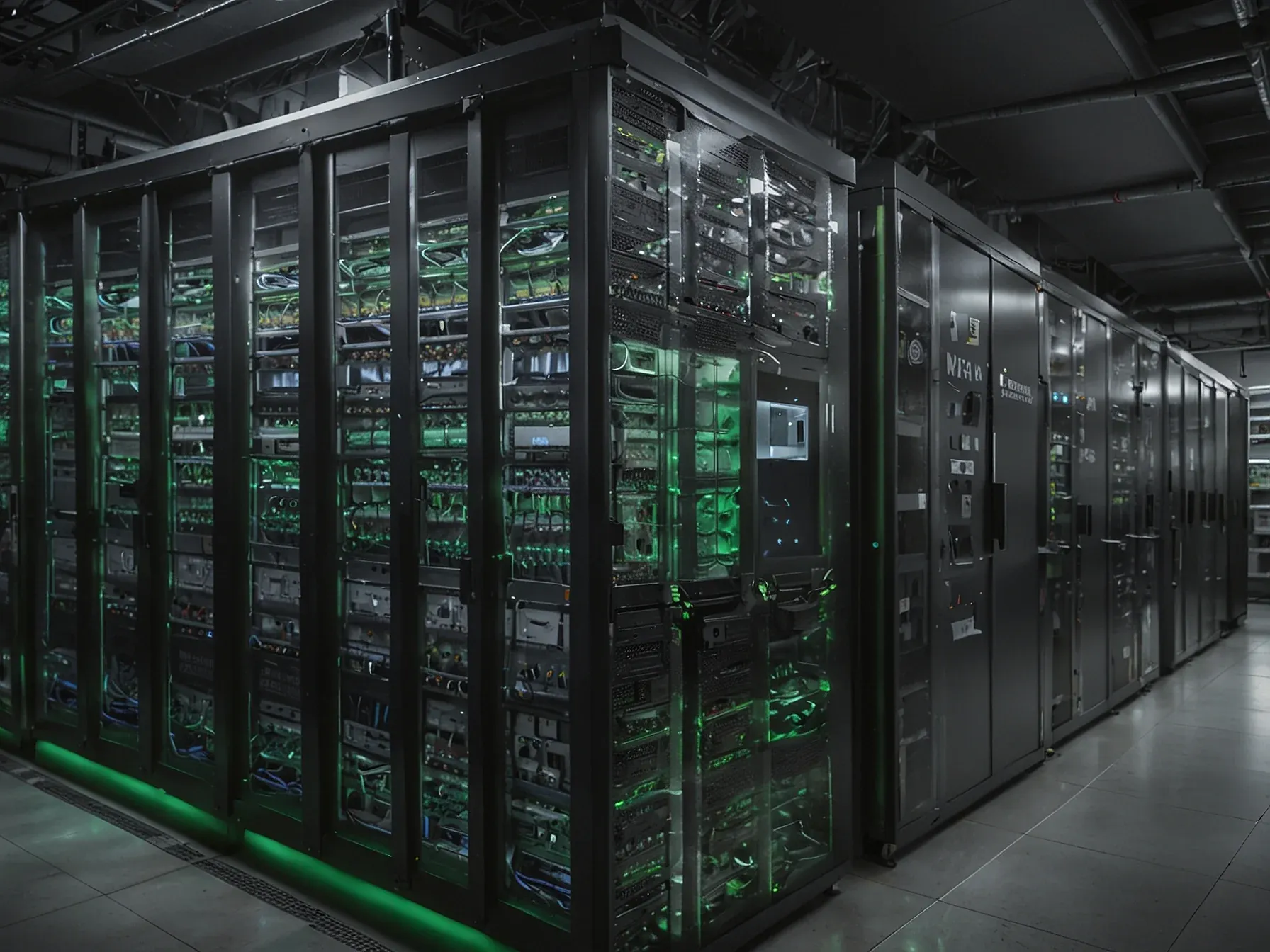
Editorial illustration for NVIDIA Blackwell Dominates New AI Benchmark with Top Performance and Efficiency
NVIDIA Blackwell Tops AI Chip Performance Benchmark
Forget peak speeds. The real price of running artificial intelligence just got a public audit, and the math is brutal. SemiAnalysis launched its new InferenceMAX v1 benchmarks this week, measuring a practical metric: the total cost of compute across messy, real-world workloads.
It's the difference between a car's top speed and its actual fuel economy. As AI pivots from simple queries to complex, multi-step reasoning, this is the financial calculus that will determine which companies survive. NVIDIA's Blackwell platform swept the field.
The margin of victory, however, is what makes the industry's other offerings look financially obsolete.
- NVIDIA Blackwell swept the new SemiAnalysis InferenceMAX v1 benchmarks, delivering the highest performance and best overall efficiency. - InferenceMax v1 is the first independent benchmark to measure total cost of compute across diverse models and real-world scenarios. - Best return on investment: NVIDIA GB200 NVL72 delivers unmatched AI factory economics — a $5 million investment generates $75 million in DSR1 token revenue, a 15x return on investment.
- Lowest total cost of ownership: NVIDIA B200 software optimizations achieve two cents per million tokens on gpt-oss, delivering 5x lower cost per token in just 2 months. - Best throughput and interactivity: NVIDIA B200 sets the pace with 60,000 tokens per second per GPU and 1,000 tokens per second per user on gpt-oss with the latest NVIDIA TensorRT-LLM stack. As AI shifts from one-shot answers to complex reasoning, the demand for inference — and the economics behind it — is exploding.
The new independent InferenceMAX v1 benchmarks are the first to measure total cost of compute across real-world scenarios. The NVIDIA Blackwell platform swept the field — delivering unmatched performance and best overall efficiency for AI factories.
A fifteen-fold return is a business model, not a benchmark. That's the stark reality of the GB200 NVL72 result: a five-million-dollar cluster theoretically generating seventy-five million in revenue. The raw throughput—sixty thousand tokens per second—is monstrous.
But the software-optimized cost of two cents per million tokens, achieved in weeks, is what alters corporate strategy. It transmutes speculative AI ventures into calculable line items. Everyone else is selling horsepower.
NVIDIA, according to this audit, is selling a stronger balance sheet.
Related Reading
 Research & Benchmarks
 Microsoft AI Chief: "If It Isn't Safe We Shouldn't Build It
 Research & Benchmarks
 Google's FACTS benchmark shows 70% factuality ceiling across four tests
 Research & Benchmarks
 Nvidia's DLSS 4.5 beta adds 6x Multi Frame Generation for RTX 50 GPUs
 Related Topic
 NVIDIA NeMo powers telco reasoning model for autonomous network workflows
Industry Applications
 Related Topic
 China offers cheaper electricity to AI firms abandoning NVIDIA chips
Business & Startups
 From Archives
 NVIDIA Blackwell Tops AI Performance Charts with Optimized Hardware and Software
Common Questions Answered
How does the NVIDIA Blackwell architecture perform in the SemiAnalysis InferenceMAX v1 benchmark?
NVIDIA Blackwell swept the InferenceMAX v1 benchmarks, delivering the highest performance and best overall efficiency across diverse AI models. The benchmark represents a comprehensive evaluation that goes beyond traditional raw performance metrics to measure total computational costs.
What economic advantage does the NVIDIA GB200 NVL72 system demonstrate?
The NVIDIA GB200 NVL72 system shows an extraordinary 15x return on investment, with a $5 million investment potentially generating $75 million in DSR1 token revenue. This remarkable economic performance highlights the system's potential to deliver significant financial returns in AI computing.
What makes the InferenceMAX v1 benchmark different from previous AI chip comparisons?
Unlike traditional benchmarks that often cherry-pick scenarios, InferenceMAX v1 provides an independent, comprehensive evaluation of AI computing costs across real-world scenarios. The benchmark focuses on total compute cost and efficiency, moving beyond simple performance numbers to offer a more holistic assessment of AI chip capabilities.
Further Reading
- NVIDIA Blackwell Raises Bar in New InferenceMAX Benchmarks - NVIDIA Blogs
- Nvidia Blackwell Dominates First Agentic AI Benchmark - TechBuzz AI
- NVIDIA Blackwell Architecture Sweeps MLPerf Training v5.1 Benchmarks - NVIDIA Developer
- How NVIDIA Blackwell Doubles Efficiency for LLMs - NexGen Cloud
- Nvidia's Blackwell leads AI benchmarks, but AMD's MI325 closes the gap - LinkedIn
