
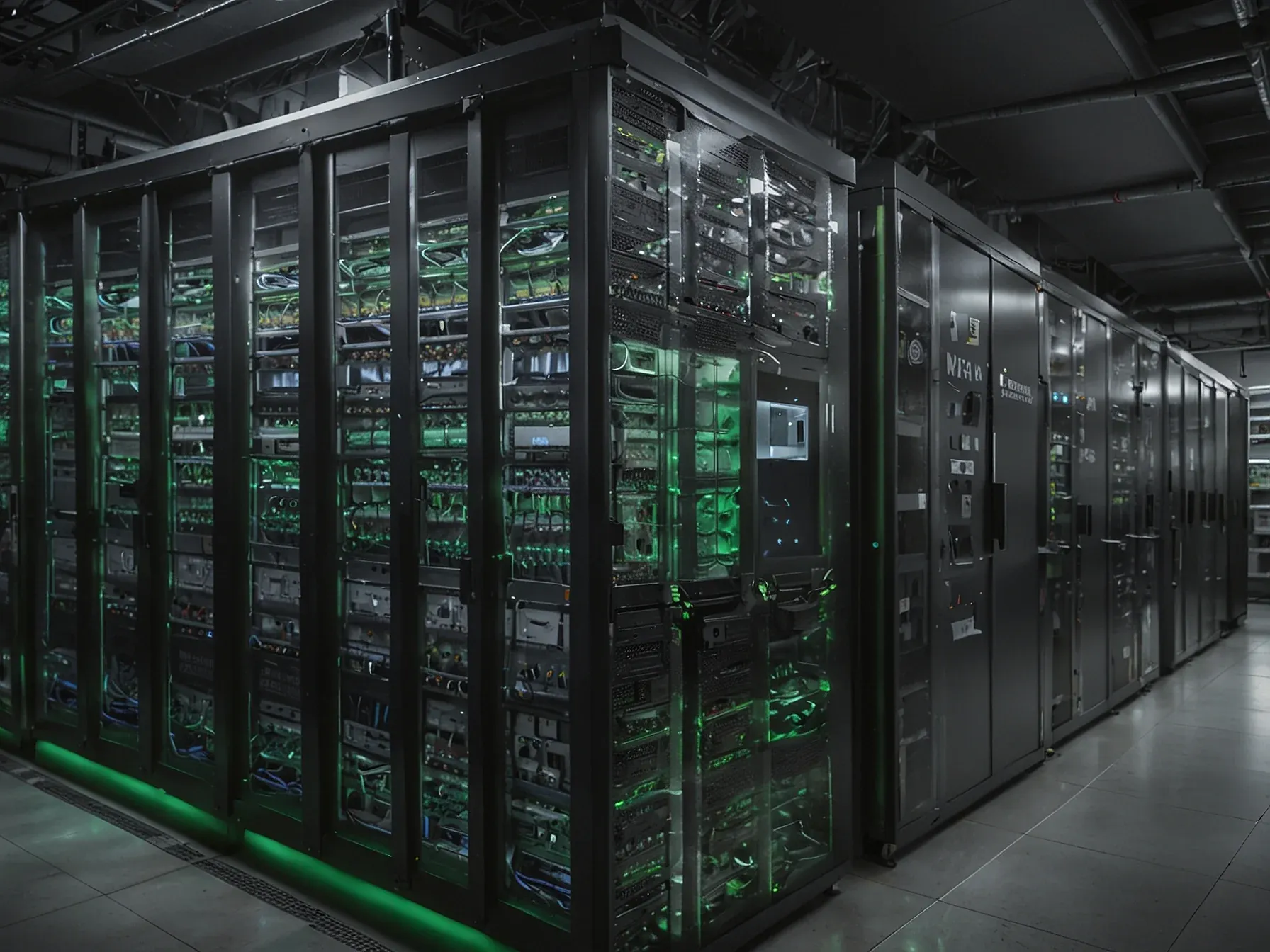
Editorial illustration for NVIDIA Blackwell Breaks AI Performance Records with Advanced Design
NVIDIA Blackwell Shatters AI Performance Benchmarks Globally
NVIDIA Blackwell Tops AI Performance Charts with Optimized Hardware and Software
NVIDIA's new Blackwell chips didn't just win another benchmark. They tore the chart in half, according to fresh numbers from SemiAnalysis. The secret isn't a mystery, just fiendishly difficult to copy. They built the hardware and the software as one thing.
Blackwell's performance comes from a deep lock between silicon and code. It uses a custom low-precision format called NVFP4, a fifth-generation NVLink network for chip-to-chip chatter, and inference engines like TensorRT-LLM that know exactly how to drive this specific machinery. This isn't a general-purpose processor with AI bolted on. It's a single system designed from the ground up to run AI models, fast and at scale.
This industry-leading performance and profitability are driven by extreme hardware-software co-design, including native support for NVFP4 low precision format, fifth-generation NVIDIA NVLink and NVLink Switch, and NVIDIA TensorRT-LLM and NVIDIA Dynamo inference frameworks. With InferenceMAX v1 now open source, the AI community can reproduce NVIDIA’s industry-leading performance. We invite our customers, partners, and the wider ecosystem to use these recipes to validate the versatility and performance leadership of NVIDIA Blackwell across many AI inference scenarios. This independent third-party evaluation from SemiAnalysis provides yet another example of the world-class performance that the NVIDIA inference platform delivers for deploying AI at scale.
Opening the hood is the real move. By making the InferenceMAX v1 benchmark code open source, NVIDIA is handing its rivals and customers a detailed map of how it won. The message is blunt: here's exactly how we did it, now try to keep up. It's a claim that demands verification, which is the point.
For companies betting billions on AI infrastructure, the SemiAnalysis report is a hard data point in a noisy market. It confirms a performance gap that is structural, not incidental. The technical lead is built into the architecture itself, into the co-design.
This creates a formidable moat. Competitors aren't just chasing faster transistors. They need to rebuild an entire stack.
The benchmark proves the platform works. The open-source release is a challenge. The industry now has a clear, reproducible target to hit, or to explain why it can't.
Related Reading
 Research & Benchmarks
 Microsoft AI Chief: "If It Isn't Safe We Shouldn't Build It
 Research & Benchmarks
 Google's FACTS benchmark shows 70% factuality ceiling across four tests
 Research & Benchmarks
 Nvidia's DLSS 4.5 beta adds 6x Multi Frame Generation for RTX 50 GPUs
 Related Topic
 NVIDIA NeMo powers telco reasoning model for autonomous network workflows
Industry Applications
 Related Topic
 China offers cheaper electricity to AI firms abandoning NVIDIA chips
Business & Startups
Common Questions Answered
How does NVIDIA's Blackwell chip represent a performance breakthrough in AI processing?
The Blackwell architecture delivers unprecedented computational power through advanced silicon engineering and sophisticated software optimization. Its key innovations include native support for NVFP4 low precision format, fifth-generation NVLink technologies, and advanced inference frameworks that dramatically improve AI processing capabilities.
What unique technologies are integrated into the NVIDIA Blackwell chip design?
Blackwell features native support for NVFP4 low precision format, which enhances computational efficiency and performance. The chip also incorporates fifth-generation NVIDIA NVLink and NVLink Switch technologies, along with NVIDIA TensorRT-LLM and NVIDIA Dynamo inference frameworks to maximize AI processing capabilities.
Why did NVIDIA open-source InferenceMAX v1 with the Blackwell architecture?
By open-sourcing InferenceMAX v1, NVIDIA is inviting the AI community to validate and reproduce their industry-leading performance metrics. This strategic move demonstrates confidence in their technological achievements and encourages broader ecosystem collaboration and validation of the Blackwell chip's capabilities.
Further Reading
- NVIDIA Blackwell benchmarks show staggering AI economics - StartupHub.ai
- NVIDIA Blackwell Leads on First Agentic AI Infrastructure Benchmark - NVIDIA Blog
- NVIDIA Blackwell Architecture Sweeps MLPerf Training v5.1 Benchmarks - NVIDIA Developer Blog
- Nvidia's Blackwell Ultra tops MLPerf AI Benchmarks - Technology Magazine
