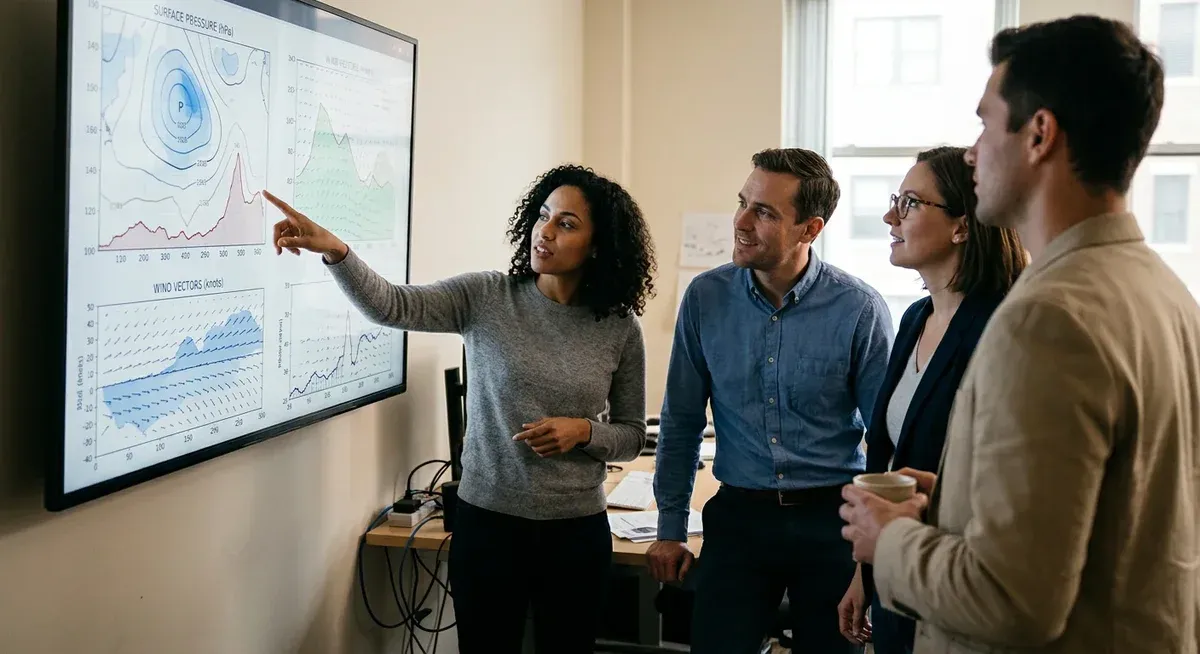
Editorial illustration for Google's AI Weather Model Gains Accuracy with Reanalysis Data
Google's WeatherNext v3 Improves Forecasts with Live Data
Google's AI Weather Model Gains Accuracy with Reanalysis Data
Google shipped version 3 of WeatherNext, its AI weather forecasting model, and detailed the update in a white paper released this week. The headline change is small in description but significant in practice: the model now takes in some satellite data directly, cutting down the lag between real-world conditions and the forecast built from them.
That matters because of how these models have worked until now. AI weather systems, Google's included, have leaned entirely on something called reanalysis, essentially a model of a model. Reanalyses digest raw weather measurements from around the globe and stitch them into one consistent snapshot of the atmosphere, filling in gaps where no sensors exist. Every AI weather model trains on this smoothed-out data and produces forecasts shaped the same way.
The tradeoff is speed and fidelity. Reanalyses typically update only every six hours, and the blending process can wash out details present in the original raw readings. Traditional forecast models sidestep this by pulling in raw data alongside reanalysis products, chasing the most current possible picture of the atmosphere. Google's latest move brings its AI system a step closer to that approach.
Google recently released version 3 of its WeatherNext model, with the biggest change being that it now ingests some satellite weather data, shortening the lag time between current weather conditions and generating a new forecast.
Why this matters
For those of us building on top of these models, the WeatherNext 3 update is a reminder that the AI-versus-traditional-forecasting debate isn't really about which approach "wins." It's about which inputs you can afford to run often. Google's decision to fold in satellite data through reanalysis rather than raw feeds shows how much of the real engineering work in AI weather still happens before a neural net sees a single number. If you're building products on WeatherNext or similar models, that's worth internalizing: your output is only as good as the reanalysis pipeline feeding it, and reanalysis itself is a modeling choice with its own assumptions baked in.
The efficiency argument, cheaper compute, more frequent runs, is genuinely useful for anyone needing near-real-time forecasts at scale. But we'd push back on treating "AI weather model" as a monolith. Google, ECMWF, and others are making different tradeoffs on data ingestion, and those choices will matter more than headline accuracy claims once developers start stress-testing these models against edge cases like rapid-onset storms.
Related Reading
Browse all Google news → Research & Benchmarks
 Microsoft AI Chief: "If It Isn't Safe We Shouldn't Build It
 Research & Benchmarks
 Google's FACTS benchmark shows 70% factuality ceiling across four tests
 Research & Benchmarks
 Nvidia's DLSS 4.5 beta adds 6x Multi Frame Generation for RTX 50 GPUs
 Related Topic
 Google to End Free Access to Gemini AI for Non-Subscribers
LLMs & Generative AI
 Related Topic
 NVIDIA and Google Cloud let developers scale AI from prototype to production
Market Trends
 From Archives
 Google’s Genome Atlas Predicts Effects of 9 Billion Variants
 From Archives
 Meta drops AI use from performance reviews after "tokenmaxxing
 From Archives
 Google Cloud, Accenture partner to address enterprise AI skills gap
Business & Startups
 From Archives
 ChatGPT regains 55.5% web traffic share as Gemini's surge fades
LLMs & Generative AI
Common Questions Answered
What is the main improvement in Google's WeatherNext version 3?
WeatherNext version 3 now ingests satellite weather data directly, which significantly reduces the lag time between real-world weather conditions and forecast generation. This change improves forecast accuracy by allowing the model to work with more current data rather than relying solely on reanalysis data.
How does WeatherNext 3's use of satellite data differ from previous AI weather models?
Previous versions of WeatherNext and other AI weather systems relied entirely on reanalysis data, which is processed and compiled information rather than raw satellite feeds. By incorporating some satellite data directly, WeatherNext 3 reduces the processing lag and provides more timely forecasts based on current atmospheric conditions.
Why is the reduction in lag time between weather conditions and forecasts significant for AI weather models?
The lag time directly impacts forecast accuracy because weather conditions change rapidly, and delays in incorporating current data can lead to less precise predictions. By shortening this lag through direct satellite data ingestion, WeatherNext 3 can generate forecasts that better reflect the actual present state of the atmosphere.
What does the WeatherNext 3 update reveal about AI weather forecasting engineering?
The update demonstrates that much of the real engineering work in AI weather forecasting happens before the neural network processes any data, specifically in data preparation and input selection. The decision to fold in satellite data through reanalysis rather than raw feeds shows that choosing the right inputs and managing data flow is as important as the AI model itself.
Further Reading
- Google WeatherNext 3 has '50% more accurate precipitation forecasts' - 9to5Google
- WeatherNext 3 - Google for Developers
- WeatherNext evaluations - Google for Developers
- WeatherNext 3: Increasing resolution and performance of ... - arXiv
- An Observations-focused assessment of Global AI Weather ... - arXiv
