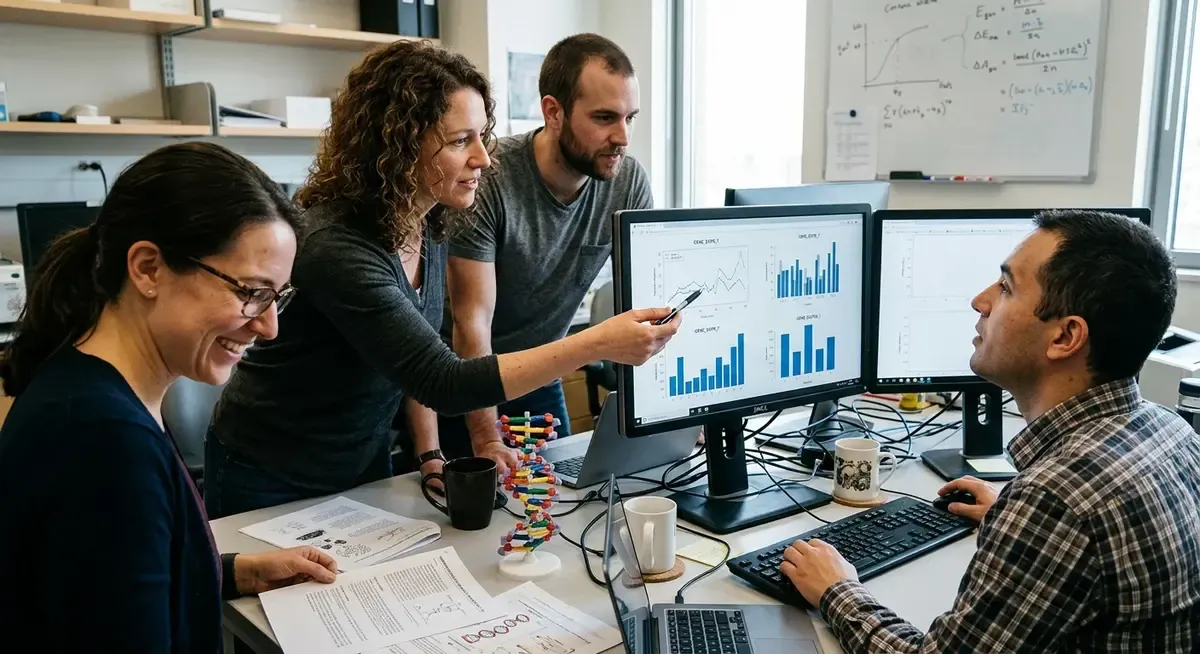
Editorial illustration for Google’s Genome Atlas Predicts Effects of 9 Billion Variants
Google’s Genome Atlas Predicts Effects of 9 Billion Variants
Google DeepMind released a tool on Tuesday that maps out every possible single-letter change to human DNA and predicts what each one might do to the body. The tool, called AlphaGenome Atlas, tackles a problem that's dogged genetics for decades: the human genome runs on roughly three billion pairs of chemical letters, shorthand as A, C, G, and T, and any one of them can mutate in nine billion different ways. Most of those changes do nothing.
Some shift ordinary traits like height or hair color. A smaller number drive disease, and until now scientists have had no fast way to sort one from another.
DeepMind's researchers built Atlas to close that gap by generating a prediction for every one of those nine billion possible substitutions, estimating effects like whether a mutation would ramp up or shut down production of a specific protein. The company frames this as a foundation for medical research going forward, since knowing which mutations matter is often the first hurdle in linking genetics to illness. In a blog post announcing the release, DeepMind's team described the scale of what they'd built.
The platform, called AlphaGenome Atlas, contains a “predictive map of every possible DNA letter change in the human genome,” the researchers said in a blog post published on Tuesday.
Why this matters
For researchers, Atlas is another sign that AI's most concrete near-term payoff in biology is as an annotation engine, not a discovery machine on its own. Nine billion variant predictions is a staggering catalogue, but a catalogue is only as good as the wet-lab work that validates it. Google calls this "the most comprehensive" resource of its kind, and that claim will get tested fast by academic labs cross-referencing predictions against known disease variants.
If the model's calls on protein production hold up, it could cut years off the hunt for disease-causing mutations that current tools miss or misclassify. If it doesn't, we'll have learned something about the limits of pattern-matching at genome scale. Founders building diagnostics or drug-discovery startups should watch how quickly independent groups publish validation studies, not how impressive the headline number sounds.
DeepMind has a habit of shipping tools that reshape a field's baseline expectations, AlphaFold being the obvious precedent. Whether Atlas earns that same status depends entirely on what happens next in labs that have nothing to do with Google.
Related Reading
Browse all Google news → Research & Benchmarks
 Microsoft AI Chief: "If It Isn't Safe We Shouldn't Build It
 Research & Benchmarks
 Google's FACTS benchmark shows 70% factuality ceiling across four tests
 Research & Benchmarks
 Nvidia's DLSS 4.5 beta adds 6x Multi Frame Generation for RTX 50 GPUs
 Related Topic
 Google to End Free Access to Gemini AI for Non-Subscribers
LLMs & Generative AI
 Related Topic
 NVIDIA and Google Cloud let developers scale AI from prototype to production
Market Trends
 From Archives
 Meta drops AI use from performance reviews after "tokenmaxxing
 From Archives
 Axis Robotics Launches Browser-Based AXIS Engine With 207 Robot Tasks
 From Archives
 ChatGPT regains 55.5% web traffic share as Gemini's surge fades
LLMs & Generative AI
 From Archives
 Google adds AI music creation to Gemini with Lyria 3.5
LLMs & Generative AI
Further Reading
- AlphaGenome Atlas: Molecular predictions for 9 Billion human DNA variants - Google DeepMind
- Google DeepMind unveils AlphaGenome Atlas mapping nearly 9 billion DNA mutations in the human genome - Crypto Briefing
- AlphaGenome - Google DeepMind
- A DNA language model based on multispecies alignment predicts the effects of genome-wide variants - Nature Biotechnology
- Learning the language of life with AI - Science
