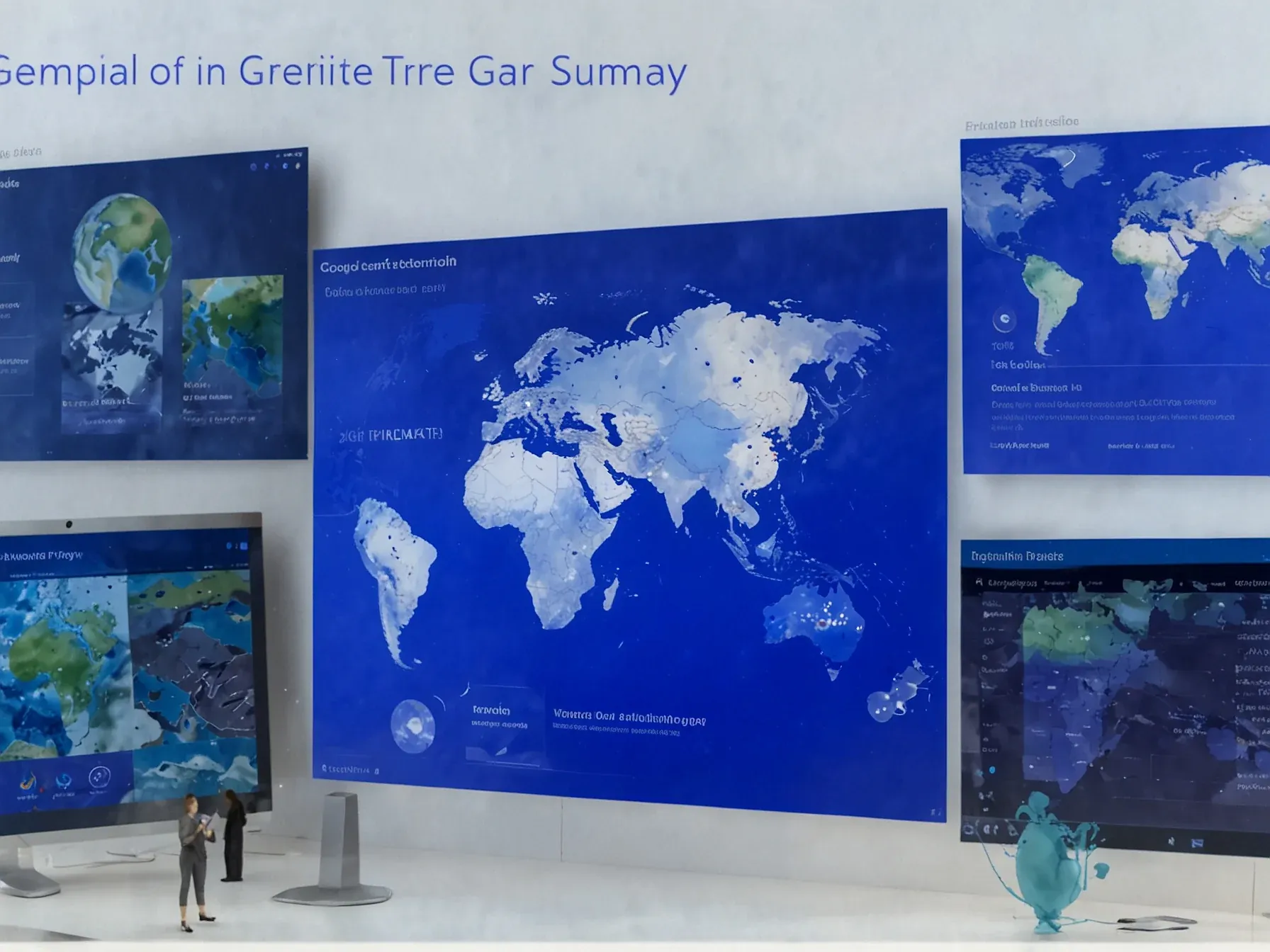
Editorial illustration for Google Boosts Earth AI with Gemini, Expands Geospatial Capabilities to More Users
Gemini AI Revolutionizes Global Environmental Mapping
Google links Earth AI with Gemini models, expands geospatial tools
Google is now shoveling live satellite imagery directly into its Gemini AI. The goal is brutally concrete: sharper predictions for floods, droughts, and disease outbreaks on the company's Earth platform. This isn't about prettier maps.
Dubbed "Geospatial Reasoning," the technical drive layers weather forecasts, population maps, and orbital feeds so Gemini can answer urgent, specific questions. Which neighborhoods will flood first? The system, built for raw speed, aims to outpace any human analyst.
Google is updating its Earth AI platform, linking it with Gemini language models and making new features available to a broader set of users. According to the company, the goal is to speed up detection of floods, droughts, and disease outbreaks, and to support more targeted responses. The central update is what Google calls "Geospatial Reasoning," a system that connects different AI models—such as weather forecasts, population density maps, and satellite imagery. Google says this approach is designed to answer complex questions, such as identifying areas most at risk from a coming storm or determining which infrastructure might be affected.
The logic of Google's "Geospatial Reasoning" is compelling: disasters follow patterns AI should spot. By opening these tools to more researchers, the company enables localized analysis from Delhi to Denver. Yet pattern recognition is not understanding.
A model can flag a suspicious cluster near a riverbank but stays blind to whether a local government has the trucks, the sandbags, or the political will to act. That chasm between a smart alert and a coordinated human response is wide. It's often political.
It's littered with broken radios. This is a formidable engineering effort. Its real-world utility, however, hinges entirely on what people do with the warnings they get.
Related Reading
Browse all Google news → LLMs & Generative AI
 ChatGPT's 'Nerdy' tweak rewards goblin metaphors in answers, study finds
 LLMs & Generative AI
 Google to End Free Access to Gemini AI for Non-Subscribers
 LLMs & Generative AI
 AI Engineers Face Rising Costs, Need New Strategies for Efficiency
 Related Topic
 NVIDIA and Google Cloud let developers scale AI from prototype to production
Market Trends
 Related Topic
 Google's FACTS benchmark shows 70% factuality ceiling across four tests
Research & Benchmarks
 From Archives
 10 Interview Questions on Agentic AI, LLMs, Tools, and Autonomous Workflows
 From Archives
 Study shows LLMs can be poisoned with under 250 samples, far below 1% threshold
 From Archives
 Anthropic targets up to one million Google TPUs by 2026 for AI expansion
Business & Startups
 From Archives
 Google expands Earth AI access, adds updates for flood forecasting
Business & Startups
Common Questions Answered
How is Google's Gemini language model enhancing Earth AI's capabilities?
Google is integrating Gemini language models into Earth AI to create a more advanced geospatial intelligence platform. The integration enables more sophisticated analysis by connecting different AI models like weather forecasts, population density maps, and satellite imagery to improve environmental monitoring and risk detection.
What specific environmental challenges is Google's Earth AI designed to address?
Google's Earth AI platform is primarily focused on speeding up detection of critical environmental and humanitarian risks such as floods, droughts, and disease outbreaks. By using advanced geospatial reasoning techniques, the system aims to support more targeted and rapid response strategies to these global challenges.
What is Google's 'Geospatial Reasoning' system and how does it work?
Geospatial Reasoning is Google's innovative approach to connecting multiple AI models and data sources, including weather forecasts, population density maps, and satellite imagery. The system allows for more nuanced and comprehensive analysis of environmental risks by integrating diverse data streams and leveraging advanced language models like Gemini.
Further Reading
- New updates and more access to Google Earth AI — Google Blog
- Google Expands Gemini-Powered AI Features in Google Earth — Article Factory AI
- Google Maps Integration Expands Gemini API Capabilities — VKTR
- Google Earth capabilities for no-code geospatial insights — Google Maps Platform
