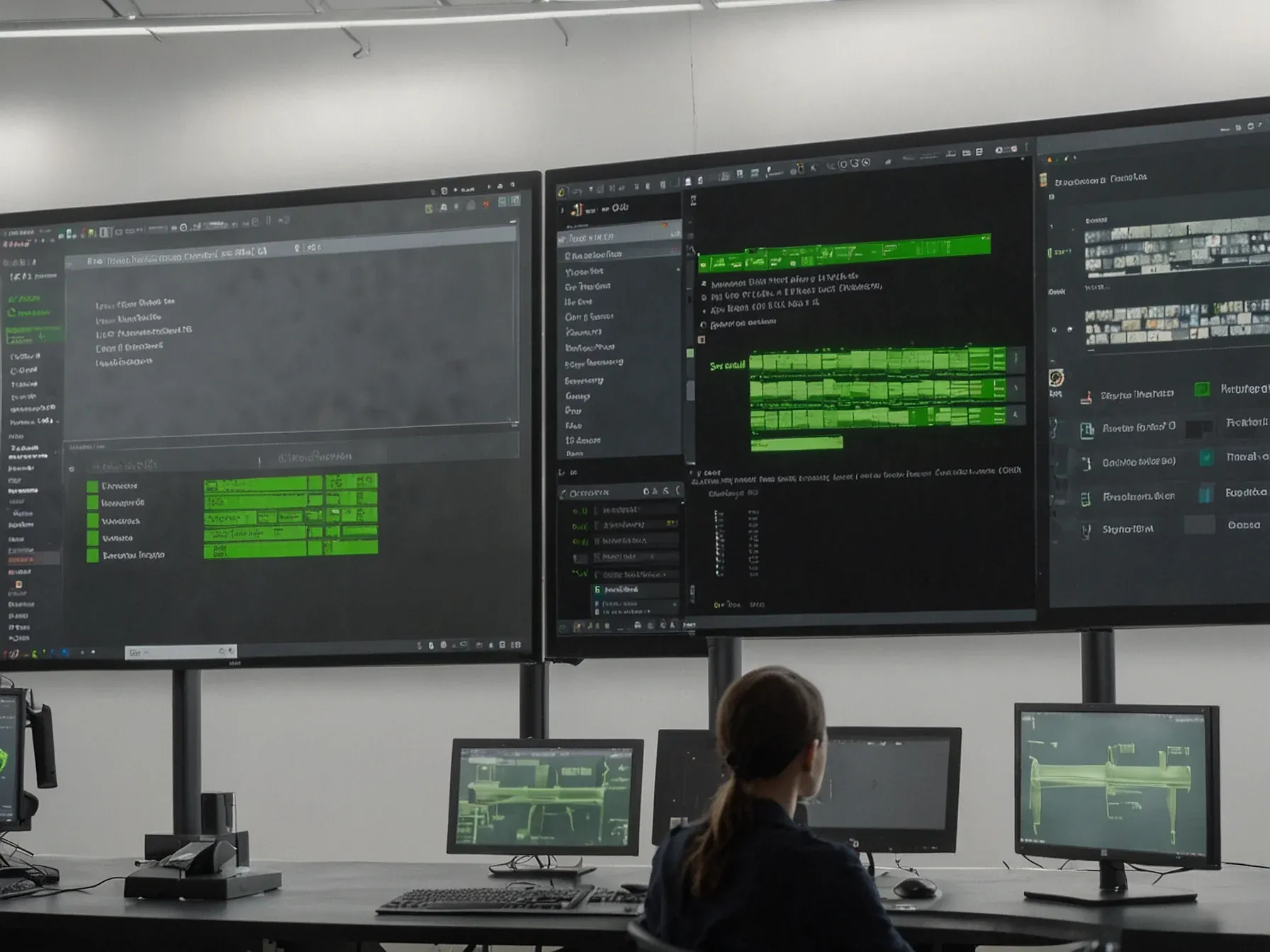
Editorial illustration for Cursor's Composer LLM Promises 4x Faster Coding with Automated Testing
Cursor Composer: AI Coding Speed Boosted 4× Faster
Cursor launches Composer LLM, claims 4× coding speed and automated testing
Another week, another AI model promising to save developers from their own jobs. This time it's Cursor, a startup that sells an AI coding environment. They just launched Composer, their first in-house large language model. The pitch is simple, specific, and audacious: four times faster coding.
The claim targets the most stubborn part of software work, which isn't the brilliant idea but the tedious execution. Cursor says Composer automates complex processes, not just writes lines. It picks tools.
It runs tests. It chases down linter errors on its own.
This moves beyond autocomplete. The suggestion is a model that can handle a full development cycle, from writing to testing to fixing. If it works, it would change a programmer's day completely.
According to Cursor, Composer completes most interactions in less than 30 seconds while maintaining a high level of reasoning ability across large and complex codebases.
The real test is whether this works inside a real project, with its broken dependencies and legacy code. Composer's trick is operating in the same runtime as the developer. That means it has to deal with git, package managers, and failing builds. An AI that only works in a clean sandbox is useless.
A fourfold speed increase is the kind of number that gets attention. It is also the kind of number that is almost impossible to verify. The model's described behaviors, like avoiding speculative guesses, are more telling. That shows a design focused on reliability over raw output.
Trust will be slow. Developers are a skeptical bunch, trained by years of buggy tools. They will need to see Composer fix real errors in their own messy codebases, not just perform in a demo. For now, it's a serious attempt to move AI coding from a fancy suggestion box to an actual engineering teammate.
Further Reading
Related Reading
 LLMs & Generative AI
 ChatGPT's 'Nerdy' tweak rewards goblin metaphors in answers, study finds
 LLMs & Generative AI
 Google tests visual 'magazine-style' UI for Gemini 3 Pro users
 LLMs & Generative AI
 AI Engineers Face Rising Costs, Need New Strategies for Efficiency
 From Archives
 Anthropic scientists test whether Claude can tell injected thoughts from text
 From Archives
 Grammarly Rebrands as Superhuman, Retains Familiar Sidebar UI
Common Questions Answered
How does Cursor's Composer LLM improve coding speed compared to traditional coding assistants?
Composer claims to boost coding speed by up to four times through advanced automation of development processes. The model can autonomously run unit tests, fix linter errors, and perform multi-step code searches, significantly reducing manual coding overhead.
What unique capabilities make Composer different from other AI coding tools?
Composer can work within the same runtime context as developers, handling complex tasks like version control and dependency management. The model has developed emergent behaviors such as making effective tool choices, using parallelism, and avoiding unnecessary or speculative code responses.
What are the key design principles behind Cursor's Composer LLM?
Composer is designed to be more aligned with real-world coding conditions, focusing on practical efficiency and autonomous problem-solving. The model learns to make intelligent tool selections and can independently perform tasks like running tests and fixing errors without constant human intervention.
Further Reading
- Papers with Code - Latest NLP Research — Papers with Code
- Hugging Face Daily Papers — Hugging Face
- ArXiv CS.CL (Computation and Language) — ArXiv
