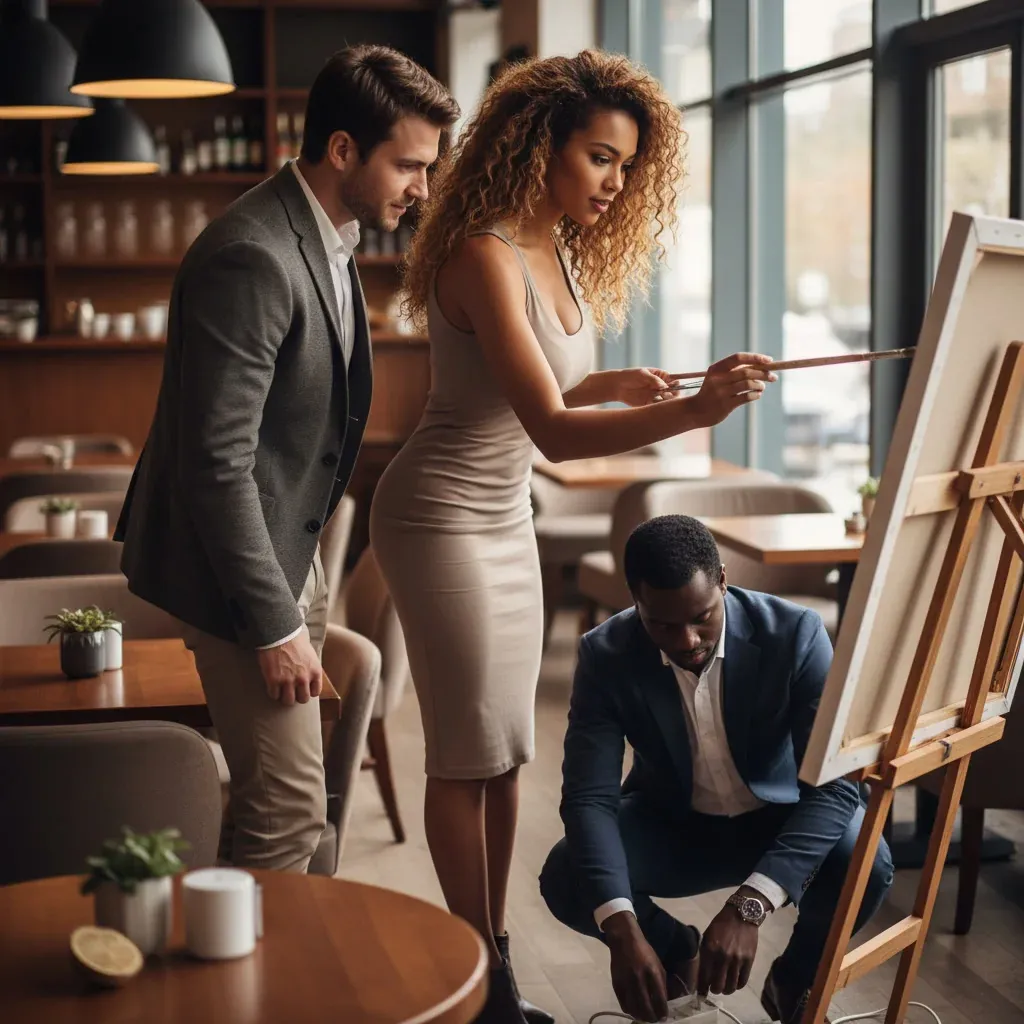
Editorial illustration for AI and Art Converge: Creators Explore a Decade of Collaborative Innovation
AI Art Collaboration: Creators Redefine Creative Boundaries
Artists reflect on a decade of AI collaborations in Gradient Canvas
Google's Gradient Canvas hits its ten-year mark. That's a decade. The real story isn't the art on the walls.
It's the sustained, often frustrating, argument happening behind it. For ten years, this initiative gave artists one rule: treat AI as a partner, not a paintbrush.
Hear directly from the multidisciplinary group of artists about what inspired their work and the unique approaches to their work with AI: Installation view of Pollinator Pathmaker: 6nvKvSPnBEEFa6vTqwXJaZ in 'Human Vision' by Alexandra Daisy Ginsberg at Google Gradient Canopy in Mountain View, California, 2025. In Silico, by Casey Reas Photo: Henrik Kam. The Recombinant Room, by Certain Measures Photo: Henrik Kam.
A Google Tree, by Clement Vallas Photo: Henrik Kam. The Garden Eternal: California, by Linda Dounia Photo: Henrik Kam. EP Flow, by Michael Joo Photo: Henrik Kam.
Somatic Landscapes, by Rashaad Newsome Photo: Henrik Kam. Machine Dreams: Biophilia, by Refik Anadol Photo: Henrik Kam. California Terrain, by Sarah Rosalena Photo: Henrik Kam.
Forget the idea that artists are being automated away. The Canvas archive proves the opposite: they're being amplified. Look at Alexandra Daisy Ginsberg's garden, built for bees.
Consider Refik Anadol's data hallucinations. These projects show what happens when you stop asking a machine for a picture and start asking it a question. The machine asks its own back.
It exposes blind spots. That tense dialogue is the collaboration. The next decade won't be about AI making art.
It will be about art forcing us to see AI as something stranger, more contingent, than a simple tool.
Related Reading
 Business & Startups
 Nordic pilot adds Gemini for Education, NotebookLM to boost AI literacy
 Business & Startups
 Kling launches Video O1, all-in-one model with MVL bridge using transformer
 Business & Startups
 DeepSeek Seeks More Capital Weeks After USD 7B Funding Round
 From Archives
 OpenAI releases GPT-5.2 for ChatGPT users and API developers, citing clear gains
 From Archives
 Cursor launches AI coding tool for designers amid rising competition
Common Questions Answered
How are artists transforming their creative process through AI collaboration?
Artists are now working alongside intelligent systems to explore new creative boundaries, treating AI as an active creative partner rather than just a computational tool. This collaborative approach challenges traditional notions of artistic authorship and allows for innovative artistic expressions that blend human imagination with machine intelligence.
What does the Pollinator Pathmaker project reveal about AI's role in artistic creation?
The Pollinator Pathmaker project demonstrates how AI can be a co-creator in artistic expression, moving beyond being a mere technological tool. By showcasing AI's potential to contribute meaningfully to creative work, the project highlights the emerging partnership between human artists and intelligent systems.
How has the perception of AI in art changed over the past decade?
AI has evolved from a distant computational tool to an active creative partner in the art world over the past ten years. This transformation represents a significant shift in understanding AI's potential, with artists now seeing intelligent systems as collaborative partners that can amplify human creativity rather than replace it.
Further Reading
- Google’s Artists + Machine Intelligence program: A decade of human–AI collaboration in art — arXiv
- Ten years of generative art: How AI collaborations reshaped creative practice — MIT Technology Review
- From experiments to exhibitions: Artists reflect on working with Google’s AI tools — The Verge
- The new creative canvas: Artists, coders, and a decade of generative AI art — WIRED
- Curating code: Museums look back on ten years of AI-assisted exhibitions — Art in America
