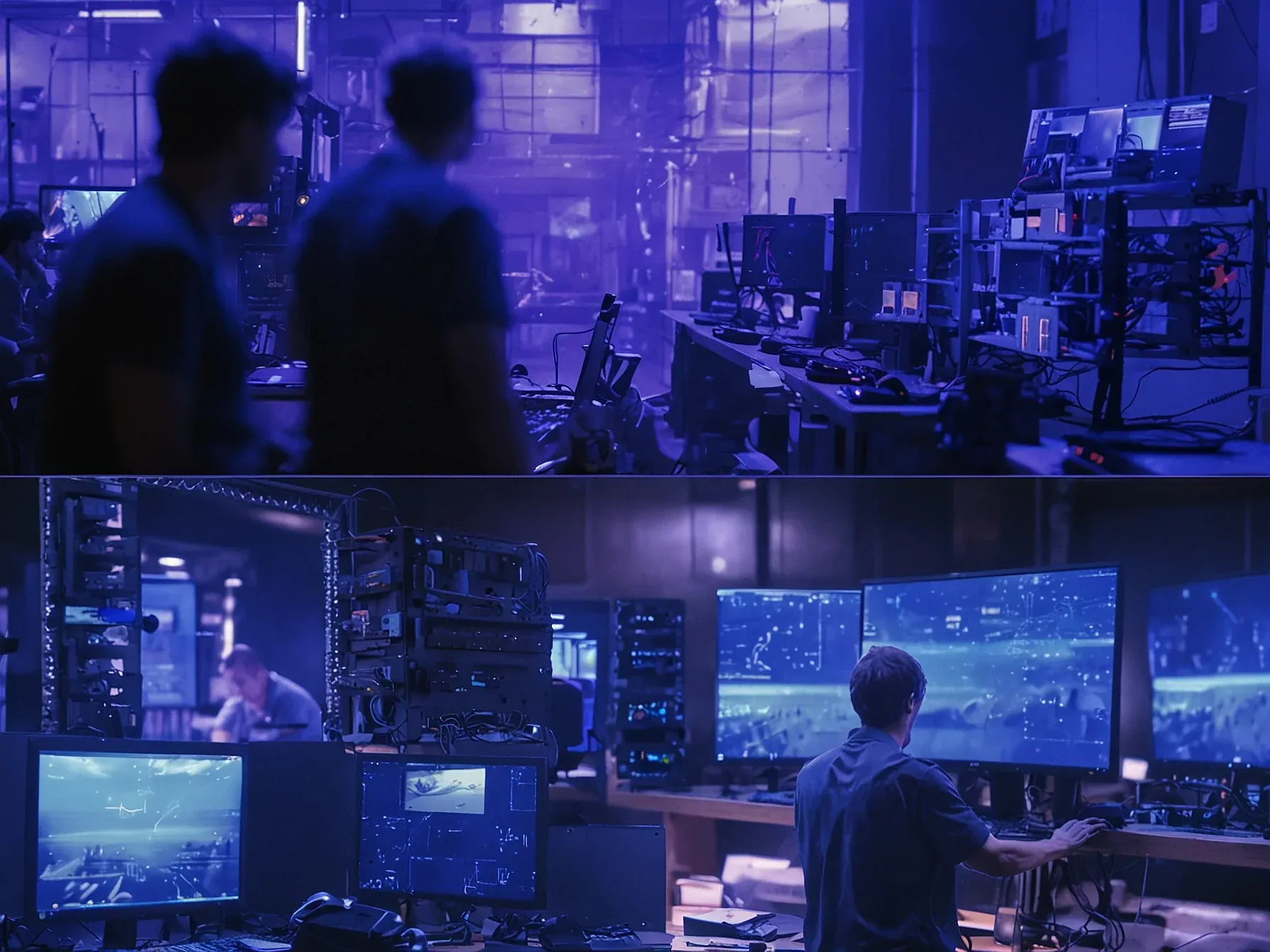
Editorial illustration for Amazon's 'House of David' Packs 350+ AI Shots in Season 2, Creators Stand Firm
350+ AI Shots Power 'House of David' Season 2 Revolution
Amazon's "House of David" generated more than 350 shots with AI in its second season. The number is less interesting than the reaction, which is basically a shrug. Show creator Noah Erwin isn't sorry. The whole thing feels less like a provocation and more like a warehouse receiving a new, faster forklift.
It suggests a quiet, grinding pivot in how TV gets made. The fight over whether AI should be used is ending. Replaced by the boring question of where it fits on the invoice.
For some, the technology remains an existential threat. For the people cutting together scenes, it's just another line item. A tool that either works for the shot or doesn't.
The real tension isn't artistic. It's professional. This normalization forces a conversation tech policy strategists have been waiting for. One about practice, not principle.
The use of AI has already started to fade into the background. "I think part of what people seem to react to is pushing 'We did this with AI' as a marketing piece to get people excited or frustrated at something," says Derek Slater, a tech policy strategist and founder of Proteus Strategies. "This will be blended into the production process as another sort of editing and VFX tool and not treated as this bespoke, separate process." But while most of the millions of people watching House of David probably don't know that AI played a role, Erwin is adamant that he and other filmmakers who may be using the technology more quietly should be loud and proud--if not to influence consumers, then to signal a new frontier to the rest of the industry.
Slater's point is correct but incomplete. The technology fades for the viewer. For the industry, its arrival is loud.
It demands new skills. New job descriptions. New budget lines.
Calling it just another VFX tool is accurate. It also glosses over how profoundly that toolset can change who does the work, and how fast.
The story here is about adoption velocity. Three hundred and fifty shots is a statement of scale, not experimentation. It means the producers trusted it for real work, not just a flashy opening sequence. They bet on it.
This is how transitions happen. Not with a manifesto, but with a producer looking at a schedule, a budget, and a problematic shot of a digital crowd, and asking for a cheaper, faster option. The frontier isn't a distant territory. It's this week's post-production meeting.
Related Reading
 LLMs & Generative AI
 ChatGPT's 'Nerdy' tweak rewards goblin metaphors in answers, study finds
 LLMs & Generative AI
 Google to End Free Access to Gemini AI for Non-Subscribers
 LLMs & Generative AI
 AI Engineers Face Rising Costs, Need New Strategies for Efficiency
 Related Topic
 Amazon Mechanical Turk enters maintenance mode as AWS retires data labeling services
Business & Startups
 Related Topic
 OpenAI Calls Apple's Lawsuit 'Rotten to Its Core' in Rebuttal
Policy & Regulation
 From Archives
 LLMOps Guide Shows How Vector Store Becomes Model's Local Memory
 From Archives
 ChatGPT API favors Wikipedia and obscure German sites, unlike web UI
 From Archives
 Amazon launches beta AI translation for self-published Kindle books
Research & Benchmarks
 From Archives
 AI translation tools fell short as in-laws assumed 95% of Europeans speak English
Common Questions Answered
How many AI-generated shots are featured in the second season of 'House of David'?
The show incorporates over 350 AI-generated shots in its second season, representing a significant use of artificial intelligence in television production. This substantial number of AI shots signals a potential transformation in visual storytelling techniques.
How are the creators of 'House of David' approaching the use of AI in their production?
The creators are treating AI as a standard creative tool rather than a marketing gimmick or novelty. They are integrating AI seamlessly into the production process, viewing it as another editing and visual effects technique that enhances storytelling.
What perspective does Derek Slater offer on the use of AI in entertainment production?
Derek Slater suggests that AI will gradually become a blended part of production processes, moving away from being a standalone or sensationalized technology. He believes AI will increasingly be treated as a standard editing and visual effects tool, rather than something designed to generate excitement or controversy.
Further Reading
- 'House of David' Season 2 Used 253 AI-Generated Shots—Here's How They Did It — VP Land
- 'House of David' Creator Explains Using AI to Create the Goliath Origin Sequence (Exclusive) — Variety Film + TV (via IMDb News)
- Papers with Code - Latest NLP Research — Papers with Code
- Hugging Face Daily Papers — Hugging Face
- ArXiv CS.CL (Computation and Language) — ArXiv
