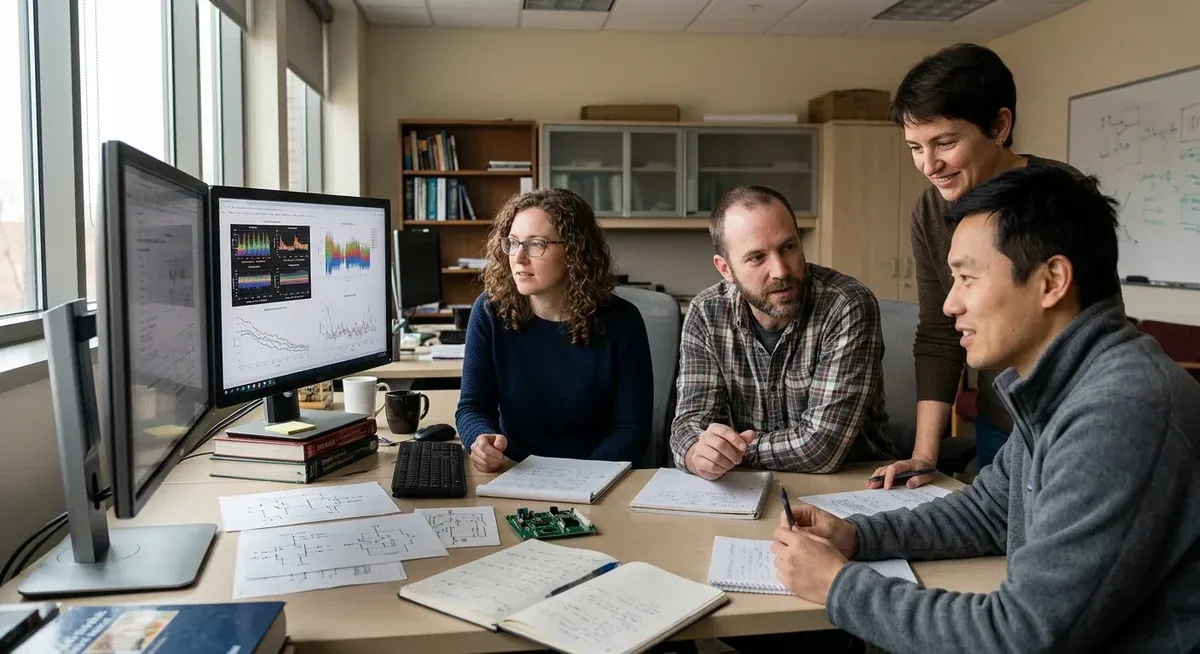
Editorial illustration for AlphaGenome Atlas Maps Each Possible DNA Change With 27,000 Predictions
AlphaGenome Atlas Maps 27,000 DNA Mutations
Google DeepMind has run the numbers on nearly every possible way a single letter in human DNA could change, and published the results as a searchable atlas. The human genome contains about three billion DNA letters, and any given person's genome differs from the reference sequence at millions of points, almost always a single swapped letter. Most of these swaps do nothing.
A handful cause disease. The problem is that you can't tell which is which just by looking at the sequence, and testing each one experimentally isn't feasible when there are roughly nine billion possible single-letter substitutions to account for.
The AlphaGenome Atlas, released this week, is DeepMind's attempt to close that gap computationally rather than in a lab. It builds on AlphaGenome, the AI model the company introduced in 2025 that reads million-letter stretches of DNA and predicts things like gene activity, protein binding, and splicing patterns. Previously, researchers had to query the model variant by variant. The Atlas precomputes predictions for all nine billion possible changes across hundreds of cell types, packaged into a dataset that dwarfs DeepMind's earlier AlphaFold protein database in scale.
Google Deepmind has predicted what each of the roughly nine billion possible single-letter changes in the human genome would likely do inside the body.
Why this matters
For researchers hunting disease-causing mutations, AlphaGenome Atlas turns an impossible search problem into a filtering exercise. Nine billion possible variants, each with roughly 27,000 prediction values, is not a dataset any single lab could generate through wet-lab experiments alone. DeepMind built it once, computationally, and now hands it to anyone trying to figure out which of a patient's millions of DNA deviations actually matters.
The real test is in the noncoding 98 percent of the genome, the switches and dials that decide when and where genes turn on. That's where human genetics research has been stuck for years, drowning in variants of unknown significance. If the Atlas's predictions hold up against real clinical data, it could shrink the time between sequencing a patient and finding an answer. If they don't, we'll have a very large, very confident-looking table of guesses.
For AI builders, this is a reminder that the next wave of scientific tools won't be chatbots. They'll be atlases: static, exhaustive, computed once and queried forever. Worth watching whether independent labs validate these predictions before they become assumed truth.
Related Reading
 Research & Benchmarks
 Microsoft AI Chief: "If It Isn't Safe We Shouldn't Build It
 Research & Benchmarks
 Google's FACTS benchmark shows 70% factuality ceiling across four tests
 Research & Benchmarks
 Nvidia's DLSS 4.5 beta adds 6x Multi Frame Generation for RTX 50 GPUs
 From Archives
 AI Agents Run Quantum Experiments Through Software
 From Archives
 Google's AI Weather Model Gains Accuracy with Reanalysis Data
Common Questions Answered
How many possible single-letter DNA changes did Google DeepMind predict in the AlphaGenome Atlas?
Google DeepMind predicted the effects of roughly nine billion possible single-letter changes in the human genome. Each of these variants was assigned approximately 27,000 prediction values, creating a comprehensive computational dataset that would be impossible for any single laboratory to generate through traditional wet-lab experiments alone.
Why is it difficult to identify which DNA mutations cause disease?
Most of the millions of single DNA letter swaps that differ between individuals and the reference genome sequence do nothing, while only a handful actually cause disease. The challenge is that you cannot determine which mutations are disease-causing simply by looking at the DNA sequence itself, making computational prediction tools like AlphaGenome Atlas essential for filtering through possibilities.
How does AlphaGenome Atlas help researchers identify disease-causing mutations?
AlphaGenome Atlas transforms the search for disease-causing mutations from an impossible problem into a manageable filtering exercise by providing pre-computed predictions for all nine billion possible variants. Instead of testing each mutation individually, researchers can now use the atlas's prediction values to prioritize which of a patient's millions of DNA deviations are most likely to cause disease.
What makes the AlphaGenome Atlas dataset unique compared to traditional laboratory research?
The AlphaGenome Atlas contains nine billion possible variants with roughly 27,000 prediction values each, a dataset so massive that no single laboratory could generate it through conventional wet-lab experiments. DeepMind built this computational resource once and made it publicly available, allowing researchers worldwide to access predictions without needing to conduct individual experiments for each variant.
Further Reading
- AlphaGenome Atlas: a high-resolution map of human DNA - Google DeepMind Blog
- DeepMind's new genome 'atlas' charts effects of all 9 billion possible DNA changes - Nature
- Google DeepMind publishes AI-powered predictions for all 9 billion possible single-letter DNA changes - Fortune
- AlphaGenome Atlas Maps 9 Billion Possible DNA Variants - IEEE Spectrum
- Google DeepMind unveils AlphaGenome Atlas mapping nearly 9 billion DNA mutations in the human genome - Crypto Briefing
